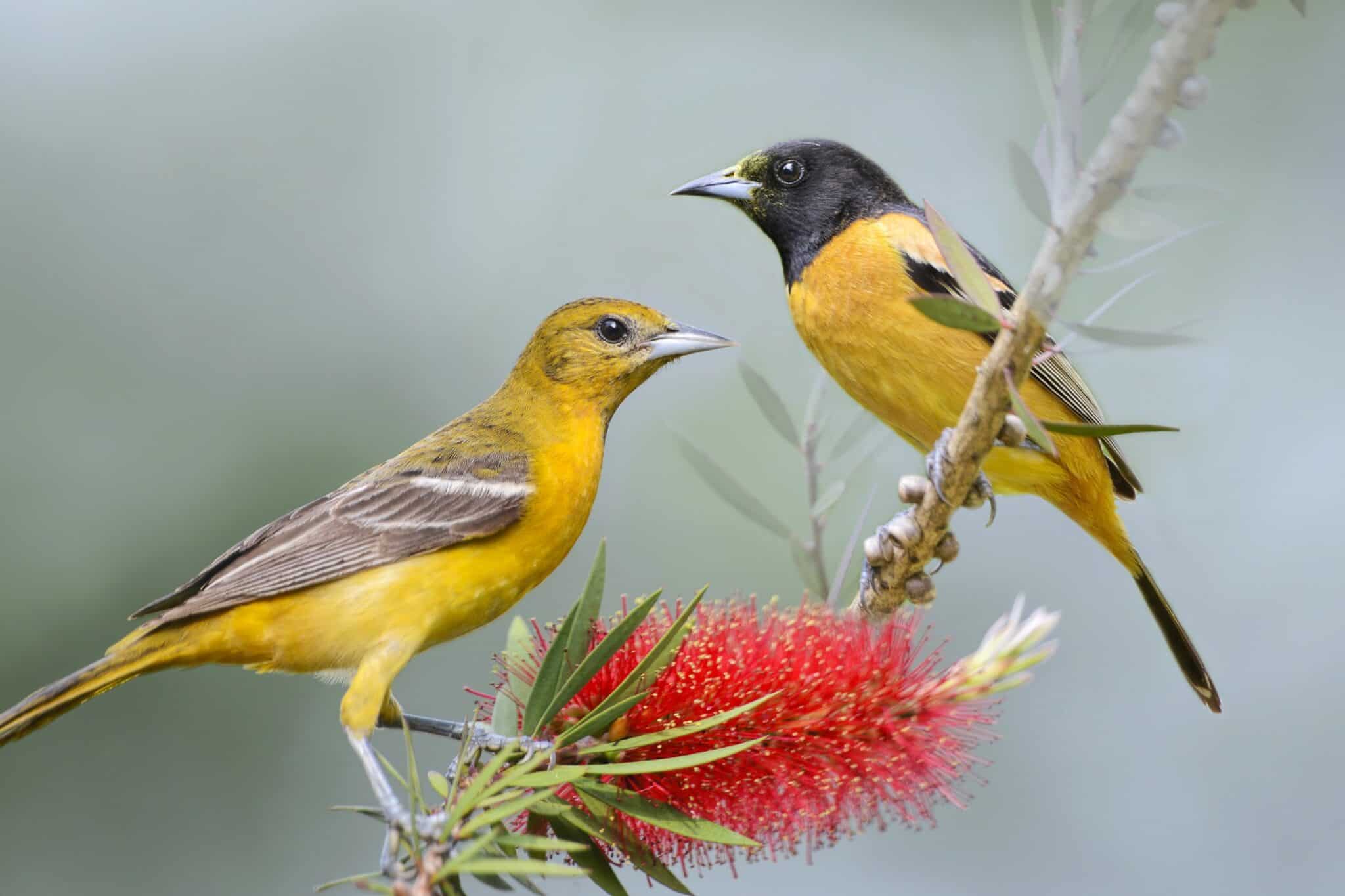
You’re looking out the window and something bright flashes past. It’s vibrant. It's high-contrast. It’s a yellow bird with black wings, and suddenly your backyard feels a lot more exotic than it did five minutes ago.
Most people immediately think they’ve spotted a canary that escaped from a local pet store. Honestly, that’s almost never the case.
North America is actually packed with native species that rock this specific "bumblebee" color palette. But here is the thing: identifying them isn’t just about the colors. It’s about how they move, what they’re eating, and even the specific shape of that black on their wings. If you see a tiny bird bouncing through the air like it’s on an invisible rollercoaster, you’re looking at something totally different than if you see a larger, sleek bird raiding your orange slices.
The Usual Suspect: The American Goldfinch
If you see a yellow bird with black wings between May and August, there is a roughly 90% chance it is an American Goldfinch (Spinus tristis). They are the classic example.
But don't get cocky.
Goldfinches are masters of disguise. During the winter, they turn a dull, pathetic brownish-olive color. If you only look for them in the summer, you’ll miss the fact that they’re sitting right in front of you in January, just looking a bit depressed. The males are the ones with the "highlighter yellow" bodies and the iconic black cap on their foreheads. Their wings aren’t just black; they have distinct white wing bars that look like little racing stripes.
Watch how they fly. It’s weirdly specific. They do this "wave" pattern. They flap a few times to go up, then tuck their wings and coast downward. While they do this, they usually make a little "per-chic-o-ree" call. It sounds like they're saying "potato chip." Seriously. Once you hear the potato chip bird, you can't unhear it.
Why the Goldfinch is unique
Unlike most backyard birds that feed their babies insects (protein is good for growing kids, right?), Goldfinches are strict vegetarians. They feed their chicks a regurgitated mash of seeds. Because of this, they nest much later than other birds—sometimes as late as July or August—so they can wait for the thistle and milkweed to go to seed.
If you see a bird that looks like a Goldfinch but it’s a bit more "neon" and lacks the black cap, you might be looking at a Lesser Goldfinch, especially if you’re out West. They have a greenish back, but the vibe is very similar.
The Evening Grosbeak: The Chunky Alternative
Imagine a Goldfinch that went to the gym and focused entirely on neck day. That’s the Evening Grosbeak (Coccothraustes vespertinus).
These birds are heavy-set. They have massive, bone-crushing beaks that are a pale, lime-yellow color. While a Goldfinch is delicate, an Evening Grosbeak looks like it could hold its own in a fight. Their yellow is more of a mustard or "old gold" shade, and their black wings have huge, unmistakable white patches.
They’re nomadic. You might see a hundred of them at your feeder one day and then not see another one for five years. Ornithologists call this an "irruption." It usually happens when the seed crops up north in the boreal forests fail. They head south in a desperate search for snacks. If you have sunflower seeds out, they will find you. And they will eat everything you own.
The Oriole Confusion
Now, if the bird you saw was bigger—closer to the size of a Robin—and the yellow was so intense it almost looked orange, you’ve hit the Oriole jackpot.
The Bullock’s Oriole and the Western Tanager often get lumped into the "yellow bird with black wings" category, though the Tanager is technically a different family.
- The Western Tanager: These guys are stunning. In the summer, the males have a bright red head, a yellow body, and coal-black wings. However, as the season fades or if you’re looking at a juvenile, that red disappears. You’re left with a brilliant yellow bird with sharp black wings and two wing bars (one yellow, one white).
- The Hooded Oriole: Found mostly in the Southwest, these birds love palm trees. They are a slimmer, more elegant yellow. Their black wings are deeply contrasted. They don’t hop; they glide through the foliage looking for insects and nectar.
Misidentifications that happen constantly
People get tripped up by the Yellow Warbler.
I get emails about this all the time. "I saw a yellow bird with black wings!" Actually, you probably saw a Yellow Warbler, but your brain filled in the gaps. Yellow Warblers are almost entirely yellow. They have some darker streaking on the chest and their wings are a darker olive-grey, but they aren't truly "black."
Then there's the Yellow-Rumped Warbler. Birders call them "Butter Butts." They aren't yellow birds. They are grey birds with a very specific, very bright yellow patch right above their tail. When they fly away from you, that yellow flash is all you see.
And we can't forget the Western Kingbird. They have a pale grey head and chest, but a bright lemon-yellow belly and dark wings. They sit on power lines and scream at anything that breathes. If it's acting like a jerk and has a yellow belly, it's probably a Kingbird.
The Science of the "Yellow"
Ever wonder why they are yellow in the first place? It’s all about the diet.
Birds can’t manufacture yellow pigment. They have to eat it. The carotenoids found in seeds and certain insects are processed by the bird's liver and deposited into the feathers as they grow. If a Goldfinch doesn't get the right nutrients during its molt, it will come out looking like a faded lemon.
The black is different. That’s melanin. Melanin doesn't just provide color; it actually makes the feathers structurally stronger. This is why so many birds—even white ones like Snow Geese—have black wing tips. The wing tips take the most beating from the wind, and the melanin helps prevent the feathers from fraying.
How to tell them apart in 5 seconds
If you’re staring at a branch and trying to figure out what you’re looking at, ask yourself these three things:
- Where is the black? If it’s just on the wings and a tiny bit on the forehead, it's a Goldfinch. If the whole head is black and the body is yellow-orange, it's an Oriole.
- What is the beak shape? Is it a tiny little cone (Goldfinch)? A giant, thick nutcracker (Grosbeak)? Or a long, sharp dagger (Oriole)?
- What is it doing? Is it hanging upside down on a thistle head? Goldfinch. Is it creeping through the leaves like a ghost? Tanager. Is it diving off a wire to catch a fly? Kingbird.
Creating a Habitat for These Species
If you want more of these high-contrast beauties in your yard, you have to play to their specific tastes. It isn't a one-size-fits-all situation.
- For Goldfinches: Plant native thistles, sunflowers, and coneflowers. They love "weedy" yards. If you use a feeder, get a Nyjer (thistle) feeder with tiny holes. It keeps the bigger, "bully" birds like Grackles from stealing all the food.
- For Orioles: They have a sweet tooth. Put out orange halves or specialized nectar feeders. Some people even put out grape jelly. Just make sure you keep the feeders clean, as sugar water can ferment and get gross fast in the sun.
- For Tanagers and Warblers: You need water. A moving water feature, like a birdbath with a "wiggler" or a small fountain, is like a neon sign for these birds. They rarely visit seed feeders, but they can't resist a bath.
Real-world observation tips
The best time to see these birds is early morning, right as the sun is hitting the tops of the trees. The yellow feathers literally glow in that low-angle light.
Don't use a phone camera if you want a good ID. The digital zoom will turn the bird into a yellow blob. Invest in a basic pair of 8x42 binoculars. You don't need the $2,000 versions; a $100 pair from a reputable brand like Nikon or Vortex will change your life.
You’ll start seeing details you never noticed before. You’ll see the individual feathers on the black wings. You’ll see the way the light reflects off the bird's eye.
Actionable Steps for Bird ID
- Download Merlin Bird ID: It’s a free app from the Cornell Lab of Ornithology. You can upload a photo or just answer three questions about the bird's size and color. It's eerily accurate.
- Check the Range Maps: If you think you saw a Scott’s Oriole but you live in Maine, you’re probably wrong. Birds occasionally get blown off course, but usually, the simplest answer is the right one.
- Listen to the "Potato Chip": Go to YouTube and search for "American Goldfinch flight call." Memorize it. You’ll realize these birds have been flying over your head for years and you just never noticed.
- Look for the Wing Bars: Pay close attention to whether the black wings are solid or if they have white stripes. That’s often the "smoking gun" for identification between different species of Tanagers and Finches.
Understanding the birds in your backyard makes the world feel a little smaller and a lot more interesting. Next time you see that flash of yellow and black, you won't just say, "Oh, a bird." You'll know exactly who is visiting.
Check your local Audubon Society chapter for bird walks. It’s the fastest way to learn because you’re standing next to people who have been doing this for forty years. They can spot a Goldfinch from 200 yards away just by the way it bounces.



