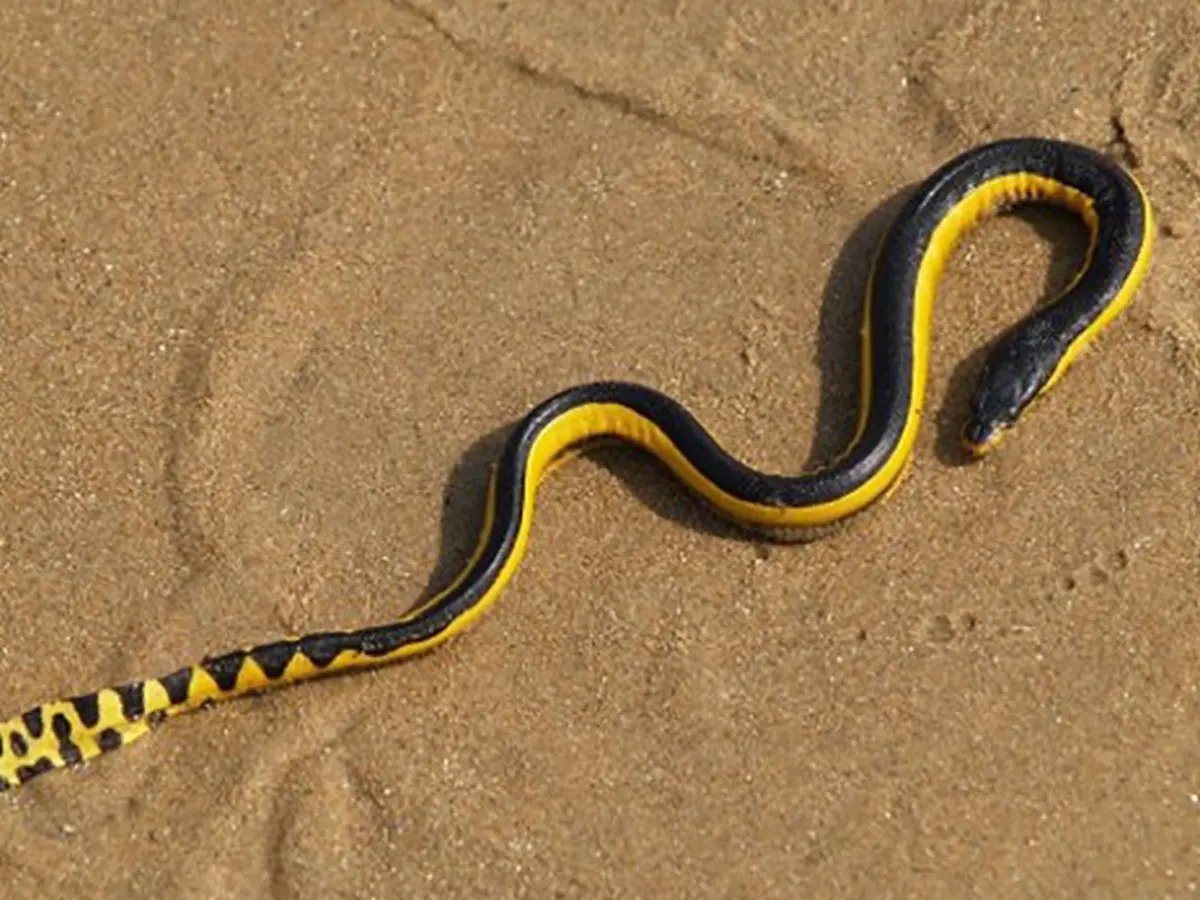
Imagine you’re floating in the middle of the Pacific Ocean. Hundreds of miles from any coastline, the water is a deep, daunting sapphire. Suddenly, you spot a splash of neon yellow. It looks like a piece of discarded plastic or maybe a stray bit of nautical rope, but then it twitches. You’ve just met a yellow belly sea snake (Hydrophis platurus), arguably the most successful and widely distributed reptile on the entire planet.
Most people assume snakes need land, or at least a shallow reef to call home. Not this one. It’s basically the marathon runner of the serpent world, but instead of running, it just... drifts. It’s weird. It’s beautiful. And honestly, it’s one of the most misunderstood creatures in the sea.
The Only Snake That Doesn't Need a Map
The yellow belly sea snake is the only truly pelagic sea snake. That’s a fancy way of saying it spends its whole life in the open ocean. While other sea snakes, like the banded sea krait, have to crawl onto land to digest a meal or lay eggs, Hydrophis platurus couldn't care less about terra firma. In fact, if you put one on a beach, it’s basically helpless. Its belly isn't flat for crawling; it's keel-shaped like the bottom of a boat. It can't move. It just sits there, vulnerable and awkward, until the tide hopefully pulls it back in.
This animal has conquered more territory than almost any other snake species. You can find them from the coast of southeastern Africa, across the Indo-Pacific, all the way to the Pacific coast of the Americas. They’ve been spotted as far north as Russia and as far south as Tasmania. How? They hitchhike. They find ocean currents and ride them like a conveyor belt.
A Living Fishing Lure
Ever wonder how a snake catches a fast-moving fish in the vast, empty blue? It doesn't chase them. That would be a waste of energy. Instead, the yellow belly sea snake uses a "sit and wait" strategy that is frankly brilliant.
They hang out at the surface in "slicks"—areas where currents meet and debris gathers. These slicks naturally attract small fish looking for shade or a place to hide. The snake just floats there, looking exactly like a piece of driftwood. When a fish swims underneath for "protection," the snake strikes with lightning speed. It can even swim backward, which is a neat party trick most snakes can't manage, allowing it to reposition itself without alerting its prey.
The Drinking Water Dilemma
For a long time, scientists were baffled. How does an animal that lives in salt water survive without shriveling up like a raisin? We used to think they had special glands to "desalinate" the ocean water.
Dr. Harvey Lillywhite, a researcher at the University of Florida, actually proved that's a myth. These snakes are perpetually dehydrated. They don't drink seawater at all. Instead, they wait for it to rain. When a heavy downpour hits the ocean, it creates a thin layer of fresh water on the surface because fresh water is less dense than salt water. The snakes literally "lick" the surface to hydrate. If it doesn't rain for months? They just tough it out. They can lose up to 25% of their body mass in water and still survive.
Toxic, But Not Exactly a Killer
Let's talk about the venom because that's what everyone asks about first. Yes, the yellow belly sea snake is highly venomous. It carries a potent neurotoxin that can cause respiratory failure or total muscular breakdown in humans. If you get bitten, you're in for a very bad time.
But here’s the kicker: they almost never bite people.
They have tiny mouths and even tinier fangs. More importantly, they aren't aggressive. Most "attacks" happen when fishermen accidentally haul them up in nets. Even then, the snake is usually more terrified than the human. There’s a persistent myth that they can’t bite a flat surface like a human arm because their mouths are too small. That’s false. They can bite you, but they really, really don't want to. They save their venom for the fish they need to eat.
The Colors Aren't Just for Show
That striking contrast—the jet-black back and the bright canary-yellow belly—isn't just nature being flashy. It’s a warning. In the biology world, we call this aposematism. It tells predators like sharks or sea birds, "Hey, I taste like poison and I’m packing venom, so maybe find a snack elsewhere."
Some researchers also think the dark back helps with thermoregulation. Since they are cold-blooded, they need the sun to warm up. That black skin absorbs heat efficiently while they float at the surface. The yellow underside might also serve as camouflage from below; to a fish looking up, the bright yellow might blend in with the sun-drenched surface of the water.
Why We’re Seeing More of Them Lately
If you’ve noticed more headlines about sea snakes washing up on beaches in California or Australia, you aren't imagining things. El Niño events play a huge role here. When the ocean warms up, these snakes follow the warm water into territories where they aren't usually seen.
Climate change is basically expanding their playground. While they love the tropics, warming currents are acting like a VIP pass into cooler regions. However, this isn't necessarily a good thing for the snake. If they get pushed too far into cold water, they become sluggish and eventually die. The ones people find on California beaches are usually "cold-stunned" and dying.
Surprising Facts About Their Life Cycle
- They give birth to live young. No eggs here. The mother carries the babies inside her for about six months and then "drops" them directly into the open ocean. The babies are independent from second one.
- They can stay underwater for 3 hours. They aren't just surface dwellers. While they prefer the top, they can dive deep to avoid turbulent storms or predators.
- They breathe through their skin. Up to 25% of their oxygen needs can be met by absorbing oxygen directly from the water through their scales. This is how they manage those incredibly long dives.
- They are "shaggy." Because they move so slowly at the surface, they often grow colonies of barnacles and algae on their skin. Every few weeks, they have to tie themselves in a knot and rub their bodies against each other to "shed" the hitchhikers and old skin.
Navigating the Myths
People love a good monster story. You’ll hear tales of "sea serpents" hundreds of feet long, and while the yellow belly sea snake is technically a sea serpent, it tops out at around 35 to 40 inches. Not exactly Godzilla.
Another big misconception is that they are "blind" on land. They aren't blind; they just don't have the musculature to move their heavy bodies. Their eyes work perfectly fine, but since they’ve evolved for the refraction of light in water, things probably look a bit weird to them in the open air.
How to Stay Safe and Respect the Species
If you ever encounter one while diving or find one washed up on a beach, follow these steps:
- Don't touch it. This seems obvious, but people often try to "rescue" them by picking them up. Even a lethargic, cold-stunned snake can strike out of instinct.
- Keep your distance. If you're snorkeling and see one, just stay still. It will likely ignore you. They are curious but not confrontational.
- Call the experts. If you find one on a beach in a place like Southern California, call the local stranding network or aquarium. They have the gear to handle the animal safely.
- Look, don't grab. If you're on a boat and see a "slick" of snakes (sometimes thousands of them gather in one spot), enjoy the view. It’s one of the rarest and most incredible sights in the natural world.
The yellow belly sea snake is a testament to how life finds a way to fill every gap on this planet. It took a body plan designed for the forest floor and adapted it for the middle of the ocean. It's a drifter, a specialist, and a vital part of the marine ecosystem.
Next Steps for Ocean Enthusiasts: Check the sea surface temperature maps before your next coastal trip; if there’s a significant warming event (El Niño), keep your eyes peeled for these yellow drifters. If you're a diver, carry a signaling mirror rather than trying to get close to surface-dwelling wildlife for a photo. Finally, support marine conservation groups like Oceana that work to keep the open-ocean currents free of the plastic debris that these snakes often mistake for their natural hunting "slicks."