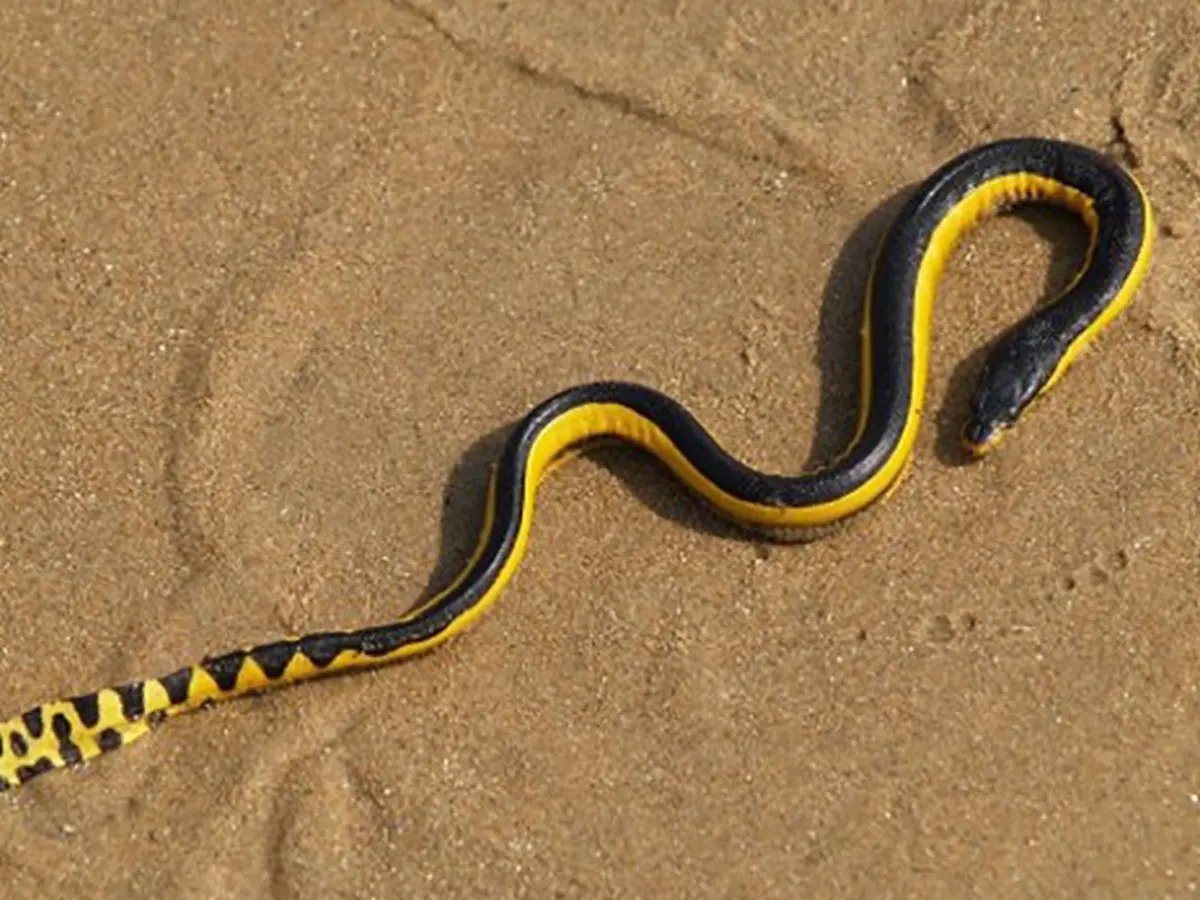
Imagine you’re floating in the middle of the Pacific Ocean, hundreds of miles from the nearest coastline. The water is a deep, endless blue. Suddenly, you spot a ribbon of bright neon yellow and charcoal black undulating near the surface. You've just met the yellow bellied sea snake. It's the only truly pelagic sea snake on the planet. Most of its cousins stick to the safety of coral reefs or shallow coastal waters, but Pelamis platurus (also known as Hydrophis platurus) lives its entire life in the open blue. It never needs to touch land. Not once.
It's a strange existence.
People often freak out when they see them washed up on a beach in California or Australia after a storm, thinking it's a sign of some ecological apocalypse. Honestly, it’s usually just a result of a strong El Niño or a particularly nasty cold snap that left the snake "cold stunned" and at the mercy of the currents. These snakes aren't out to get you. They're actually quite small—rarely topping 30 inches—and their mouths are tiny. But yeah, they are incredibly venomous.
The yellow bellied sea snake doesn't drink salt water
You’d think a creature living in the ocean would be able to process salt like a sea turtle or a shark. Nope. For a long time, biologists like William Dunson thought these snakes used sublingual salt glands to "drink" seawater and pump out the excess salt. It made sense. It was the textbook answer for decades.
Then came Professor Harvey Lillywhite from the University of Florida.
His research basically flipped the script. He discovered that yellow bellied sea snakes are actually living in a state of perpetual dehydration. They don't drink salt water at all. Instead, they wait for it to rain. When a heavy rainstorm hits the ocean, the fresh water doesn't mix with the salt water immediately. It forms a thin, temporary "lens" of fresh or brackish water on the surface. That is when the snakes feast—on water.
If it doesn't rain for months? They just shrivel up. They can lose up to 25% of their body mass and still survive. It’s a brutal, precarious way to live. When you see one on the surface, it isn't just sunbathing; it might be waiting for a drink.
Life in the "Slicks"
These snakes are masters of using ocean physics to their advantage. They spend most of their time in "slicks"—long lines of calm water created by converging currents. These slicks act like a giant conveyor belt for debris, plankton, and, most importantly, small fish.
The yellow bellied sea snake is a sit-and-wait predator.
It floats there, looking exactly like a piece of driftwood or a bit of kelp. Small fish, seeking shelter in the open ocean, swim right under the snake. Big mistake. The snake can strike backward, sideways, or forward with incredible speed. Because they have a paddle-like tail that is laterally compressed, they are surprisingly agile in the water, even though they are completely helpless on land. If you put one on a beach, it can't even crawl. Its belly scales aren't wide like a cobra's or a rattlesnake's; they're small and useless for traction.
Dealing with the Venom Mythos
Let’s talk about the bite because that’s what everyone asks about. Yes, the venom of a yellow bellied sea snake is a potent cocktail of neurotoxins and isotoxins. It's designed to paralyze fish instantly so they don't swim away and die where the snake can't find them.
Is it lethal to humans? Absolutely.
But here’s the reality: fatalities are incredibly rare. These snakes are not aggressive. They have no "territory" to defend in the middle of the Pacific. Most bites happen when fishermen try to untangle them from nets or when a curious person picks one up on a beach. Even then, they often deliver a "dry bite" without injecting venom. They don't want to waste their precious chemical weapons on something they can't eat.
The neurotoxins specifically target the respiratory system. If you were bitten and envenomated, you’d eventually stop being able to breathe. Anti-venom exists, but because these snakes live so far offshore, getting a dose in time is the real challenge.
A truly global wanderer
No other snake has a distribution quite like this one. You can find the yellow bellied sea snake from the eastern coast of Africa, across the Indian Ocean, all the way to the Pacific coast of the Americas. They've been spotted as far north as Russia and as far south as New Zealand.
They are the ultimate hitchhikers.
Their range is mostly limited by temperature. They need water that is at least 18°C (about 64°F) to survive long-term. If the water drops below that, their metabolism shuts down. This is why you see "stranding events" in places like Southern California during certain times of the year. The snakes follow warm water currents north, the current shifts or the season changes, and suddenly they are trapped in water that is too cold for them to function.
The Mystery of the Shedding Skin
Living in the ocean presents a unique problem: barnacles.
If you're a slow-moving object in the sea, things want to grow on you. Sea snakes have to deal with algae, bryozoans, and barnacles attaching to their scales. This isn't just a cosmetic issue; it creates drag and makes them less efficient hunters.
To combat this, the yellow bellied sea snake sheds its skin much more frequently than land snakes. They also perform a behavior called "knotting." The snake will literally tie itself into a knot and then slide the knot down its body. This friction helps scrub off hitchhikers and loose skin. It’s a bizarre sight—a snake cleaning itself by turning into a living macramé project.
How they breathe and dive
While they are air-breathers, they are incredibly efficient at it. A yellow bellied sea snake can stay submerged for up to three hours. They don't just rely on their lungs, either. They can actually absorb up to 33% of the oxygen they need through their skin while underwater.
Conversely, they can also discharge carbon dioxide through their skin.
When they do dive, they can go down to depths of about 50 meters, though they prefer staying near the surface where the "slicks" and the food are. Their nostrils are located on the top of their snout and are equipped with valves that snap shut the moment they submerge.
Breeding without a home base
Since they never go to land, how do they have babies? Most sea snakes in the Laticauda genus (sea kraits) have to go ashore to lay eggs. Not this one.
The yellow bellied sea snake is ovoviviparous.
This means the eggs develop inside the mother’s body, and she gives birth to live young right in the open ocean. Usually, a female will have about two to six "pups" at a time. These babies are born fully functional and ready to hunt. There is zero parental care. The moment they hit the water, they are on their own, navigating the vastness of the Pacific.
Why the yellow belly?
Evolution rarely does things by accident. The high-contrast coloration—dark on top, bright yellow on the bottom—is a classic example of aposematism. It’s a warning.
In the animal kingdom, bright colors usually mean "I taste bad" or "I am literally a tube of death."
Predators like sharks or large tuna see that flash of yellow and generally decide it's not worth the risk. There’s also an element of countershading. From below, the yellow might blend in with the bright surface of the water (sorta). From above, the dark back blends with the dark depths. But mostly, it's a "stay away" sign.
Facing the Future
Climate change is shifting the boundaries for these animals. As ocean temperatures rise, the "thermal envelope" for the yellow bellied sea snake is expanding. We are seeing them further north and further south than ever before.
While they aren't currently endangered—their population is likely in the millions—they are sensitive to changes in ocean currents and rainfall patterns. Remember, they need that surface rain to drink. If climate change alters tropical storm tracks or creates longer droughts over the ocean, these snakes could face a serious hydration crisis.
If you ever find yourself on a beach and see one of these creatures washed up, please don't touch it. Even if it looks dead, they can remain still for long periods and may strike if provoked.
Practical steps for ocean safety
- Look but don't touch: If you see a yellow and black snake on the sand, give it at least 10 feet of space.
- Report the sighting: Use apps like iNaturalist or contact local wildlife authorities. These sightings help scientists track how species are moving due to climate change.
- Understand the "slick": If you're a diver or sailor, keep an eye on floating debris lines. You’ll see an entire ecosystem there, and the yellow bellied sea snake is the apex predator of that tiny, floating world.
- Keep your distance in the water: They aren't aggressive, but if you swim through a slick, you might startle one. They are much faster than you.
These snakes are a testament to how life finds a way to colonize even the most inhospitable environments. They turned their backs on the land millions of years ago and never looked back. They don't need us, and they don't want us around. They just need the rain, the current, and the endless blue.