Color in the wild is rarely just about looking pretty. It’s a language. When you spot birds that are yellow and blue, you aren’t just seeing a random genetic fluke; you’re looking at a complex interaction of structural physics and dietary chemistry. It’s wild to think about, but blue pigment doesn't actually exist in the bird world. If you ground up a Blue Jay feather, the powder would be brown. The blue comes from light scattering—sort of like why the sky looks blue—while the yellow comes from what the bird ate for breakfast.
Blue and yellow are "complementary" colors on the color wheel. This makes them pop. Nature uses this high contrast for a few reasons, mostly involving sex and territory. If you’re a tiny bird in a dense, green forest, you need a high-visibility jacket to tell rivals to stay away or to tell a mate that you’re the healthiest specimen in the neighborhood.
The Physics of Being Blue and Yellow
Blue is a lie. Well, a structural lie. Ornithologists like those at the Cornell Lab of Ornithology explain that blue in feathers is created by "structural color." Tiny air pockets in the barbs of the feathers scatter incoming light, reflecting only the blue wavelengths.
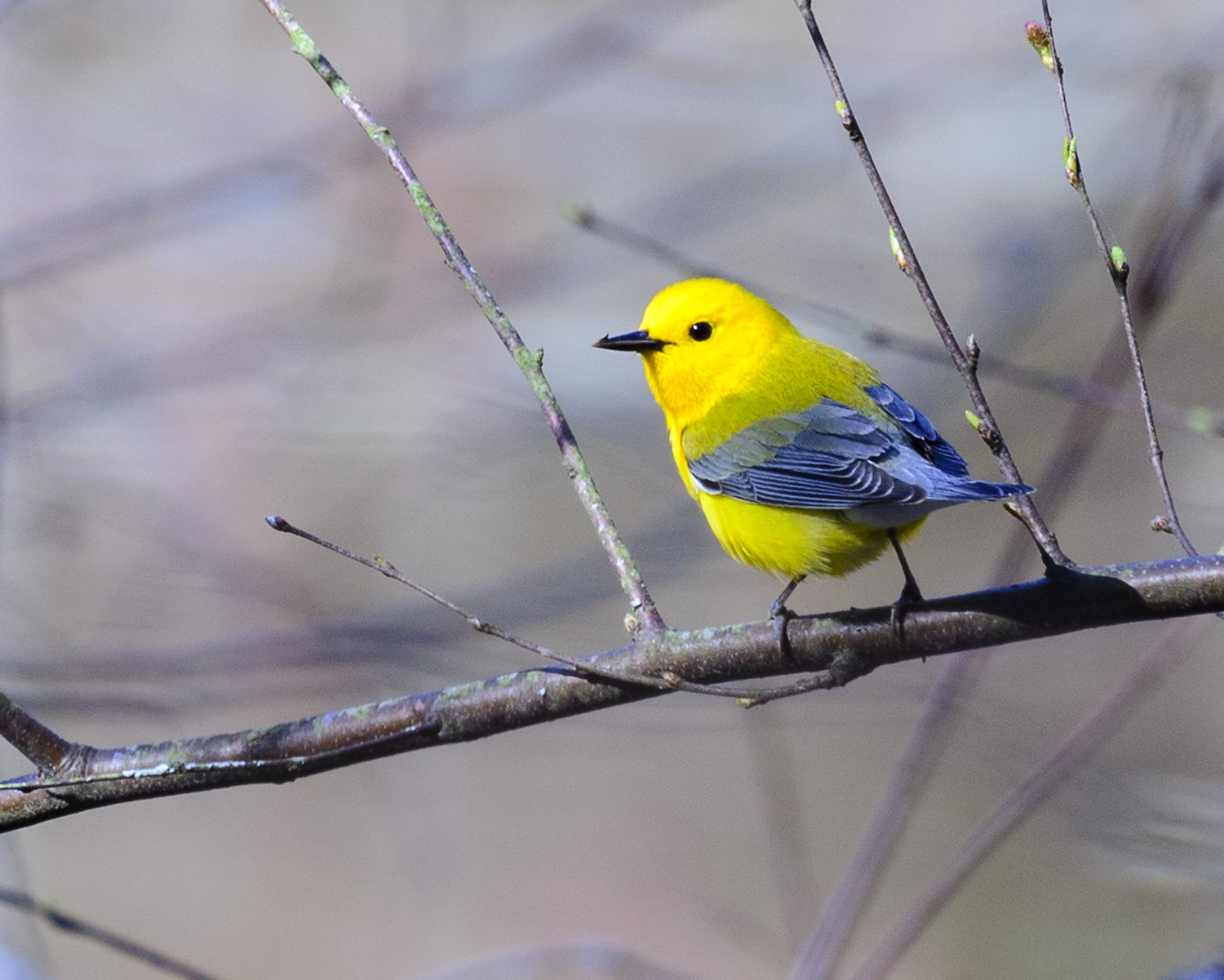
Yellow is different. It's a "carotenoid." To get that bright lemon or gold hue, a bird has to eat specific plants or insects that have eaten those plants. If a Prothonotary Warbler doesn't get the right nutrients, its yellow will look dull and faded.
When you see these two colors together, you’re seeing a bird that is both a master of physics and a very successful forager. It’s a flex.
The Heavy Hitters: Blue-and-Yellow Macaws
You can't talk about birds that are yellow and blue without mentioning the Ara ararauna. These guys are huge. We’re talking nearly three feet from head to tail. They live in the humid forests of South America, and honestly, they are loud enough to wake the dead.
The contrast on a Macaw is jarring. Their topside is a deep, shimmering cyan, while their underside is a rich, buttery yellow. In the wild, this serves as "countershading." If a predator looks up from below, the yellow blends with the bright sky. If they look down from above, the blue blends with the shadows of the forest floor.
Macaws are also surprisingly smart. They have the cognitive abilities of a human toddler. Dr. Irene Pepperberg’s work with parrots showed us that these birds aren't just "parroting" sounds; they understand shapes, colors, and even the concept of "zero."
The Tiny Titan: The Blue Tit
Crossing the ocean to Europe, the Eurasian Blue Tit (Cyanistes caeruleus) is basically the mascot of English gardens. It’s a tiny, acrobatic puffball. They have a bright blue cap and wings paired with a yellow chest that looks like a tennis ball.
Back in the 1920s, these birds became famous for a specific behavior: they learned how to open milk bottles. When the milkman left bottles on doorsteps, the Blue Tits would pierce the foil caps to drink the cream off the top. This wasn't just one bird; the behavior spread through the whole population. It’s one of the earliest recorded examples of "cultural transmission" in animals.
North American Favorites: Bluebirds and Warblers
If you’re in the States, your best bet for seeing birds that are yellow and blue is looking for the Eastern Bluebird or various wood warblers.
The Bluebird is mostly blue with a rusty-red chest, but in certain lights, that "rust" can look quite orange-yellow. However, if you want the "true" yellow and blue combo, you need to find a Blue-winged Warbler.
Blue-winged Warbler (Vermivora cyanoptera)
This bird is a stunner. It has a bright yellow body and blue-gray wings. They are tiny—barely five inches long. They love "early successional" habitats, which is just a fancy way of saying overgrown fields and brushy edges.
They are also involved in a bit of a genetic soap opera. They frequently interbreed with Golden-winged Warblers. The result? Hybrids known as "Brewster's Warblers" or the much rarer "Lawrence's Warblers." It’s a mess for birdwatchers trying to check off their lists, but it’s a fascinating look at evolution in real-time.
Prothonotary Warbler
I have a soft spot for these. They are sometimes called "Swamp Candles" because their yellow is so intense it looks like it's glowing against the dark, murky water of a cypress swamp. While their backs are more of an olive-green, their wings are a distinct blue-gray.
They are one of the few warblers that nest in holes (cavities) rather than building nests on branches. Because of habitat loss in wetlands, people often put up wooden nest boxes for them, similar to bluebird houses.
Why Do We Care So Much?
There is something psychologically satisfying about these colors. In art, yellow and blue are used to create balance. In nature, they signal vitality.
When we see birds that are yellow and blue, our brains register it as a sign of a healthy ecosystem. Carotenoids (the yellow) are antioxidants. A bird with bright yellow feathers is essentially showing off its immune system. "Look at me," the bird says. "I have so many nutrients that I can waste them on my clothes."
Rare Sightings: The Blue-and-Yellow Tanager
Deep in the Andes, you might find the Blue-and-yellow Tanager (Pipraeidea bonariensis). These aren't your typical backyard birds. They live in high-altitude scrub and light forests.
The male has a vivid blue head and wings with a bright yellow-to-orange belly. They are restless. They don't sit still. They move through the canopy in mixed-species flocks, which is basically a bird "gang" where different species hang out together to stay safe from hawks. More eyes mean more chances to spot a predator.
How to Attract Them to Your Yard
You want them in your yard? It’s not just about putting out a generic birdseed mix.
- For Bluebirds: They don't eat seeds. They want insects. Mealworms are the gold standard.
- For Blue Tits: High-fat foods like suet or sunflower hearts.
- For Warblers: They are harder to attract to feeders since they mostly eat bugs, but a moving water feature (a dripper or a small fountain) is like a neon sign for them.
The Misconception of "Blue" Pigment
I mentioned this earlier, but it's worth double-clicking on. If you take a yellow feather and soak it in a solvent, the color will eventually wash out. It’s a chemical.
If you take a blue feather and crush it, the blue disappears. It becomes a dull grey or brown. This is because you’ve destroyed the "Tyndall scattering" structure. It's the same reason why a Blue Morpho butterfly looks brown if you look at its wing from the wrong angle.
Nature is a master of illusions.
What to Do Next
Identifying birds that are yellow and blue is a great entry point into serious birding because they are so distinct.
- Get a decent pair of 8x42 binoculars. This is the "sweet spot" for birding—enough magnification to see detail, but a wide enough field of view so you aren't hunting for the bird in the leaves.
- Download the Merlin Bird ID app. It’s free and made by Cornell. You can record the sound of a bird, and it will tell you what it is in real-time. It’s basically magic.
- Check your local "hotspots" on eBird. People log their sightings daily. If someone saw a Prothonotary Warbler at a park near you yesterday, there’s a high chance it’s still there today.
- Plant native. If you want yellow birds, you need the insects they eat. Native oaks and cherries support hundreds of species of caterpillars—the primary food source for most colorful songbirds.
The world of birds that are yellow and blue is surprisingly deep. From the physics of light to the chemistry of their diet, these creatures are living proof of how complex and interconnected our environment really is. Keep your eyes on the edges of the trees, especially during spring migration. You might just see a flash of gold and azure that changes your whole day.