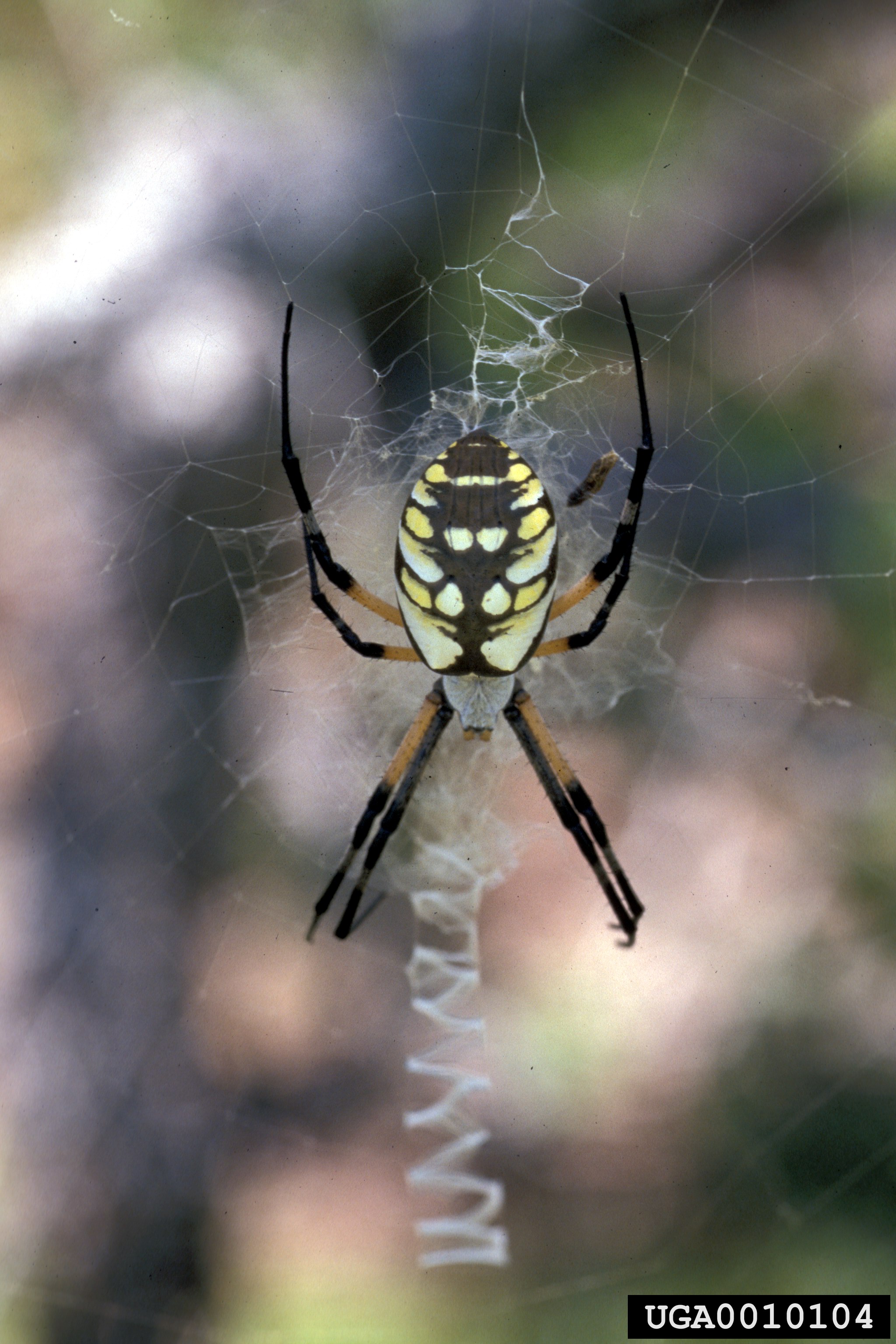
You’re walking through the backyard, coffee in hand, maybe thinking about the weeds you need to pull, and then you see it. A massive, vibrating web stretched across the tomato plants with a neon-bright monster sitting right in the center. It's huge. It’s got these vivid, yellow and black spiders markings that look like nature’s version of a "Caution" sign. Your heart skips. You wonder if you should call an exterminator or maybe just move houses entirely.
Wait.
Before you grab the broom, let's talk about what you're actually looking at. Most of the time, that striking creature is an Argiope aurantia. People call them Black and Yellow Garden Spiders, Writing Spiders, or even Zipper Spiders. They look intimidating, sure, but they are basically the unpaid security guards of your garden. They aren't interested in your toes. They want the grasshoppers that are eating your lilies.
The Reality of Yellow and Black Spiders in Your Yard
If you’ve spotted one, you’ve likely noticed the "zipper." This is a thick, zig-zagging pattern of white silk running down the center of the web called a stabilimentum. Scientists have been arguing about why they build it for decades. Some experts, like those at the University of Florida’s entomology department, suggest it might act as a structural support. Others think it’s a giant "Do Not Enter" sign for birds so they don't fly through and wreck hours of hard work.
These spiders are masters of the "sit and wait" technique. They don't hunt. They just hang out, head down, waiting for a vibration.
Is it dangerous?
Honestly, no. Not really.
A black and yellow spider bite is about as painful as a bee sting for the average person. Unless you’re allergic to spider venom specifically, you’ll just have some redness and swelling. They are incredibly docile. You practically have to poke them with a finger or squeeze them to get a bite. Even then, they’d much rather drop to the ground and hide in the mulch than pick a fight with a human who is 1,000 times their size.
I’ve spent years photographing these things. I’ve accidentally bumped their webs. They just shake the web—a behavior called "web flexing"—to try and look bigger and scarier. It’s a bluff. It’s all theater.
Identifying the "Writing Spider" and Its Lookalikes
Not every yellow and black spider is an Argiope. You have to look at the shape. The Argiope aurantia has a distinct, shield-shaped abdomen. The yellow is bright, almost like school-bus yellow, contrasted against a deep, velvety black.
Then you have the Joro spider (Trichonephila clavata).
These are the new kids on the block in the Southeastern United States. Originally from East Asia, they’ve been spreading rapidly since they were first spotted in Georgia around 2014. They are much "leggier." Their webs are golden-tinted and can span several feet, often high up in the trees. While they are also yellow and black (with some red splashes), they represent a different ecological shift. They aren't necessarily "bad," but they are definitely invasive.
There is also the Marbled Orbweaver. These guys are rounder. Like a marble. Their colors are more orange-yellow, and they tend to hide in a "retreat" made of folded leaves off to the side of the web rather than sitting in the middle like the Argiope.
The Life Cycle of a Backyard Architect
It starts in the fall. If you look near the edge of a web in late September, you might see a brown, papery sac. That’s the egg case. It’s tough. It’s waterproof. Inside, hundreds of tiny spiderlings are waiting out the winter.
When spring hits, they emerge. They are tiny. They use a process called "ballooning" to travel, throwing out a strand of silk and letting the wind carry them to new territories. Most don't survive. Birds eat them. Ants eat them. Cold snaps kill them.
The ones that do survive grow at an incredible rate.
The females are the stars of the show. They grow up to an inch long in body length, while the males are tiny, brownish, and barely noticeable. The males don't even build their own webs most of the time; they just hang out on the outskirts of a female's web, hoping they don't get eaten during the mating process. It’s a tough life for a guy spider.
Why You Should Keep Them Around
If you hate mosquitoes, you should love these spiders. A single black and yellow garden spider can catch dozens of insects in a week. They eat:
- Aphids
- Flies
- Wasps
- Grasshoppers
- Stink bugs (which is a huge plus for gardeners)
Basically, they are a chemical-free pest control system. If you kill the spider, you're just inviting the pests back to dinner.
I remember talking to a local nursery owner who told me she used to move her garden spiders by hand if they built webs across the main walking paths. She’d just let them crawl onto a stick and relocate them to the back fence. They usually stayed put. They aren't territorial about the specific spot; they just want a place with good airflow and plenty of bugs.
Common Misconceptions That Need to Die
People see bright colors and think "Black Widow." While Black Widows have some red, they are shiny, bulbous, and hide in dark, messy corners like woodpiles or crawlspaces. Yellow and black spiders are "Orbweavers." They like the light. They like the sun.
Another weird myth? That they’ll bite you in your sleep.
Orbweavers almost never enter homes. There’s no food for them there. Your living room doesn't have a high enough concentration of flying insects to support a spider that grows that big. If you find a yellow spider in your house, it’s likely a Long-legged Sac Spider, which is a completely different (and much smaller) species.
What to Do If You Find One
First, take a breath. It isn't going to jump on you.
If the web is in a spot where you’re constantly walking into it—like between your car and the garage—you can relocate it. Use a broom handle to gently wrap up the silk and the spider. Move it to a tall shrub or a fence row. It’ll rebuild in a few hours.
If it’s in the garden, just leave it. Watch it.
Watch how it wraps a grasshopper in silk with surgical precision. It’s honestly one of the most fascinating things you can see in your own backyard. It’s a tiny bit of "National Geographic" right next to your azaleas.
Identifying by Region
Depending on where you live, the "black and yellow" variety might change slightly:
- Pacific Northwest: You might see the Cross Orbweaver. More brown/orange than bright yellow, but still striking.
- The South: Expect the Argiope and the Joro.
- The Southwest: Look out for the Banded Garden Spider (Argiope trifasciata), which has thinner, more frequent stripes across its back.
Actionable Steps for Coexisting with Spiders
- Check before you prune. Before you go hacking away at your bushes in late summer, do a quick scan for webs.
- Turn off outdoor lights. If you have too many spiders and it’s bothering you, reduce the light. Lights attract moths and beetles. Bugs attract spiders. No bugs, no spiders.
- Use the "Stick Method." If you must move a web, don't use pesticides. A simple stick or a piece of cardboard is enough to move the resident to a new home.
- Teach the kids. Instead of teaching children to stomp on every bug they see, show them the "writing" in the web. It’s a great way to build an appreciation for the ecosystem.
- Document the eggs. If you find an egg sac in the fall, leave it. You’ll have a fresh batch of "security guards" ready to go by May.
Ultimately, these yellow and black spiders are a sign of a healthy garden. They mean you have an ecosystem that is working. They aren't villains; they're just architects with a very specific, very bright dress code.



