You’re walking through your garden in Orlando or maybe hiking a trail near the Everglades, and you see a flash of gold and obsidian. It’s a snake. Your heart rate spikes. It’s okay. Most people freak out because Florida is basically the Australia of the United States when it comes to things that slither, crawl, or bite. But here’s the thing about yellow and black snakes in Florida: most of them are actually your best friends in the garden. They eat the rats you hate. They eat the roaches. Some of them even eat the snakes that can actually hurt you.
Florida has over 40 species of snakes. Only six are venomous. If you see something yellow and black, you’re almost certainly looking at a harmless neighbor. But "almost" is a big word when we’re talking about wildlife. Understanding the nuances of scales, pupil shapes, and stripe patterns isn't just for biology nerds. It's for anyone who wants to enjoy their backyard without unnecessary panic.
The Most Common Culprit: The Eastern Rat Snake
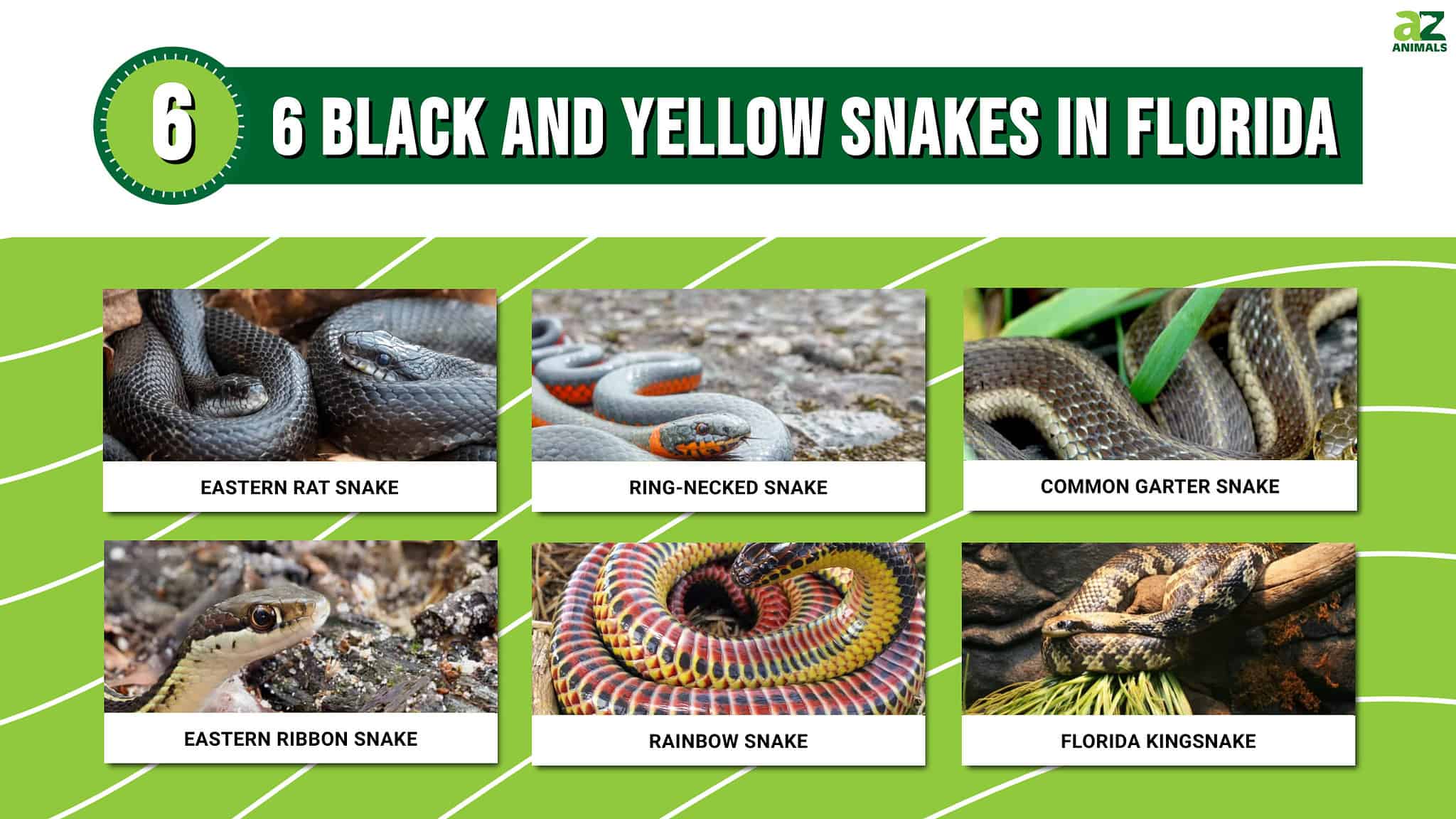
If you see a long, thin, yellow snake with four dark stripes running down its body, you’ve found an Eastern Rat Snake (Pantherophis alleghaniensis). In many parts of Florida, people still call these "Yellow Rat Snakes." They are ubiquitous. You’ll find them in rafters, in trees, and definitely in your mulch piles.
These guys are the acrobats of the Florida reptile world. I've seen them scale vertical brick walls just to get to a bird's nest or a clutch of rodents. They can grow up to seven feet long, which sounds terrifying, but they are generally pretty chill unless you try to grab them. If you corner one, it might shake its tail in dry leaves to mimic a rattlesnake. It’s a bluff. A total act.
The "yellow" in these snakes varies wildly depending on where you are in the state. In the Panhandle, they might look more gray or blotchy. As you head south toward the Everglades, they turn that classic, bright "banana" yellow with distinct black or dark brown stripes. They are non-venomous constrictors. Basically, they are free pest control that doesn't charge a monthly fee.
The Eastern Garter Snake: The Striped Resident
Everyone knows the Garter Snake. Or they think they do. In Florida, the Eastern Garter Snake (Thamnophis sirtalis sirtalis) often shows up with three longitudinal stripes. Usually, these stripes are yellow or cream against a dark black or olive-green body.
They love moisture. If you have a leaky outdoor faucet or a decorative pond, you’ll probably have a Garter snake. They aren't big—usually topping out around 26 to 30 inches. They eat frogs, slugs, and earthworms. While they technically have a very mild venom that helps them subdue small prey, it is not considered clinically significant to humans. If one bites you, it might itch or swell a tiny bit, but you aren't going to the hospital. Honestly, they’re more likely to musk on you. It smells like rotting cabbage and skunk. It's gross. That's their real defense.
The One to Respect: The Eastern Coral Snake
We have to talk about the Eastern Coral Snake (Micrurus fulvius). This is the "big one" when it comes to yellow and black snakes in Florida. It is beautiful. It is also highly venomous. Unlike the pit vipers (rattlesnakes and cottonmouths) which have triangular heads and heat-sensing pits, the Coral Snake looks like a harmless toy. It has a blunt, black nose and a slender body covered in rings of red, yellow, and black.
You’ve probably heard the rhyme: "Red touch yellow, kill a fellow; red touch black, friend of Jack." It actually works for Florida’s native species. On a Coral Snake, the red bands are always bordered by thin yellow bands.
They are reclusive. They spend most of their time underground or under leaf litter. They don't want to see you. They aren't aggressive. Most bites happen when someone tries to pick them up because they think it’s a "pretty" snake. Don't do that. Coral snake venom is neurotoxic, meaning it shuts down your nervous system. Fortunately, because they have short, fixed fangs, they have to actually "chew" to inject venom, and there hasn't been a death from a Coral Snake in the U.S. since the antivenom was developed in the 1960s (though production of that antivenom has been spotty lately, which is a whole other rabbit hole).
The Striking Ring-necked Snake
Sometimes you’ll find a tiny, dark snake, maybe 10 inches long, that looks like a piece of shoelace. You flip it over, and the belly is a shocking, neon yellow or orange with black spots. This is the Southern Ring-necked Snake.
- Size: Tiny.
- Behavior: They curl their tails into a corkscrew to show off their bright underside when threatened.
- Diet: Small lizards and worms.
They are completely harmless to humans. They are actually quite delicate. If you find one in your pool skimmer, just lift it out. They are one of the most common snakes in suburban Florida, yet people rarely see them because they are so good at hiding under flower pots.
The Mud Snake: A Rare Beauty
Deep in the cypress swamps and slow-moving blackwater rivers, there’s a snake that looks like it belongs in a museum. The Mud Snake (Farancia abacura) is a heavy-bodied snake that is glossy black on top. But its belly? It’s a mosaic of brilliant red or pinkish-yellow and black checkers.
These snakes are specialists. They almost exclusively eat "sirens" and "congo eels" (which are actually giant aquatic salamanders). Because they are so specialized and aquatic, you won't see them in your suburban driveway. But if you're kayaking and see a thick black snake with flashes of yellow or red on the sides near the belly, count yourself lucky. It’s a rare sight. They are famously docile. There is an old tall tale that they are "Hoop Snakes" that bite their tails and roll after people. That is, obviously, complete nonsense. They also have a pointed tail tip they use to poke at predators, leading to the nickname "Sting Snake," but they can't actually sting you.
Why are they in my yard?
Snakes don't hang out in your yard because they want to scare you. They are there for two reasons: food and shelter. Florida’s suburban sprawl has invaded their natural habitats, but many species have adapted beautifully.
If you have a lot of yellow and black snakes in Florida appearing near your home, look at your landscaping. Piles of firewood, thick layers of pine straw, and overgrown bushes are basically five-star hotels for reptiles. Also, check for rodents. If you have bird feeders, you have dropped seed. Dropped seed attracts mice. Mice attract Rat Snakes. It’s a simple caloric equation.
Expert Identification Tips
Don't rely solely on color. Colors can fade, or a snake might be "in blue" (about to shed), which makes their skin look dull and opaque. Instead, look at the scales. Are they "keeled"? Keeled scales have a small ridge down the center, making the snake look dull and feel rough, like a cat's tongue. Garter snakes have keeled scales. Rat snakes have weakly keeled scales.
Look at the eyes. In Florida, all our harmless yellow and black snakes have round pupils. Our venomous pit vipers have vertical, cat-like pupils. However, the Coral Snake—the venomous one—also has round pupils. This is why the "Red on Yellow" rule is so vital for that specific species.
Coexisting with Florida’s Snakes
We live in a state that is essentially a giant swamp with air conditioning. We share it with amazing wildlife. If you see a snake, the best thing you can do is give it space.
- Back away. Most snakes can only strike a distance of about half their body length.
- Use a hose. If you really want a snake to move along, a gentle spray from a garden hose will usually send them packing.
- Identify before you act. Killing a snake is usually illegal (for certain species) and always unnecessary.
- Keep pets away. Dogs are curious and get bitten because they stick their noses where they shouldn't.
Actionable Steps for Homeowners
If you want to reduce the number of snakes around your immediate porch or entryway, start with "habitat modification." You don't need chemicals or those "snake repellent" granules you see at big-box stores. Honestly? Those granules don't work. Sulfur and mothballs are just as likely to annoy you as they are the snake.
Instead, keep your grass mown short. Snakes feel vulnerable in short grass because hawks can see them. Seal up any gaps in your home’s foundation or under your garage door using weather stripping or expanding foam. If there’s no way for a mouse to get in, the snake won't follow. Finally, keep your yard tidy. Move the woodpile away from the house and up off the ground. By removing the "clutter," you're making your property a lot less attractive to the local reptile population. If you encounter a snake you can't identify, take a photo from a safe distance and upload it to the "Florida Snake ID" groups on social media; the experts there respond in minutes.
Summary of Key Species
- Eastern Rat Snake: Large, yellow with four black stripes. Excellent climber.
- Eastern Garter Snake: Small/Medium, black with yellow stripes. Loves water.
- Eastern Coral Snake: Small, red/yellow/black rings. Venomous. Black nose.
- Ring-necked Snake: Tiny, black with a yellow/orange belly and neck ring.
- Mud Snake: Large, black with red/yellow checkered belly. Swamp dweller.
Next time you spot a flash of yellow in the grass, take a breath. It’s probably just a Rat Snake looking for a snack, doing its part to keep the Florida ecosystem in balance. Observe it, appreciate the colors, and let it go about its day.
Practical Next Steps
- Audit your perimeter: Walk around your house and look for any gaps larger than a quarter; seal them to prevent snakes from entering crawlspaces.
- Download a guide: Keep a PDF of the Florida Museum of Natural History snake guide on your phone for instant, offline identification.
- Trim the "Skirts": Prune the bottom branches of your ornamental shrubs so there is a clear space of 6 inches between the ground and the foliage, removing hiding spots near walkways.



