Walk into any sneaker shop in London, Tokyo, or New York, and you’ll see it. That specific, almost aggressive shade of neon. It’s not just "yellow." It’s Volt. It’s Opti Yellow. It's the high-visibility streak that defined an entire era of footwear design. When the yellow Air Max 95 first hit the pavement in 1995, it didn't just look different; it looked like it belonged in a different century. People either loved the "ugly" anatomy-inspired ribs or they couldn't wrap their heads around why a running shoe had a black midsole. But that's the thing about this specific colorway—it wasn't designed to be polite.
Sergio Lozano, the mastermind behind the silhouette, took a massive risk. He looked at the erosion of the Grand Canyon and the human anatomy for inspiration, layering the upper to mimic muscle fibers and ribs. But the color choice? That was pure rebellion. Most running shoes back then were white. Boring, clean, safe white. Lozano chose grey gradients to hide dirt and then slapped on that iconic neon yellow to scream "performance." It worked. Decades later, the yellow Air Max 95 remains the ultimate "if you know, you know" sneaker for collectors who value grit over hype.
The Science of the Glow: Why Yellow Works
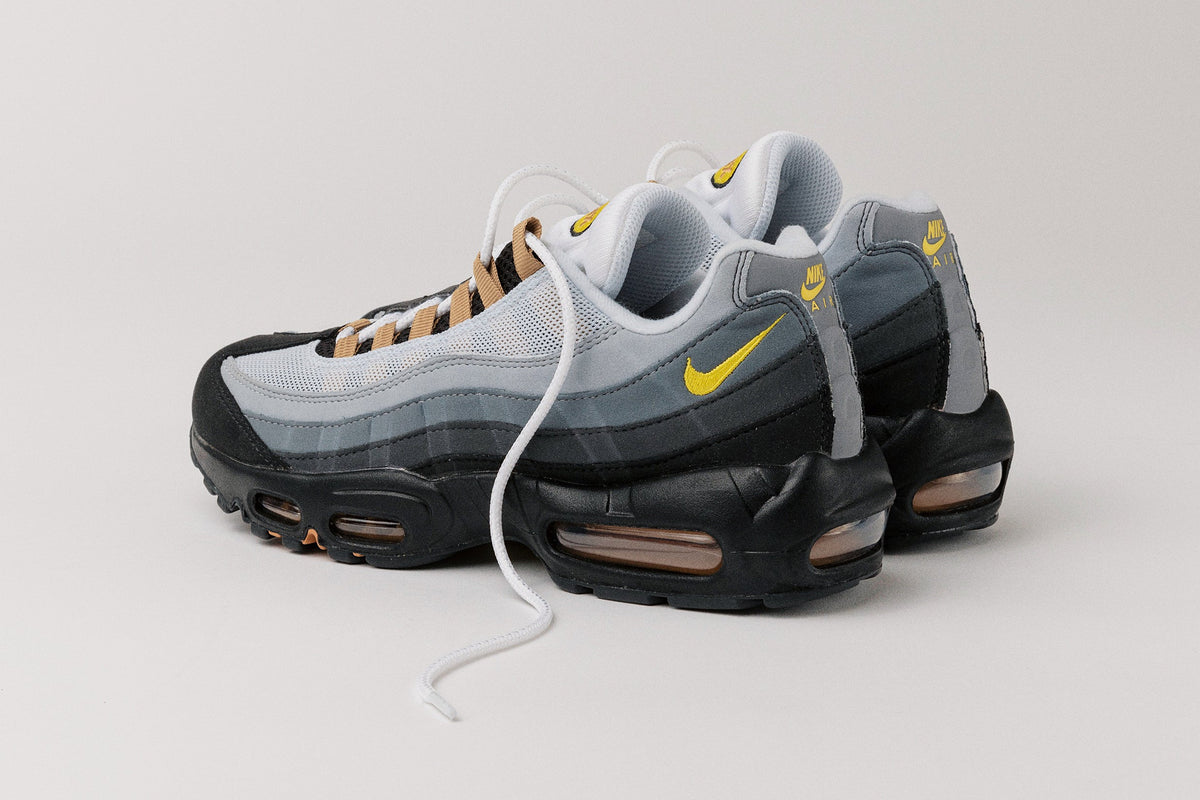
Yellow is a polarizing color in fashion. It’s loud. It’s hard to pull off. Yet, on the Air Max 95, it feels essential. The reason is contrast. By placing those sharp yellow accents—the eyelets, the mini-Swoosh, and the pressurized Air units—against a backdrop of "Cool Grey" and "Anthracite," Nike created a visual pop that hasn't been matched since. It mimics the look of a rainy asphalt road reflecting a streetlamp.
There is a psychological component to this specific palette. According to color theory, yellow is the first color the human eye notices. It signals caution, speed, and energy. When you see someone wearing a pair of "Tour Yellow" or "Volt" 95s, your brain registers them before you even see their face. It’s a power move. Honestly, wearing these sneakers is less about matching an outfit and more about letting the shoes dictate the vibe of the entire room.
Anatomical Design and the 1995 Revolution
Let’s get technical for a second because the construction of the yellow Air Max 95 is actually wild. Lozano’s design was the first to feature visible Air in the forefoot. Think about that. Before '95, the "bubbles" were mostly tucked away in the heel. By bringing that neon yellow gas-filled urethane to the front, Nike was flexing its technological muscles.
The lacing system? Those are the "ribs." The layered suede and mesh? Those are the "muscles." The spine-like outsole? Well, that’s literally a spine. It sounds a bit morbid when you describe it like that, but on foot, it creates a chunky, aggressive profile that somehow manages to look streamlined. You’ve got this heavy-duty aesthetic that still feels fast. It’s a weird contradiction that shouldn't work, but it does.
Breaking Down the Best Yellow Colorways
Not all yellow Air Max 95s are created equal. You’ve got the OGs, and then you’ve got the modern reinterpretations that sometimes miss the mark.
The OG Neon: This is the blueprint. Technically, it’s "Volt," which sits on the line between green and yellow. It’s the shoe that started the craze. If you own a pair of these, you own a piece of industrial design history.
The "Tour Yellow": These are more of a "true" yellow. They often feature a white midsole instead of the classic black, which gives the shoe a much cleaner, more athletic look. It’s less "gritty city" and more "summer in LA."
The "Amarillo": Released a few years back, this version leaned into a deeper, golden yellow. It paired beautifully with navy blue accents, creating a look that felt almost like a vintage varsity jacket.
The "Lemon Drop": A more recent lifestyle take. This one uses softer suedes and muted, pastel yellows. It’s for the person who wants the comfort of a 95 without looking like they’re directing traffic on a highway.
Sometimes Nike gets experimental with the materials. You’ll see some versions with "safari" prints or reflective 3M panels. While purists usually stick to the suede and mesh combo, the leather-heavy "Opti Yellow" releases have proven to be much more durable for daily wear. Suede is a nightmare in the rain, basically. If you live somewhere like Seattle or London, you’re better off looking for a synthetic leather finish unless you want your yellow to turn into a muddy brown within a week.
Cult Status: From Japan to the UK
The yellow Air Max 95 isn't just a shoe; it’s a cultural marker. In Japan during the late 90s, the "Air Max hunting" phenomenon was a real thing. People were literally getting mugged for their Neons. The demand was so high that pairs were selling for thousands of dollars in the Ura-Harajuku district. It was the first true "viral" sneaker before the internet even existed as we know it today.
In the UK, the 95 (often called the "110" because of its original £110 price tag) became the unofficial uniform of the underground music scene. From grime to jungle, the yellow accents were a staple on the feet of MCs and ravers alike. It represented a certain type of working-class luxury. It was expensive, it was flashy, but it was tough enough to survive a night in a crowded club or a sprint across a damp estate.
"The Air Max 95 was the first shoe I saw that felt like it was from the future but also looked like it could take a beating." — This sentiment is echoed by almost every collector who grew up in that era.
How to Style the Loudest Shoe in Your Closet
Styling a yellow Air Max 95 is a high-risk, high-reward situation. You can’t just throw them on with anything. If you wear them with a matching yellow tracksuit, you look like a giant banana. Don’t do that. Honestly, the best way to wear these is to let the shoes do all the talking.
Go for a monochromatic base. Black cargo pants or dark grey joggers work perfectly because they allow the grey gradient of the shoe to blend in while the yellow pops out. If you’re feeling bold, a tiny hint of yellow in your t-shirt graphic or your socks can tie it all together, but keep it subtle. You want people to notice the shoes, not the fact that you’re trying too hard to match them.
Avoid overly skinny jeans. The 95 is a "beefy" shoe. It’s got a wide footprint and a chunky silhouette. If you wear them with tight denim, you end up with the "mickey mouse" effect where your feet look disproportionately large. Go for a straight-leg or relaxed fit. It balances the visual weight.
Performance vs. Lifestyle: Can You Actually Run in These?
Technically, yes. People did it in 1995. But should you run in them today? Probably not.
Modern running technology has moved so far past the 95 that using these for a marathon would be like trying to race a Tesla in a 1995 Jeep Wrangler. They’re heavy. The heel-to-toe transition is stiff compared to modern "ZoomX" or "React" foams. The Air units, while revolutionary at the time, feel firm by today's standards.
These are lifestyle shoes now. They are built for walking the dog, going to the pub, or standing at a concert for four hours. The support is actually great for standing because the dual-pressure Air units provide a stable base that doesn't bottom out like softer foams. Just don't expect to set any 5K personal bests in them.
Common Misconceptions About the Yellow 95
People often think the "Neon" and "Yellow" versions are the same thing. They aren't. As mentioned earlier, the OG Neon is a specific citrusy-green. If you buy a pair of "University Yellow" 95s thinking they are the OGs, you’re going to be disappointed when you see them in person. The shades are vastly different.
Another myth is that the Air bubbles will pop easily. While it can happen if you step on a literal nail, the TPU (thermoplastic polyurethane) used for the Air Max units is incredibly tough. Most of the "popped" bubbles people complain about are actually just the mid-sole foam compressing over time, making it look like the air is gone. If you take care of them, these shoes can last a decade.
The Resale Market and Authenticity
Buying a pair of yellow Air Max 95s today can be a minefield. Because they are so popular, the market is flooded with fakes. Some of the high-end "reps" are terrifyingly close to the real thing.
When you’re looking at a pair, check the "ribs." On authentic pairs, the stitching should be tight and the gradient should be smooth, not blocky. The Air units should be clear, not cloudy, and they should feel firm when you press them. If the yellow looks "bleeding" into the grey suede, walk away.
Check the SKU on the tongue tag. A quick Google search of that number should bring up the exact colorway and year of release. If it brings up a different shoe, you’re looking at a fake. Sites like StockX or GOAT are generally safe, but even they make mistakes. The best bet is always to buy from reputable retailers during a "restock" event.
Maintenance: Keeping the Yellow Bright
Yellow shows dirt. It’s a fact of life. To keep your 95s looking fresh, you need a decent cleaning kit.
- Don't use the washing machine: The heat can warp the glue and ruin the Air units.
- Suede brush is king: Since most yellow 95s use suede or nubuck, a dry brush is your best friend for removing surface dust.
- Avoid the "home remedies": Don't use bleach on the yellow mesh. It will turn it an ugly, sickly orange. Use a dedicated sneaker cleaner like Jason Markk or Crep Protect.
- The Midsole Trick: Since the midsole is usually black on the yellow colorways, you can get away with a lot of wear. A simple damp cloth will keep the black looking deep and matte.
Actionable Steps for the Aspiring Collector
If you’re looking to grab your first pair of yellow Air Max 95s, don't just jump at the first pair you see on an ad. Do this instead:
- Verify the "Year of Release": Look for the 2020 "Neon" Retro if you want the most accurate OG feel. It has the correct packaging and the "pressure" markings on the Air unit.
- Size Up Half a Size: Air Max 95s run notoriously tight, especially in the midfoot. If you have wide feet, you’ll definitely want that extra 0.5 size.
- Check the Suede Quality: Before buying, look at high-res photos. The "hairy" suede versions look great but are a nightmare to clean. The "flat" nubuck versions are much more durable.
- Inspect the Air Units: If buying used, make sure there is no fogging in the yellow bubbles. Fogging usually means moisture has leaked in, which leads to "sole crumbling" later on.
- Lock Down Your Fit: Pair them with tapered trousers. The shoe is the star; don't bury it under baggy jeans that drag on the floor.
The yellow Air Max 95 is a loud, proud, and slightly weird piece of footwear history. It’s survived thirty years of changing trends because it doesn't try to fit in. Whether you call it Volt, Amarillo, or just plain yellow, it remains the definitive choice for anyone who wants their sneakers to have a bit of an edge.