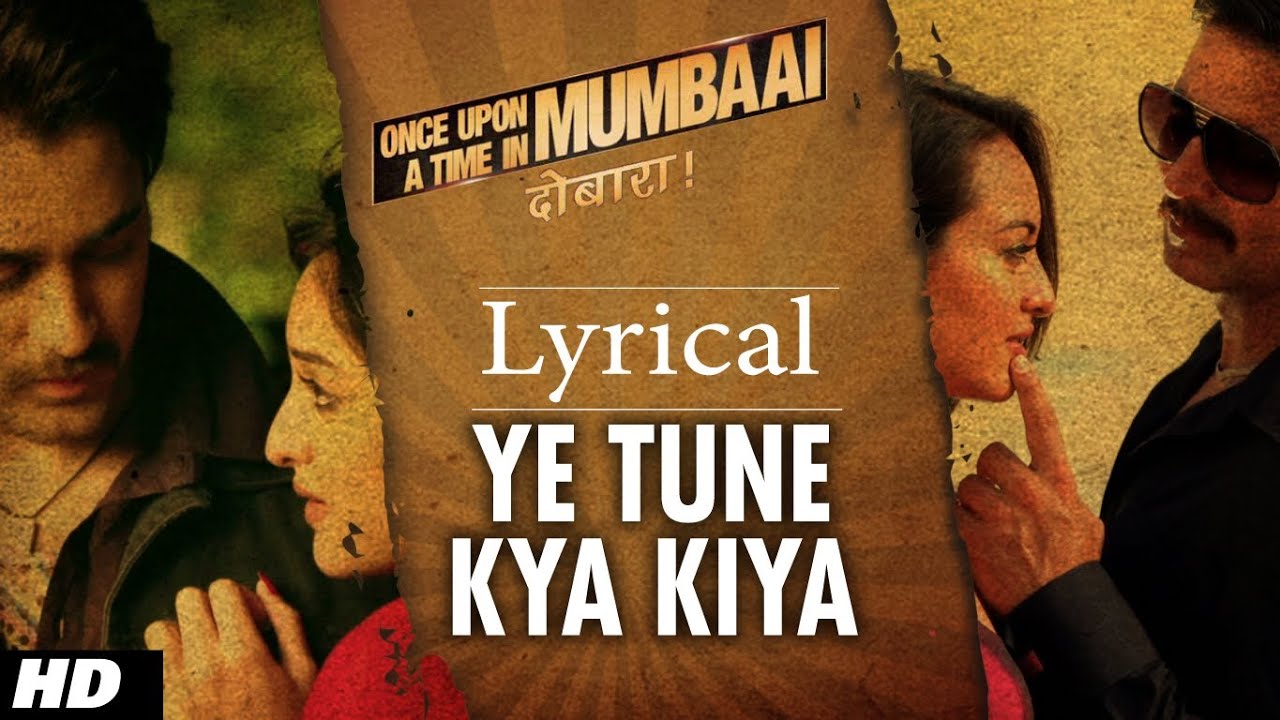
It is 2 a.m. You are staring at a screen or out a window, and suddenly, that haunting sarangi intro kicks in. You know the one. Javed Bashir’s voice enters with a texture that feels like velvet rubbed against sandpaper—rough, soulful, and desperately pained. If you’ve spent any time on the melancholic side of Bollywood YouTube or Spotify, you’ve looked up the Yeh Tune Kya Kiya lyrics more than once.
Songs come and go. Most movie tracks have the shelf life of an open yogurt. But this one? It stuck. Released in 2013 for the film Once Upon a Time in Mumbaai Dobara, the song outlasted the movie’s actual theatrical run. It’s a weird phenomenon. The film was a sequel that struggled to live up to its predecessor, yet this specific composition by Pritam became a modern qawwali staple.
The Rajat Arora Magic in the Yeh Tune Kya Kiya Lyrics
Most people credit the singer, and rightfully so, but the backbone of this emotional wrecking ball is Rajat Arora’s writing. Arora has a very specific "old school Bombay" flair. He writes lyrics that sound like they should be painted on the back of a rickshaw or whispered in a dimly lit Irani café in 1970.
Take the opening lines: “Ishq woh bala hai, jisko chhua isne woh jala hai.” Love is a calamity; whoever it touches, burns. It’s not exactly groundbreaking poetry on paper, but in the context of the Yeh Tune Kya Kiya lyrics, it sets a grim stage. It isn't a "flowers and sunshine" romance. It’s the kind of love that feels like a heavy fever.
The brilliance lies in the conversational desperation. When the protagonist asks, "Yeh tune kya kiya?" it isn't just a question. It’s an accusation. It’s the sound of someone realizing they’ve lost their logic, their dignity, and their peace of mind to another person. We’ve all been there, right? That moment where you realize you’re doing something stupid for someone who probably doesn't deserve it, but you're too deep in to turn back.
Why Javed Bashir Was the Only Choice
Could a mainstream pop singer have done this? Probably not. Pritam, who is often criticized for "inspirations" but rarely for his casting, knew he needed a Sufi powerhouse. Javed Bashir brings a Pakistani classical lineage that adds weight.
When he hits the high notes in the chorus, there’s a slight break in the voice. That’s not a mistake. It’s the "dard" (pain) that listeners crave. In an era of Auto-Tune, hearing a human being actually sound like their heart is physically cracking is rare.
Dissecting the Most Misunderstood Lines
A lot of listeners hum along to the hook without actually processing the verses. There’s a specific bit that goes:
“Zarrat-o-mein bikhre pade thhe, tune itna diya ki hum bhar gaye.”
Basically, the narrator is saying they were scattered like dust particles—insignificant and broken. Then this person came along and gave them so much (love, attention, or maybe just chaos) that they finally felt "full." But here’s the twist: being "full" in this song isn't necessarily a good thing. It’s a suffocating kind of fullness. It’s the kind that leads to the eventual "tabahi" or destruction mentioned later.
The Yeh Tune Kya Kiya lyrics play with this duality constantly.
- The Hunger: “Bhookh hi nahi thi, ab mitaaye nahi mitti.” (I wasn't even hungry for this, and now I can't satisfy the craving.)
- The Loss of Self: “Hum toh dil ke hi maare thhe, par ab toh jaan se gaye.” (I was already struggling with my heart, but now I'm dead.)
It’s dark stuff. It reflects the obsessive nature of the film's characters—Shoaib (played by Akshay Kumar) and his toxic, overbearing love. Even if you haven't seen the movie, the lyrics stand alone as a portrait of obsession.
Why the Composition Feels Like a Fever Dream
Pritam is a master of the "crescendo." He starts you off slow, making you think you’re in for a standard ballad. Then the tabla picks up. The harmonium gets aggressive. By the time the bridge hits, the song has transformed into a full-blown qawwali rock fusion.
This structure is why the song is a favorite for late-night drives. It matches the rhythm of an overthinking mind. You start calm, you start analyzing, and by the end, you’re mentally shouting the lyrics at an imaginary ex.
Interestingly, the song uses a traditional Sufi structure but dresses it in Bollywood clothes. It’s accessible but deep. You don't need a PhD in Urdu to feel the impact of words like kafir or khuda. They are part of the shared emotional vocabulary of the subcontinent.
The Visual Impact and the "Akshay Kumar" Factor
Let’s be honest: seeing Akshay Kumar in a 70s-style mustache, looking menacingly into a mirror while this song plays, added a layer of "gangster romance" that people loved. It gave the Yeh Tune Kya Kiya lyrics a face. It wasn't just a song; it was the anthem of a "villain" who thinks he’s the hero of his own tragic love story.
Social media has given this track a second life. On Instagram Reels and TikTok, you’ll see thousands of creators using the “Be-intehaan” section to underscore dramatic transitions or moody aesthetic shots. It has become shorthand for "intense longing."
Common Misconceptions About the Song
One thing people get wrong is thinking this is a "sad" song. It’s not. It’s a "passion" song. Sadness is passive. This song is active. It’s angry, it’s demanding, and it’s slightly unhinged.
Another misconception? That the lyrics are purely about romantic love. If you look at the Sufi roots Javed Bashir draws from, these same words could be applied to a devotee’s relationship with the divine—a "fanaa" or annihilation of the self. While the movie uses it for a love triangle, the weight of the words carries a much older, more spiritual gravity.
How to Truly Appreciate the Lyrics
If you want to get the most out of this track, stop listening to it on tiny phone speakers. Put on some decent headphones.
- Listen for the Sarangi: The string instrument in the background isn't just filler. It mimics the human cry. Every time Bashir takes a breath, the sarangi finishes his thought.
- Focus on the Silence: There are tiny pauses between the heavy drum beats. That’s where the lyrics breathe.
- Read the Urdu properly: Don't just look at the Romanized version. Understand the difference between "Ishq" (love) and "Junoon" (obsession). This song is firmly in the Junoon camp.
The Yeh Tune Kya Kiya lyrics remind us that Bollywood, at its best, isn't just about catchy hooks. It’s about the "ghazal" tradition hiding inside a commercial potboiler. It’s about the fact that sometimes, the only way to describe how you feel is to admit that someone has absolutely ruined you—and you kind of liked it.
Practical Steps for Fans of This Vibe
If this song is on your "On Repeat" playlist, you’re clearly into a specific sub-genre of Bollywood music. To expand your horizons beyond just this one track, you should check out the works of Nusrat Fateh Ali Khan (specifically Rashke Qamar) or explore more of Pritam’s Sufi-rock experiments like Kun Faya Kun (though that's Rahman, the vibe is adjacent) or Bulleya from Ae Dil Hai Mushkil.
For those trying to learn the Yeh Tune Kya Kiya lyrics for a karaoke night or just to sing in the shower, pay close attention to the "talaffuz" (pronunciation). The way you say the "Kh" in Khuda or the "Z" in Zarra makes all the difference. It’s the difference between a pop song and a soul-crushing anthem.
Stop looking for a "happy" version of this feeling. Some songs are meant to be felt in the dark, and this is one of them. Embrace the melodrama. It’s cheaper than therapy and much more poetic.
Deepening Your Connection to the Track
- Watch the Unplugged Versions: There are several live performances by Javed Bashir where he strips away the Bollywood production. These versions highlight the raw desperation of the lyrics even more.
- Study Rajat Arora’s Filmography: If you like this writing style, watch The Dirty Picture or the original Once Upon a Time in Mumbaai. He has a knack for "dialogue-heavy" lyrics that feel like cinematic scenes.
- Check the Translations: If Urdu isn't your first language, look for literal translations rather than poetic ones. Knowing that Dua means prayer but Iltija means a desperate plea changes how you hear the second verse.
The song doesn't just end; it fades out, leaving you with that haunting question hanging in the air. You're left wondering if the narrator ever got an answer, or if they're still out there, wondering "Yeh tune kya kiya?"



