Country music in the early 1980s was a strange, transitional beast. It was caught right between the outlaw grit of the 70s and the slick, neo-traditionalist movement that would eventually give us George Strait. In the middle of that tug-of-war stood Barbara Mandrell. She wasn't just a singer; she was a force of nature who could play basically every instrument with strings while hosting a primetime variety show on NBC.
But when people talk about her legacy today, Years by Barbara Mandrell is usually the song that enters the chat first.
It’s a weirdly haunting track. Released in late 1979 and dominating the charts in 1980, it didn't sound like the "twangy" stuff your grandpa listened to. It had this lush, almost melancholic production that felt like a warm blanket on a cold night. It was sophisticated. It was "Countrypolitan." Most importantly, it was a song that captured a very specific human emotion: the realization that time is moving faster than you are.
The Story Behind the Song
A lot of people think Barbara wrote it. She didn't. That’s a common misconception with 80s country icons. The song was actually penned by Kye Fleming and Dennis Morgan. If those names sound familiar, it's because they were essentially the hit-making factory for MCA Records back then. They wrote "I Was Country When Country Wasn't Cool" and "Sleeping Single in a Double Bed" too. They knew exactly how to bottle Barbara's vocal range—which was surprisingly soulful—and put it over a melody that stuck in your head for days.
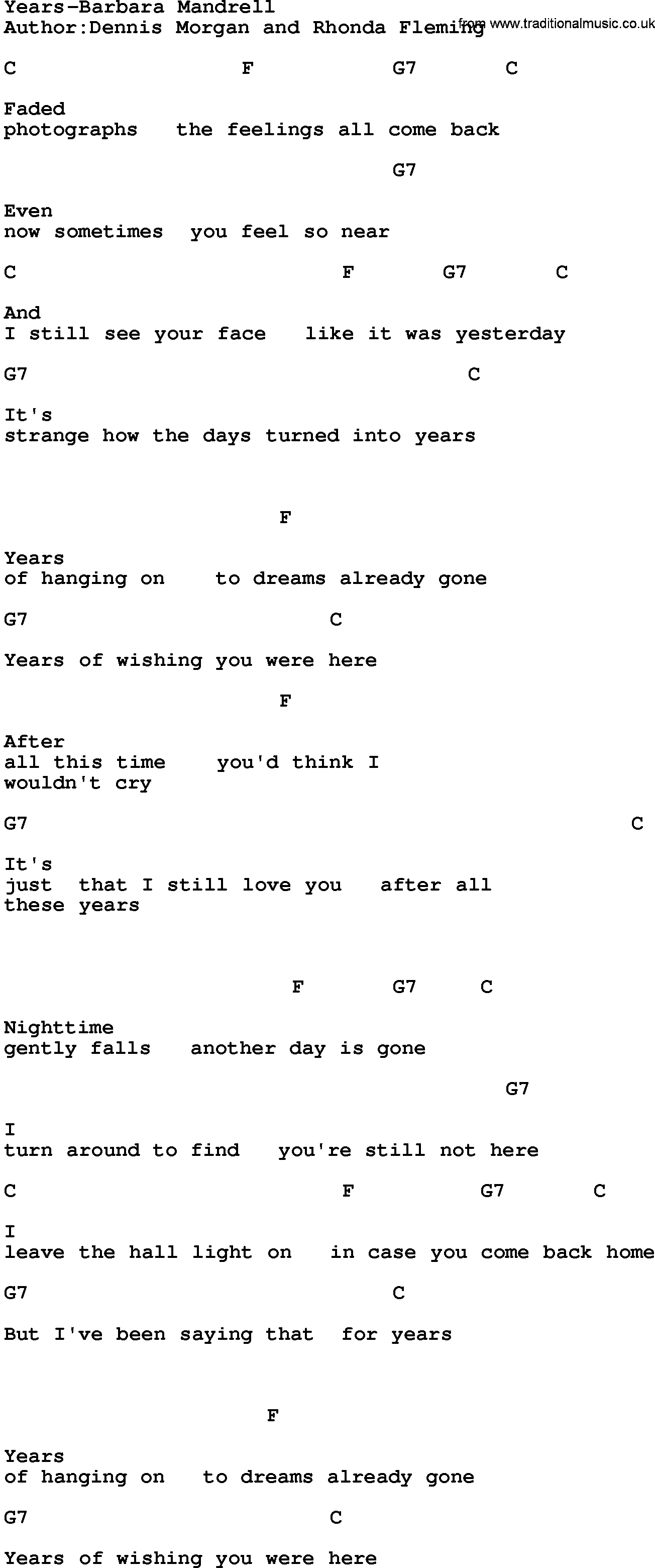
Honestly, the lyrics are pretty simple on the surface. It’s a retrospective look at a relationship. But there's a weight to it. When she sings about the "years" piling up, it doesn't feel like a celebration. It feels like an admission.
Recording it wasn't just another day at the office. This was the lead single for her album Just for the Record. At this point in her career, Mandrell was under immense pressure. She was filming Barbara Mandrell and the Mandrell Sisters, touring like a madwoman, and trying to maintain her status as the "Sweetheart of Country Music." You can hear a bit of that exhaustion—or maybe just maturity—in the vocal take. It’s seasoned.
Why Years Hit #1 (And Stayed There)
Timing is everything in the music business. In 1980, the world was a bit of a mess. High inflation, the Iran Hostage Crisis, and a general sense of "where is the world going?" made nostalgic music extremely popular. Years by Barbara Mandrell tapped into that collective anxiety.
It hit the top of the Billboard Hot Country Songs chart on February 23, 1980. It stayed there for two weeks, but its impact lasted much longer. It wasn't just a country hit; it crossed over. People who didn't even like country music were humming the chorus.
- It wasn't too "hillbilly" for the city folk.
- The production used strings and a soft-rock beat.
- The lyrics were universal. Everyone has "years" they look back on.
Critics at the time were somewhat divided. Some thought it was too "pop," a criticism Barbara faced her entire career. But the fans didn't care. They saw a woman who was talented, hardworking, and singing something they actually felt. It's funny how critics often miss the emotional mark that the public hits instantly.
The Variety Show Connection
You can't talk about this song without talking about the NBC show. Barbara Mandrell and the Mandrell Sisters was a massive hit, drawing millions of viewers every week. This gave her a platform that almost no other country artist had at the time.
When she performed Years on the show, she didn't just stand behind a mic. She sold it. The lighting was always dramatic, the costumes were pure 80s glitz, and she often looked directly into the camera with this piercing gaze. It made the song feel personal to every single person sitting in their living room.
It’s kind of wild to think about now, but variety shows were the social media of 1980. If you performed a song on Saturday night to 40 million people, it was going to be a hit on Monday morning. Barbara was a master of that medium.
The Musicality of the Track
If you strip away the 80s reverb, the song is actually a masterclass in songwriting structure.
The verses build tension. They’re relatively low in her register, creating an intimate, almost whispered vibe. Then the chorus opens up. That’s where the "Mandrell Magic" happens. Her voice climbs, the orchestration swells, and the word "Years" is elongated to emphasize the passage of time. It’s a classic Nashville trick, but done with such precision that it doesn't feel manipulative. It feels earned.
The guitar work on the track is also worth noting. It’s subtle. It doesn't scream for attention, but it provides this steady, rhythmic pulse that keeps the song from becoming a "sappy" ballad. It has a groove. Not a dance groove, but a soulful one.
Longevity and Legacy
Why do we still care about a 45-year-old country song?
For starters, Barbara Mandrell's retirement in 1997 made her catalog feel more "precious." She didn't fade away; she chose to leave. This gave her hits a definitive end point, turning them into timestamps of an era. When you hear Years, you aren't just hearing a song; you're hearing the peak of the Nashville Sound's crossover era.
Also, the song has been covered, but nobody really "owns" it like she does. Other artists have tried to bring more grit or more modern production to it, but they usually lose the vulnerability. Barbara had this way of being a "superstar" while still sounding like she was telling you a secret over coffee.
Common Misconceptions About the Song
- It’s a breakup song: Not exactly. It’s more of a "growing old together" or "looking back at a long-term love" song. It’s bittersweet, but not necessarily sad.
- It was her only #1: Far from it. She had six #1 hits on the country charts. But this one had the most "staying power" in terms of radio recurrents.
- She played the steel guitar on the record: While she was a virtuoso on the steel guitar, she didn't always play on her studio tracks. Session legends usually handled that to keep the "Nashville Sound" consistent, though she played it constantly during live sets and on TV.
What Most People Get Wrong
People often lump Barbara Mandrell in with the "easy listening" crowd of the era. That’s a mistake. If you listen to the vocal runs in Years, there’s a lot of R&B influence in there. She grew up idolizing soul singers, and you can hear that in the way she bends notes.
She wasn't just a "country" singer. She was a stylist.
The industry tried to box her in, but Years proved she could handle a sophisticated adult contemporary arrangement just as well as any pop star in Los Angeles or New York. It was a defiant record in its own quiet way. It said, "I can be glamorous, I can be technical, and I can still make you cry."
How to Appreciate "Years" Today
If you’re coming to this song for the first time, or maybe haven't heard it since a car ride in 1985, listen to it on a good pair of headphones. Ignore the dated synth pads for a second and just focus on the phrasing.
Notice how she handles the bridge. Notice the way the drums stay behind the beat. It’s a very "patient" record. It doesn't rush to get to the hook. It respects the listener enough to let the story unfold.
For those looking to dive deeper into Barbara Mandrell’s work beyond this hit, check out:
- I Was Country When Country Wasn't Cool: The ultimate "identity" anthem.
- Sleeping Single in a Double Bed: For a masterclass in 80s hooks.
- The Midnight Oil: For her earlier, darker, more traditional country sound.
Actionable Insight for Music Fans:
If you’re building a classic country or "yacht country" playlist, Years is your anchor. It bridges the gap between the 70s story-song and the 80s production powerhouse. To truly understand the evolution of female vocalists in Nashville, you have to study Mandrell's 1979-1981 period. It was the blueprint for everyone from Reba to Carrie Underwood.
The next step is simple. Go find the original 1980 studio recording—not a later "re-recorded" hits version—and listen to that final fade-out. It captures a moment in music history where everything just clicked.



