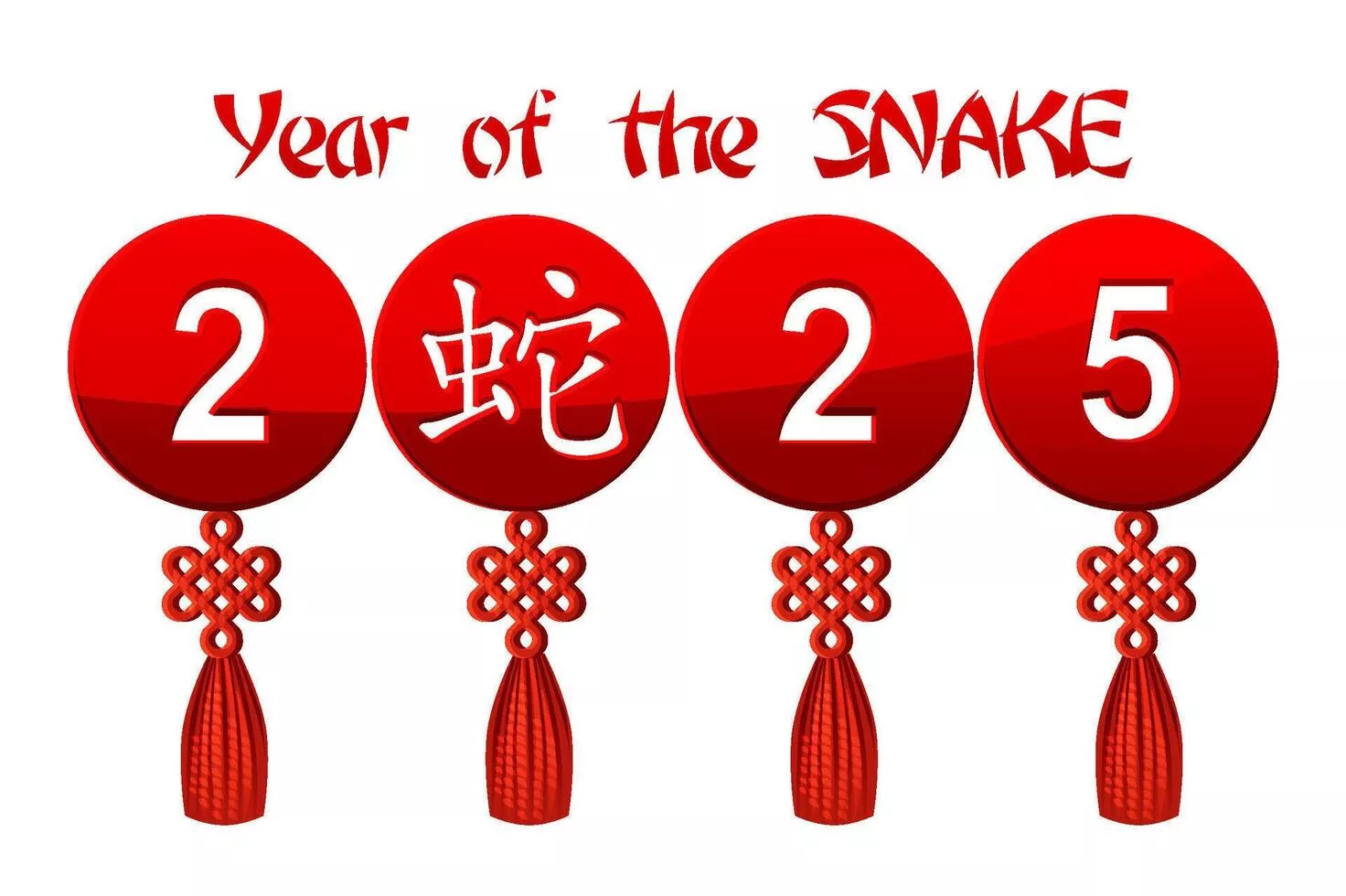
Everyone is looking for them right now. You’ve seen the generic red backgrounds and the gold-foil reptiles on every social media feed from Beijing to New York. It’s 2025. The Wood Snake is officially here. But honestly, most of the year of the snake images you’re seeing online are actually kind of… wrong.
They’re often recycled from 2013. Or worse, they use the wrong elemental colors.
If you’re trying to find an image that actually respects the cultural nuance of the Lunar New Year, you can’t just grab the first green snake you see on a stock photo site. There is a massive difference between a "scary" snake and a "lucky" snake in Chinese iconography. One belongs in a horror movie; the other belongs on your red envelope (Hongbao).
The Wood Snake is unique. It’s not just any snake. It’s associated with the element of Wood and the color green, but that doesn't mean every green snake image works. It's about vitality. Growth. The "bending" nature of a willow tree.
Why Most Year of the Snake Images Fail the Vibe Check
Most people just search for "snake" and call it a day. Huge mistake.
In Chinese culture, the snake is often called the "Little Dragon." It's supposed to be elegant. It's supposed to be wise. When you're looking at year of the snake images, if the snake looks aggressive or has its fangs out, it’s a cultural "no." That’s not what the New Year is about. The New Year is about welcoming luck, not scaring away your grandmother.
Designers often forget the elemental cycle. Since 2025 is the Year of the Wood Snake, the visual language should lean into organic textures. Think jade. Think forest greens. Think of patterns that look like vine growth or intricate wood carvings.
If you see a bright red snake with fire coming out of its mouth, that’s a Fire Snake. That was 1977. It’ll be again in 2037. Using it now is sort of like wearing a "Happy 2020" shirt to a party in 2025. People might not say anything, but they’ll know something is off.
The Jade Factor and Traditional Aesthetics
Ancient Chinese art doesn't really do "realistic" snakes. It’s all about the "S" curve. This curve represents flow and flexibility. If the image you’re looking at is stiff or anatomically "perfect" in a biological sense, it’s probably not a traditional New Year image.
Look for "Ruyi" motifs. These are cloud-like or mushroom-like shapes that represent "as you wish." A lot of high-quality year of the snake images will weave the snake around a Ruyi scepter. This symbolizes that the snake is bringing you your heart's desires.
Also, check the scales. In high-end digital art and traditional paper cutting (Jianzhi), the scales aren't just scales. They are often replaced with plum blossoms or peonies. This is a deliberate design choice. It softens the animal. It turns a predator into a vessel for spring.
The Digital Shift: AI vs. Human Art in 2025
Let's be real: AI is everywhere. If you go to a stock site today, 90% of the year of the snake images are generated by Midjourney or DALL-E.
They look amazing at first glance. They’re shiny. They’re 8k. They’re cinematic. But look closer. AI has a really hard time with Chinese calligraphy. If there are characters in the background of your image, make sure they actually mean something. I’ve seen thousands of images where the "Fu" (Luck) character is upside down—which is actually a tradition, as "upside down" sounds like "arrived"—but AI often just turns it into gibberish lines that look like a doctor’s prescription.
Human artists like those featured in the South China Morning Post or independent creators on platforms like Behance are focusing more on the "Wood" aspect this year. They’re using muted earth tones. It’s a reaction against the oversaturated, neon-heavy designs of the last few years.
- Check the eyes: Traditional lucky snakes have gentle, almost human-like eyes.
- Watch the tongue: A flickering tongue is often seen as "gossipy" or "dishonest" in certain folk interpretations. Many auspicious images keep the mouth closed.
- The tail: It should be tucked or curled, never striking.
How to Actually Use These Images for Your Brand or Home
If you're a business owner, don't just slap a snake on a discount flyer. It’s tacky.
Instead, use the "Wood" element to your advantage. 2025 is about renewal. It’s about the slow, steady growth of a tree. Your year of the snake images should reflect that. Use textures like paper, silk, or wood grain.
For personal use, like wallpapers or social posts, people are gravitating toward "minimalist" snakes. A single gold line that traces the shape of a snake is much more "2025" than a busy, cluttered illustration. It’s about "less is more."
- Social Media: Vertical images with "negative space" at the top for text.
- Print: High-resolution vectors. Don't use JPEGs; they’ll look pixelated on a red envelope.
- Home Decor: Look for "paper-cut" style images. They have a timeless feel that doesn't look like a corporate ad.
Finding Authentic Sources
You’ve got to move beyond Google Images.
Try looking at museum archives like the Palace Museum in Beijing. They often release digital versions of ancient scrolls. These are the gold standard for year of the snake images. They have a patina and a history that a digital generator just can't mimic.
Also, look at the work of contemporary artists like Chen Fenwan, who is known for "modernizing" paper cutting. Her work with zodiac animals is incredible. It’s bold. It’s pink. It’s orange. It breaks the "red and gold" rule but stays true to the spirit of the craft.
The Psychology of the Snake in 2025
Why do we care so much about these images anyway?
It’s about identity. The snake is the most misunderstood sign in the zodiac. People hear "snake" and think of the Garden of Eden or something "sneaky." But in the East, the snake is the "protector of the home."
When you choose an image, you're choosing how you want your year to feel. Do you want it to feel aggressive and fast? Or do you want it to feel like the Wood Snake—thoughtful, flexible, and enduring?
The best year of the snake images aren't just pictures. They are intentions.
Common Pitfalls to Avoid
I’ve seen a lot of people accidentally use images of Cobras.
Unless you’re in a very specific regional context (like some parts of India or Southeast Asia where the Naga is worshipped), the Chinese Zodiac snake is typically modeled after a non-venomous grass snake or a generic "serpent." A King Cobra with a flared hood carries a very different energy. It’s intense. It’s a bit much for a "Happy New Year" message to your boss.
And please, avoid the "cartoon" snakes with hats. We’re better than that in 2025.
Actionable Steps for Finding the Perfect Image
If you want an image that actually stands out and respects the culture, follow this checklist.
First, identify your goal. Are you looking for "Auspicious Traditional" or "Modern Minimalist"? If it’s traditional, search for "Chinese paper cut snake 2025" or "Nianhua snake art." Nianhua is the traditional New Year woodblock printing style.
Second, check the color palette. Since it's the Wood Snake year, look for "Imperial Green" or "Jade" tones mixed with the traditional red. This shows you actually know what year it is.
Third, verify any text. If there is a "Kanji" or "Hanzi" character, use a translation app or ask a friend. Don't trust the AI-generated "squiggles."
Fourth, look for the "Little Dragon" aesthetic. The snake should look like it’s related to a dragon—long, elegant, and maybe even a bit mythical.
Lastly, consider the source. Support actual artists on sites like Etsy or Creative Market. They’re creating year of the snake images that have soul, which is exactly what the Wood Snake represents.
Go for something that feels alive. Avoid the static, boring stuff. 2025 is a year of bending and growing, so find an image that looks like it’s ready to move.



