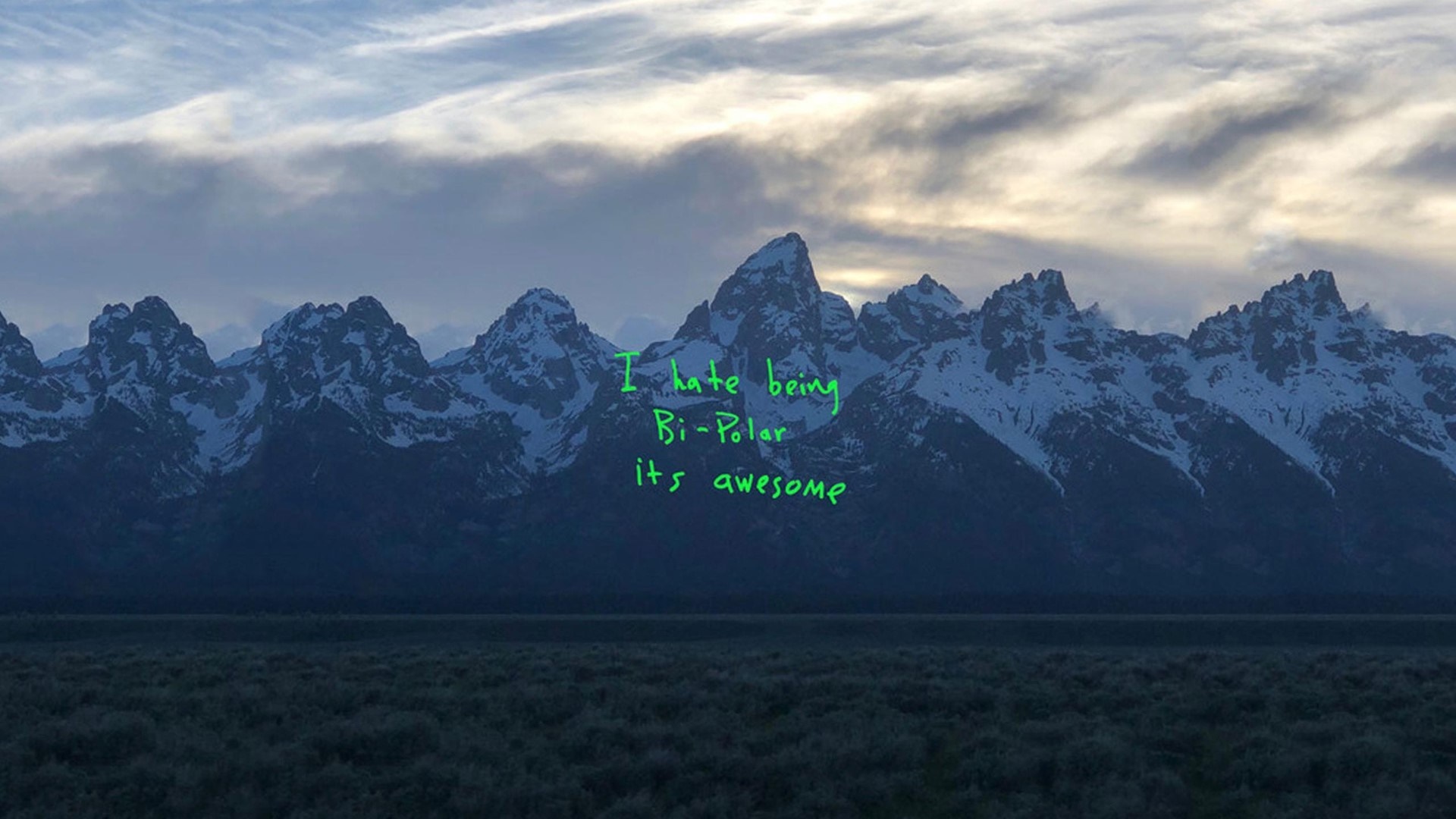
It was the summer of 2018. Kanye West—now legally known as Ye—was deep in a chaotic, creative frenzy in Jackson Hole, Wyoming. He wasn't just making music; he was orchestrating a cultural earthquake. When the i hate being bipolar its awesome album (officially titled Ye) finally dropped, it wasn't just the music people talked about. It was that cover. Green, handwritten text scrawled over a photo of the Teton Range.
People thought it was a mistake. Some thought it was a joke. It wasn't. It was the most public, raw declaration of mental health struggles we'd seen from a superstar of that caliber.
The Wyoming Sessions were a blur. Kanye was producing five albums back-to-back. He had Daytona for Pusha T, Nasir for Nas, and his own project. The Ye album was actually scrapped and rewritten in just two weeks following a disastrous, now-infamous interview at the TMZ offices. You remember the one. It was the "choice" comment. The world was ready to cancel him, and in response, he retreated to the mountains to write about the lightning storm inside his head.
The Story Behind the Cover Art
Most people don't realize how last-minute that cover actually was. Kim Kardashian later confirmed that Kanye took the photo of the mountains on his iPhone while they were on the way to the album’s listening party. He literally shot it, wrote the words "I hate being bi-polar its awesome" on it, and sent it to the label.
It was impulsive.
That’s the thing about the i hate being bipolar its awesome album—it embodies the very condition it describes. The font is shaky. The message is contradictory. It’s the definition of a "mixed state" in clinical terms, where you feel the crushing weight of depression and the electric high of mania at the same exact time.
Musically, the album is short. Only seven tracks. Barely 23 minutes. But in those 23 minutes, Ye covers more ground than most artists do in an hour-long double LP. He talks about his fears as a father on "Violent Crimes." He screams about his "superpower" on "Yikes." Honestly, it’s a lot to take in.
Why the "Superpower" Narrative is Controversial
On the track "Yikes," Kanye famously shouts, "That's my superpower, n****, ain't no disability! I'm a superhero! I'm a superhero!"
This became a massive talking point for mental health professionals. Dr. Janelle S. Peifer, a licensed psychologist, has noted in various discussions about celebrity mental health that framing a serious disorder like Bipolar Type I as a "superpower" is a double-edged sword. On one hand, it’s empowering. It removes the stigma of being "broken." On the other hand, it can romanticize a condition that causes real, tangible destruction in people's lives.
Kanye wasn't interested in a nuanced medical debate. He was interested in how it felt to him right then.
The Sound of the Wyoming Mountains
The production on the i hate being bipolar its awesome album is surprisingly stripped back compared to the maximalist sounds of My Beautiful Dark Twisted Fantasy. It’s crunchy. It’s soulful. It’s got these weird, haunting vocal samples that feel like they’re echoing off the canyon walls.
"I Thought About Killing You" starts the album with a long, spoken-word intro. It’s uncomfortable. He talks about premeditated murder—specifically killing himself and those he loves. It’s the kind of honesty that makes you want to look away, but you can’t. This isn't "Gold Digger" Kanye. This is a man who is clearly struggling to keep his feet on the ground.
- Ghost Town: This is arguably the masterpiece of the album. It features 070 Shake, Kid Cudi, and John Legend. It feels like a breakthrough.
- All Mine: A gritty, hyper-sexual track that feels like a sharp left turn from the heavy themes of the opening.
- Wouldn't Leave: A tribute to his wife at the time for sticking by him through the public outbursts.
The transition from "Ghost Town" to "Violent Crimes" is where the album really finds its soul. In "Ghost Town," 070 Shake sings about putting her hand on a stove to see if she still bleeds. It’s about numbness. Then "Violent Crimes" hits, and it’s a soft, piano-driven lullaby where Kanye worries about his daughters growing up in a world of predatory men.
The contrast is jarring. But life is jarring.
Is it Actually a Good Album?
Critics were split. Pitchfork gave it a 7.1, which is "good" but not the "classic" status usually afforded to West. Some felt it was rushed. Others felt it was his most honest work because it lacked the polish and "curation" of his earlier hits.
The truth is, the i hate being bipolar its awesome album isn't meant to be a polished pop record. It’s a diary entry. If you listen to it expecting The College Dropout, you’re going to be disappointed. If you listen to it as a document of a man experiencing a public mental health crisis in real-time, it’s fascinating.
The cultural impact, however, was undeniable. Search interest for "Bipolar Disorder" spiked after the album's release. People started having conversations about medication—Kanye mentions taking Lexapro and other meds on the record—and the reality of living with a mood disorder.
He called it "the sundown."
The Bipolar Stigma and Pop Culture
Kanye’s journey with his diagnosis didn't end with this album. In 2019, he sat down with David Letterman on My Next Guest Needs No Introduction and went even deeper. He described the "brain sprain" and how he feels when he's ramping up into an episode. He talked about the paranoia.
The i hate being bipolar its awesome album was the first time he really put those feelings into his art in a direct way. Before Ye, we saw flashes of it on The Life of Pablo, but Ye was the first time the diagnosis was the centerpiece.
It’s important to remember that Kanye’s experience isn't universal. Bipolar disorder manifests differently for everyone. While Kanye sees his mania as a creative engine, many others find it completely debilitating. The "I hate being bipolar its awesome" slogan perfectly captures that duality. It is both a gift of intense energy and a curse of intense instability.
Misconceptions About the Wyoming Era
A lot of people think Kanye went to Wyoming just for the scenery. In reality, it was a strategic move to get away from the "energy" of Los Angeles. He bought a massive ranch—Monster Lake Ranch—and set up shop.
He wasn't alone. He flew out dozens of artists, engineers, and writers. It was like a summer camp for the hip-hop elite. But despite all the people around him, the i hate being bipolar its awesome album feels incredibly lonely. Most of the guest features are tucked into the background or used as instruments rather than verses.
It’s Kanye talking to himself.
The album also marked a shift in his political identity, which alienated a huge portion of his fanbase. This tension is baked into the music. You can hear him grappling with the fact that people are angry at him, and his defense mechanism is to double down on his "superpower."
Actionable Insights for Fans and Listeners
If you're revisiting the album or discovering it for the first time, there are a few ways to really "get" what’s happening here. It’s more than just seven songs on a streaming service.
1. Listen to the "Wyoming Five" in Order To understand the headspace of the i hate being bipolar its awesome album, you have to hear the context. Listen to Pusha T's Daytona, then Ye, then Kids See Ghosts (his collab with Kid Cudi). You can hear the progression from cold, calculated street rap to personal chaos to spiritual healing.
2. Focus on the Samples Kanye’s sampling on this record is subtle but brilliant. He uses everything from Slick Rick to obscure 1970s soul. On "Ghost Town," he samples "Take Me for a Little While" by The Royal Jesters. It adds a layer of nostalgia and longing that the lyrics alone don't fully capture.
3. Read the Lyrics to "Violent Crimes" with a Grain of Salt Interestingly, it was later revealed that Pardison Fontaine wrote a significant portion of the lyrics for "Violent Crimes." This doesn't make the sentiment less real for Kanye, but it shows how he uses other writers as "architects" to help build the house of his thoughts.
4. Watch the Letterman Interview If you want to understand the "awesome/hate" dynamic, the David Letterman interview is essential viewing. It provides the medical and personal context that the album only hints at. It’s Kanye at his most articulate regarding his mental health.
5. Check Out the Merch History The merch for this era—bright neon hoodies with "Wyoming" and the "I hate being bipolar" text—became iconic streetwear. It turned a mental health struggle into a fashion statement, which is controversial but undeniably effective at keeping the conversation alive.
The i hate being bipolar its awesome album is a snapshot of a specific moment in time. It’s messy. It’s loud. It’s quiet. It’s brilliant. It’s frustrating. Just like the man who made it. Whether you love him or hate him, you can't deny that he turned his internal struggle into a piece of art that people are still dissecting years later. It’s not just an album; it’s a landmark in the history of celebrity, mental health, and the messy intersection of the two.



