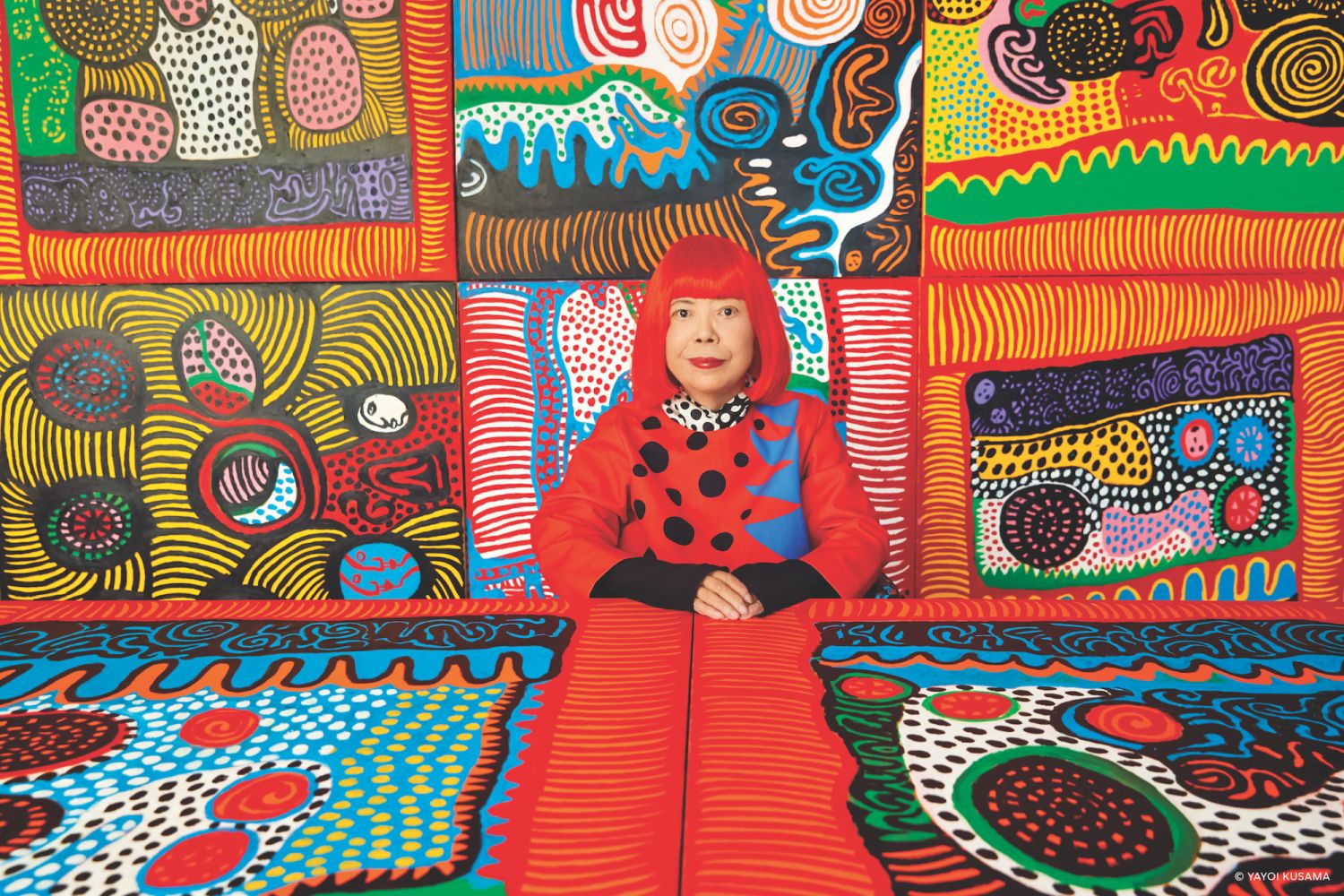
Ask anyone to name Yayoi Kusama most famous work, and they’ll probably shout "the pumpkins!" or maybe "those mirror rooms on Instagram!" They aren't wrong. Not exactly. But there’s a massive gap between the Kusama we see on social media—the colorful, whimsical "Princess of Polka Dots"—and the woman who literally paints to stay alive.
Honestly, the "fame" of her work is a bit of a double-edged sword. People wait in line for three hours at the Hirshhorn or The Broad just to get 60 seconds inside a mirrored box. They want the selfie. They want the aesthetic. But if you talk to Kusama herself, or read her 2003 autobiography Infinity Net, you realize these installations aren't meant to be "cute." They are tools for survival. Discover more on a similar subject: this related article.
The Infinity Mirror Rooms: Not Just a Photo Op
If we’re talking about cultural impact, the Infinity Mirror Rooms are easily her most famous creation. Specifically, Infinity Mirrored Room – The Souls of Millions of Light Years Away (2013).
It’s a dark chamber. LED lights hang from the ceiling, flickering in a rhythmic, pulse-like pattern. Mirrors cover every single surface. When you step inside, the floor disappears. You're floating. You’re everywhere and nowhere at the same time. Additional analysis by Rolling Stone delves into related perspectives on the subject.
Why she actually made them
Kusama didn't invent these for the digital age. The first one, Phalli’s Field, debuted back in 1965. She was living in a cold, gritty New York City, struggling to make a name for herself in a scene dominated by white men like Andy Warhol and Claes Oldenburg.
She was suffering.
The mirrors were a solution to a physical problem. She was exhausted from sewing thousands of "soft sculptures"—stuffed, phallic fabric tubers—by hand. By lining a room with mirrors, she could create a field of ten thousand sculptures while only having to make a few hundred.
It was a hack. A way to achieve "self-obliteration" without dying from exhaustion.
The Pumpkin Obsession
Then there are the pumpkins. You’ve seen the giant yellow one at Naoshima (the one that famously washed away in a typhoon in 2021 and had to be remade). Why pumpkins?
For Kusama, the pumpkin is a self-portrait.
- Childhood Roots: Her family owned a plant nursery in Matsumoto.
- The Hallucination: When she was a kid, a pumpkin literally started talking to her.
- The Vibe: She calls them "humble and amusing."
Most artists aim for the sublime or the terrifying. Kusama found peace in a squash. She spent a whole month once painting a single pumpkin, scrupulously detailing every tiny bump on its rind. She says they represent a "spiritual balance." To the rest of the world, they’re just high-end landmarks, but to her, they’re "generous unpretentiousness" in a world that is often cruel.
The "Infinity Nets" That Started It All
If you ask an art historian about Yayoi Kusama most famous work, they might point you away from the rooms and toward a canvas. The Infinity Nets.
These are massive paintings. We’re talking 33 feet long sometimes. They consist of nothing but tiny, interlocking loops of paint. No focal point. No beginning. No end.
In the late 50s, she would paint these for 50 hours straight. No food. No sleep. Just the repetitive motion of the wrist. It was a trance. She was trying to outrun the "curtain of depersonalization" that fell between her and reality.
Wait, what does that actually mean? Basically, Kusama sees the world differently. Since age ten, she’s had hallucinations where patterns—dots, nets, or flowers—spread from objects onto her own body. The Infinity Nets were her way of taking that terrifying vision and pinning it to a wall. If she could put the net on the canvas, maybe it would stop smothering her.
What People Get Wrong About the Dots
"The Polka Dot Queen." It sounds like a brand. Like something you’d see on a Louis Vuitton bag (which, to be fair, you definitely have).
But the dots aren't decorative.
In her 1968 performance Self-Obliteration by Dots, she didn't just paint dots on walls; she painted them on horses, on the ground, and on naked people. The goal? To make the individual disappear.
"Our earth is only one polka dot among a million stars in the cosmos," she once said.
When you cover yourself in dots, you aren't standing out. You’re blending in. You're becoming part of the "unity of our environment." It’s actually a very ego-less way of looking at the world, which is ironic considering she is now one of the most recognizable faces in art.
The Reality of Her Life in 2026
It’s 2026, and Kusama is 96 years old. She still lives, by choice, in the Seiwa Hospital for the Mentally Ill in Tokyo. She’s been there since 1977.
Every morning, she walks across the street to her studio. She paints. She works on her ongoing series, My Eternal Soul. She’s still fighting the same "flashes of light" and "auras" she saw as a child.
There’s a massive retrospective touring Europe right now—moving from Museum Ludwig in Cologne to the Stedelijk Museum in Amsterdam later this year. People will flock to it. They’ll stand in the Chandelier of Grief or The Souls of Millions of Light Years Away.
They’ll take the photo.
But the real "work" isn't the photo. It’s the fact that she’s still here, still painting, still turning a "disability" (her words, not mine) into a bridge for the rest of us to walk across.
How to actually experience her work
If you’re planning to see a Kusama exhibit, don't just look through your phone lens. Try this instead:
- Read the labels: Look for the dates. Notice how her "obsessions" haven't changed in 70 years.
- Focus on the texture: In the Infinity Nets, look at the "impasto" (the thickness of the paint). You can see the physical toll of the repetition.
- Practice "Self-Obliteration": When you’re in a mirror room, try to find where "you" end and the reflection begins. It’s harder than it looks.
- Check the 2026 Schedule: If you're in Europe, the Amsterdam show at the Stedelijk starts September 11, 2026. Book tickets months in advance; they always sell out.
Her art is a lifeline. Use it like one. Don't just look at the dots—try to feel the silence behind them.



