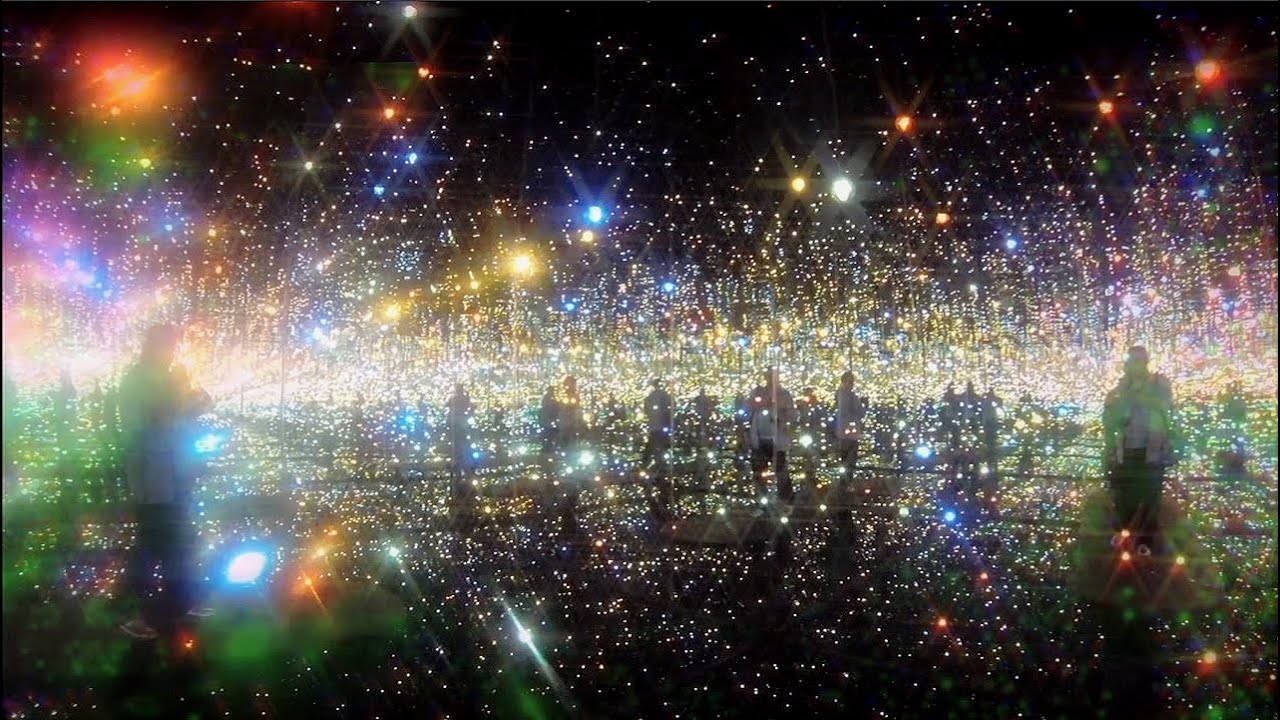
You’ve seen the photos. Honestly, everyone has. A tiny figure standing in a vast, twinkling galaxy of hanging LED lights, or surrounded by a field of polka-dotted pumpkins that seem to stretch into the next century. It’s the ultimate Instagram trophy. But if you think a Yayoi Kusama mirror room is just a high-end photo booth designed for social media, you’re missing the actual point of the art.
Kusama didn't start making these in the age of the smartphone. Not even close. She’s been building these "Infinity Rooms" since 1965.
Back then, there were no filters. No likes. Just a woman in New York City trying to manage intense hallucinations by turning them into something she could touch—and eventually, something we could walk inside. When you step into one of these rooms today, you aren't just entering a cool space. You're entering a coping mechanism.
The Secret History of the Yayoi Kusama Mirror Room
Most people assume these rooms were an overnight sensation. They weren't.
Kusama’s first mirrored installation, Infinity Mirror Room—Phalli’s Field, debuted in November 1965 at the Castellane Gallery in New York. It was weird. It was radical. Instead of just painting dots on a canvas, she used mirrors to multiply hundreds of red-spotted, fabric-stuffed "phallic" shapes.
Why? Because she was physically exhausted.
She had been sewing these soft sculptures by hand for years. It was grueling work. She realized that by using mirrors, she could create the illusion of thousands of objects without having to sew every single one. It was a breakthrough of efficiency, sure, but it also allowed her to achieve what she calls "self-obliteration."
Basically, she wanted to disappear into her art.
In 1966, she followed up with Peep Show (also known as Endless Love Show). This one was different. You didn't walk in; you looked through a small window. It used a hexagonal mirror setup and flashing colored lights. It felt like a psychedelic machine.
Then, she almost vanished from the Western art world for decades.
Kusama returned to Japan in the 1970s and eventually checked herself into a psychiatric hospital in Tokyo, where she has lived by choice since 1977. The world sort of forgot about her until the late 80s and 90s. When she represented Japan at the 1993 Venice Biennale with a room full of yellow pumpkins, the "Kusama-mania" we know today finally started to simmer.
Why Do They All Have Different Names?
Not every room is the same. Far from it.
Kusama has created more than 20 unique variations over the years. Some are filled with water, some with glowing lanterns, and others with giant pink balloons.
- The Souls of Millions of Light Years Away (2013): This is the one you probably see on your feed the most. It’s at The Broad in LA. It uses hanging LEDs and a shallow pool of water to make you feel like you’re floating in deep space.
- Aftermath of Obliteration of Eternity (2009): This one uses golden lanterns. It’s inspired by the Japanese toro nagashi ceremony, where lanterns are floated down a river to guide ancestral spirits. It’s much more somber and quiet than the others.
- Love is Calling (2013): Think giant, neon, tentacle-like inflatable sculptures covered in dots. It’s colorful, loud, and features a recording of Kusama reciting a poem about love in Japanese.
- Let’s Survive Forever (2017): This one features stainless steel silver orbs. It’s a bit more industrial-feeling, with a mirrored column in the center that creates a "room within a room" effect.
Where to Find a Yayoi Kusama Mirror Room in 2026
Finding these rooms requires some serious planning. You can’t just walk in off the street. Most museums use a strict timed-entry system, and tickets often sell out months in advance.
As of early 2026, there are several major spots where you can still catch them.
The Stedelijk Museum in Amsterdam is currently running a massive retrospective that opened in late 2025 and goes until January 17, 2027. If you’re in Europe, that’s your best bet. They have a huge range of her work, from early drawings to the major immersive installations.
In the US, The Broad in Los Angeles remains the "home base" for many fans. They have The Souls of Millions of Light Years Away as a permanent fixture. Crystal Bridges Museum of American Art in Arkansas is also expected to bring My Heart is Dancing into the Universe back on view in 2026 after their gallery expansions.
If you are in Toronto, the Art Gallery of Ontario (AGO) has Let’s Survive Forever on view through at least October 2026.
Honestly? Check the museum's website at 10:00 AM on the day tickets drop. Usually, it's the last Wednesday of the month. If you miss that window, you’re basically looking at the resale market, which most museums (like the SFMOMA) strictly forbid. They check IDs. Don't get scammed.
The "60-Second" Rule is Real
Here is the part no one tells you: you only get about 45 to 60 seconds inside.
It sounds like a joke. You wait in line for three hours, and then a museum attendant literally sets a timer.
It’s brutal.
But it’s necessary. Because the rooms are tiny—usually only accommodating four people at a time—the math just doesn't work otherwise. If everyone stayed for five minutes, the line would stretch to the next city.
This creates a weird tension. Do you take a photo? Or do you just stand there and look?
Most people spend the first 40 seconds trying to get the lighting right on their phone. Then the door opens, and it’s over. My advice? Take one quick shot, then put the phone in your pocket. The scale of the "infinity" doesn't actually hit you until you stop looking at the screen.
Dealing with the "Instagram Trap" Reputation
Is it just for the 'gram?
Art critics have been fighting about this for a decade. Some call it "experience art" or "theme park aesthetics." They argue that the meaning is lost because people are too busy posing.
But that’s a bit elitist, isn't it?
Kusama has always wanted her art to be participatory. She wants you to be part of the work. When you see your own reflection repeated a thousand times, you are the art. You are becoming "obliterated" into the patterns, just like she described in her autobiography, Infinity Net.
The rooms deal with heavy themes: mental health, the fear of death, and the vastness of the universe. The fact that they happen to look good in a square crop is sort of a side effect of Kusama's obsession with repetition. She’s been doing the same dots since the 1950s. She didn't change her style for the iPhone; the world just finally caught up to her vision.
Safety and Accessibility
One thing to keep in mind is that these rooms can be intense.
They are dark. They have flashing lights. They use mirrors on the floors (though many now have walkways). If you have vertigo or a history of seizures triggered by light, you might want to skip certain ones like The Souls of Millions of Light Years Away.
Also, most of these rooms have very narrow entrances. For example, at the SFMOMA, the entry for Dreaming of Earth’s Sphericity is a low, rounded doorway. It’s about 46 inches high at the midpoint. They are wheelchair accessible, but it can be a tight squeeze for larger motorized scooters.
Actionable Tips for Your Visit
If you’re serious about seeing a Yayoi Kusama mirror room without losing your mind, follow these steps:
- Join the Museum Membership: This is the ultimate "cheat code." Members usually get first dibs on tickets before the general public. At the AGO or The Broad, this can save you from a "Sold Out" screen.
- Dress for the Floor: Many rooms have mirrored floors. If you’re wearing a skirt or dress, you might feel a bit exposed. Wear pants or leggings, or check if the museum provides "booties" to cover your shoes.
- The "Two-Visit" Strategy: If you can, try to go twice. The first time is for the photos. Get it out of your system. The second time, leave the phone in the locker. You’ll actually notice the silence and the way the lights pulse.
- Check for Standby: Some museums, like SFMOMA, have a first-come, first-served line for same-day visitors if a ticket holder doesn't show up. It’s a gamble, but it works on weekdays.
- Go Early: This isn't just about the lines. The mirrors are cleaner in the morning. By 4:00 PM, a thousand people have breathed on the glass and stepped on the floor. The "infinity" looks a lot better without smudges.
Ultimately, Kusama’s work is about the tiny place we occupy in a massive, never-ending universe. Whether you're there for the philosophy or the profile picture, the experience of losing your boundaries—even for just 60 seconds—is something that sticks with you long after the door opens.



