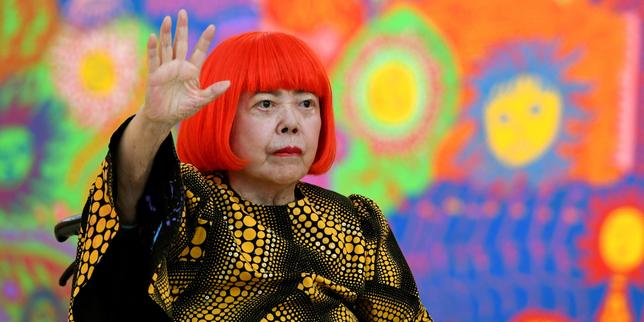
Japanese avant-garde icon Yayoi Kusama died at a Tokyo hospital at the age of ninety-seven, leaving behind an artistic empire built on infinity mirrors, giant pumpkins, and an unyielding psychological compulsion. Her death closes a chapter on an eight-decade career that bridged post-war isolation in rural Nagano with the hyper-commercialized Instagram era. Yet the breathless tributes masking her passing as a neat, triumphant Hollywood arc miss the jagged, uncomfortable reality of her survival. Kusama did not merely conquer the global art market; she weaponized her own psychological torment into a brand of mass hypnotic consumption that outlived her contemporaries and baffled traditional critics.
Born in Matsumoto in 1929, Kusama's artistic genesis was rooted in terror rather than bohemian romance. Long before her Infinity Mirror Rooms became mandatory backdrops for smartphone-wielding crowds, those flashing lights and repeating polka dots were coping mechanisms for debilitating childhood hallucinations. She described seeing the world obscured by dense fields of spots and flashes of light. While her family expected her to marry domestically, she packed sixty silk kimonos filled with sketches and fled to New York in 1957. Expanding on this idea, you can find more in: Dolly Parton Media Expansion Economics and Legacy Valuation.
New York was not waiting for her. Abstract Expressionism dominated the gallery circuit with muscular masculine gestures, while Kusama offered obsessive, flat repetition. She starved in a freezing Manhattan loft with broken windows, painting massive Infinity Nets that spanned entire walls. Her ambition was staggering, matching—and occasionally predating—the innovations of figures like Andy Warhol and Claes Oldenburg. Yet while her male peers reaped institutional validation and immense wealth in real-time, Kusama found her ideas quietly absorbed by others while she scraped by. Famously, when Warhol debuted his cow-wallpaper installation, Kusama recognized her own strategies from her preceding New York exhibitions, plunging her into a despair that culminated in a suicide attempt from her studio window.
The history of avant-garde art is littered with brilliant casualties who faded into obscurity, but Kusama engineered a calculated, relentless second act. Frustrated by the margins of the art establishment, she pivoted to public performance art in the late 1960s. She organized anti-war "happenings", painting polka dots onto naked participants in front of the New York Stock Exchange and the Statue of Liberty. She wrote letters to Richard Nixon offering illicit favors in exchange for a ceasefire. These spectacles guaranteed media oxygen, turning her body into a provocative political canvas. Observers at GQ have provided expertise on this matter.
Yet the physical and mental toll accumulated rapidly. By 1973, depleted and deeply distressed, she returned to Japan. Four years later, she voluntarily checked herself into a Tokyo psychiatric facility, where she maintained a permanent residence for the remainder of her life. She established a routine that split her existence between clinical supervision and a nearby dedicated studio, painting daily until her final weeks. From this sequestered environment, she orchestrated her eventual global resurrection.
The art world's institutional memory is notoriously fickle, but globalization and digital media breathed hyper-inflationary life into her catalog. In 1993, she represented Japan at the Venice Biennale, transforming a pavilion into a mirrored room filled with polka-dot pumpkins. That installation shattered traditional boundaries between viewer and object. Visitors were no longer passive spectators standing behind velvet ropes; they were active participants stepping directly inside the artist's private delusions.
Museum directors realized that Kusama's immersive environments were tailor-made for public appetite. Blockbuster queues wrapped around major institutions from London to New York, transforming ticket sales into record-breaking cultural events. Market values followed suit. A single early painting fetched millions at auction, placing her among the highest-earning living female artists in history. Commercial partnerships with global luxury houses like Louis Vuitton brought her signature dots to handbags, ready-to-wear lines, and automated humanoid window displays.
This mass commercialization exposed deep fault lines in her legacy. Critics occasionally questioned whether the endless replication of polka dots had devolved into theme-park spectacle, stripping her early radicalism of its teeth. Furthermore, long-overdue scrutiny arose regarding offensive language present in some of her historical autobiographical writings, forcing cultural institutions to reckon with the complex flaws of an idolized figure. Kusama later issued statements expressing deep regret for hurtful phrasing, a reminder that visionary genius rarely exists in a moral vacuum.
Despite these controversies, her work retained a hypnotic gravitational pull because the underlying engine remained authentic to her trauma. She did not manufacture dots as a trendy aesthetic choice; she painted them to stay alive. When visitors stepped into her mirrored chambers, gazing into infinite reflections of light and color, they were engaging with a physical manifestation of a psychiatric survival strategy.
Her passing leaves a vacuum in contemporary culture that cannot easily be filled by market substitutes. The multi-million-dollar auction results and corporate brand collaborations will undoubtedly continue, managed by her estate and foundation. Yet the core of her power was never the commercial machinery. It was the absolute, unyielding courage of a solitary woman in a psychiatric ward who picked up a brush every morning to stare down her own demons, turning an infinite void into a universal language.