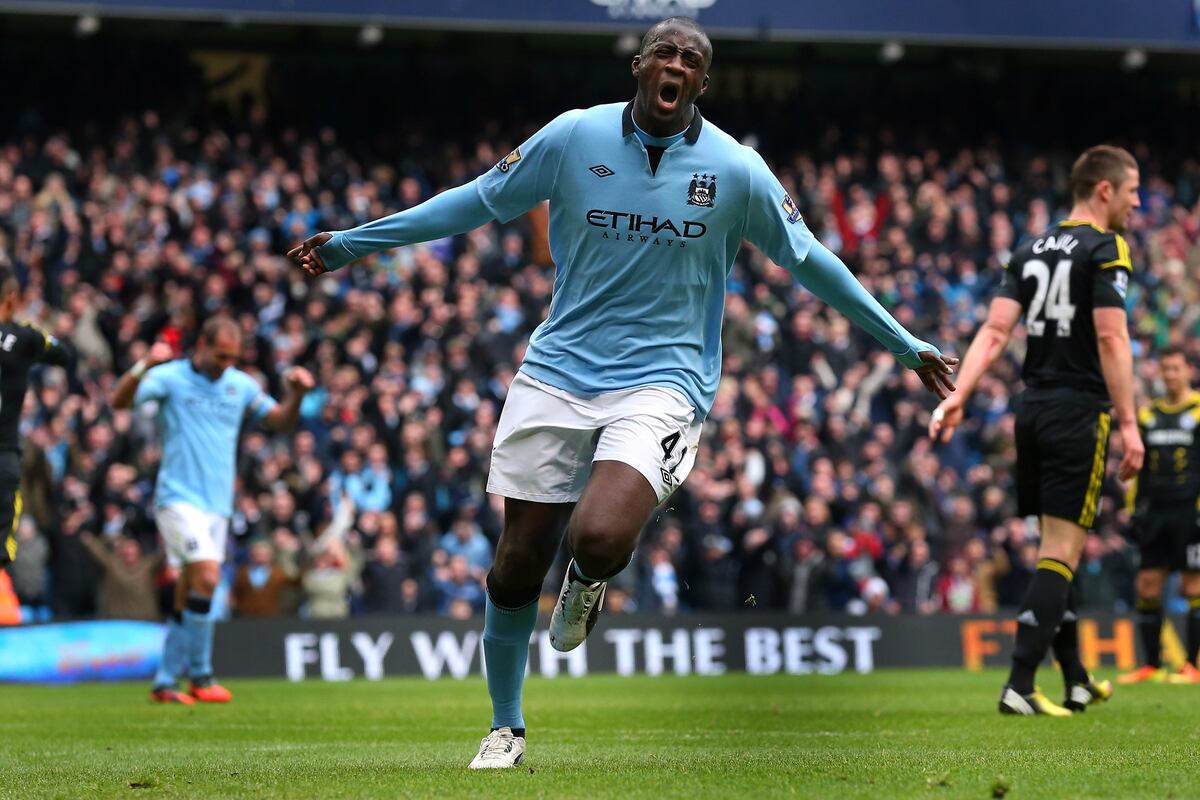
When people talk about the modern Manchester City, they usually start with Erling Haaland’s absurd goal tallies or the tactical geometry of Pep Guardiola. Maybe they mention Kevin De Bruyne’s vision. But honestly? None of that happens without Yaya Toure. He was the physical manifestation of City’s transition from "noisy neighbors" to a global superpower.
He didn't just play in the midfield; he owned the air around it.
Yet, for some reason, the conversation around him usually devolves into jokes about birthday cakes or his public spats with Guardiola. It’s a bit of a shame. When you look at the raw impact he had between 2010 and 2018, you’re looking at arguably the most dominant individual peak of any midfielder in Premier League history.
The 2013-14 Season: A Midfielder Scoring 20 Goals?
Let’s talk about that 2013-14 campaign. It was stupid. I mean that in the best way possible.
Usually, if a midfielder scores 10 goals in a season, everyone says they had a "great attacking year." Yaya Toure scored 20 in the Premier League alone. In 35 games. From central midfield.
To put that in perspective, he was outscoring world-class strikers. It wasn’t just the volume of goals, either; it was the variety. He was 6'3" and built like a middleweight boxer, yet he was whipping in free-kicks with the delicacy of a 5-foot-nothing playmaker.
I remember watching him pick up the ball in his own half against Aston Villa or Fulham. He’d start that galloping run. You know the one. His strides were so long it looked like he was moving in slow motion, but defenders were literally bouncing off him. He’d carry the ball 50 yards and then just side-foot it into the top corner like he was bored.
That season, he wasn't just City's best player; he was the best player in the country, even if Luis Suarez took the official awards. Toure was the one who dragged City across the finish line when the title race got tight.
What Really Happened With the Birthday Cake
You can’t write about Yaya Toure at Manchester City without the cake. It’s basically a law.
In 2014, his agent, Dimitri Seluk, went on a media rampage claiming the club didn't show Yaya enough respect because they didn't properly celebrate his 31st birthday. The "evidence" was that they didn't shake his hand or give him a proper cake. It sounded petty. It sounded like a spoiled superstar looking for an exit.
But Yaya's perspective years later was a bit more nuanced. He admitted it was a "bad mistake" to back his agent's comments on Twitter. In an interview with The Times, he mentioned how much that incident damaged his relationship with the fans. He felt it made people see him as an ego-maniac rather than the guy who had just scored the winning goals in the 2011 FA Cup semi-final and final.
The reality? It was likely a clumsy attempt by his representative to leverage a better contract or show dissatisfaction with the hierarchy. Unfortunately, it became the defining meme of his career.
The Guardiola Paradox
The relationship with Pep is another layer of the Yaya story that most people simplify too much.
- Pep sold him at Barcelona to make room for Sergio Busquets.
- Pep then arrived at City and eventually froze him out again.
- Yaya accused Pep of having "problems with Africans," a claim he later expressed regret over.
It was a clash of philosophies. Guardiola wants "obedient" players who fit into a rigid system. Yaya was a maverick. He was a force of nature who thrived on freedom. When Manuel Pellegrini was in charge, Yaya had a "defending is optional" license because his attacking output was so high. Under Pep, that wasn't going to fly.
Still, even at 33, when Pep finally brought him back into the fold after a public apology in 2016, Yaya was still often the most composed player on the pitch. He adapted. He played deeper. He showed he had the "football brain" to match the "beast" physique everyone obsessed over.
Why He’s the Ultimate Big-Game Player
If you need a goal to save your life in a final, you pick Yaya.
Look at the 2011 FA Cup. That was the trophy that broke City’s 35-year drought. Who scored the winner in the semi-final against Manchester United? Yaya. Who scored the winner in the final against Stoke? Yaya.
Then you’ve got the 2014 League Cup final against Sunderland. City are 1-0 down and looking sluggish. Yaya hits a first-time lob from about 30 yards out. It wasn't even a blast; he just guided it into the far corner. Game changed.
He had this "aura" where he could decide a match whenever he felt like it. Most players are lucky to have one "signature" moment at a club. Yaya has a highlight reel of about fifteen, most of them coming when the pressure was at its absolute peak.
The Complexity of His Legacy
Is he the greatest City player ever? Before the era of De Bruyne and David Silva, he was the undisputed answer for many.
The weird thing is, because of the way it ended—the lack of playing time in his final year, the comments about Pep—his exit felt a bit muted. But if you look at the stats, they're undeniable.
- 316 appearances
- 82 goals
- 3 Premier League titles
- 1 FA Cup
- 2 League Cups
He changed the profile of what a Premier League midfielder could be. Before Yaya, you were either a "destroyer" (like Roy Keane) or a "creator" (like Paul Scholes). Yaya was both. Simultaneously.
Actionable Insights for Football Students
If you’re a coach or a young player looking at Yaya Toure’s time at City, here is what you actually need to study:
- The "Gallop" Technique: Notice how he used his arms to shield the ball while running. It wasn't just speed; it was using his frame as a literal barrier between the ball and the defender.
- Scanning: Watch his head in his peak years. He knew exactly where the space was before he received the ball, allowing him to turn and drive in one motion.
- Set Piece Variety: He didn't just hit power shots. He learned to "clip" the ball over walls, proving that physical players can have elite technical finesse.
Next time you see a highlight of a Manchester City goal from the early 2010s, look for the #42 shirt. Chances are, he started the move, finished it, or bullied three people in the process of making it happen. The cake might have been a lie, but the talent was the realest thing the Etihad has ever seen.