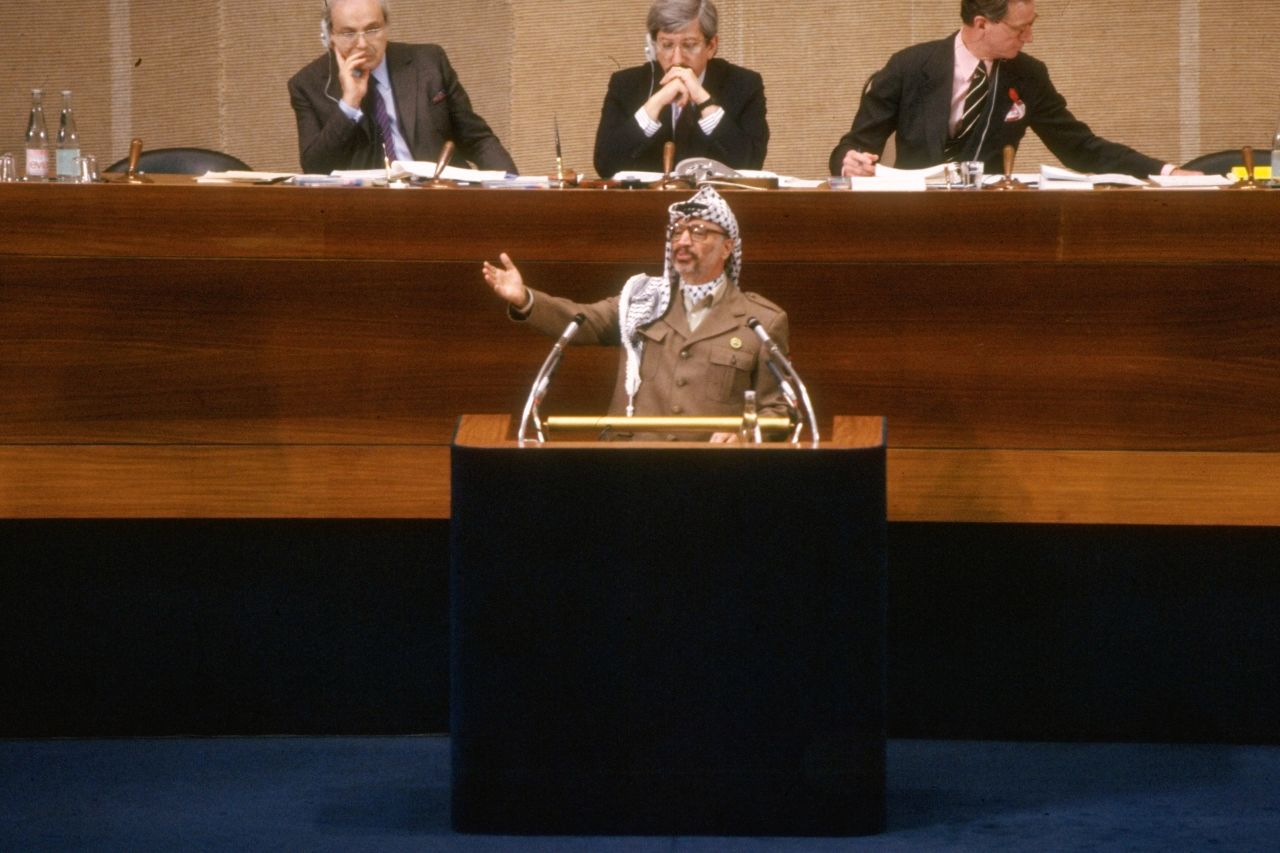
It’s one of the most scorched-in images of 20th-century diplomacy. November 13, 1974. A man in a checkered keffiyeh and a sand-colored windbreaker stands behind the marble rostrum of the United Nations General Assembly. He looks like a soldier, not a suit-and-tie politician. But it wasn't just the clothes that set the world on fire. It was the holster.
The Yasser Arafat UN speech with gun (or the holster of one) became an instant Rorschach test for the Middle East. To some, he was a revolutionary hero offering peace. To others, he was a "terrorist" bringing a weapon into a house of diplomacy. Honestly, even fifty years later, people still argue about whether that holster was empty or loaded.
The Day the PLO Took the World Stage
Before 1974, the United Nations was basically a club for sovereign states. Non-state actors didn't get invited to speak at the General Assembly. But the world was shifting. Decolonization was in full swing. Asian and African nations were gaining power, and they weren't exactly fans of the status quo.
Arafat’s invitation was a massive blow to Israel. At the time, the U.S. and Israel viewed the Palestine Liberation Organization (PLO) as nothing more than a violent group. Just a year earlier, the 1973 Yom Kippur War had ended, and tensions were at a breaking point. Then, suddenly, the "arch-terrorist" is landing on the North Lawn of the UN in a helicopter.
He didn't come in a limo. He came in a bird.
Because of death threats, Arafat actually spent the night in the UN Chief’s office. Security was insane. When he finally walked into the hall, the room was electric. Half the delegates gave him a standing ovation; the Israeli seats were pointedly empty.
What Was Really in That Holster?
This is where the history gets kinda fuzzy. You’ll see old photos of Arafat with a clear brown leather holster strapped to his hip. In the hallowed halls of the UN, where weapons are strictly forbidden, this was a massive "f-you" to protocol.
Here is the reality behind the "gun":
- The Claim: Arafat supposedly had his personal pistol on him throughout the speech.
- The Aide’s Defense: His staff insisted the holster was empty. They claimed it was a symbolic part of his uniform.
- The Security Report: Some reports suggest UN security actually asked him to remove the pistol before he stepped onto the rostrum.
Basically, it depends on who you ask. The Yasser Arafat Museum in Ramallah actually displays his personal pistol and holster, claiming it's the one that "raised controversy" during the UN appearance. Whether he was actually "strapped" while speaking or just wearing the leather shell, the message was sent. He wasn't there as a supplicant. He was there as a fighter.
"Do Not Let the Olive Branch Fall"
The climax of the speech is the part everyone remembers. It’s the quote that defined Palestinian diplomacy for decades.
"Today I have come bearing an olive branch and a freedom fighter's gun. Do not let the olive branch fall from my hand."
He said it three times. His finger was raised. He sounded urgent.
What's fascinating is that the speech wasn't just about fighting. It was about a vision for a "one democratic state" where Jews, Christians, and Muslims could live together. Of course, to the Israeli government, this was just code for the destruction of the State of Israel. They saw the "freedom fighter’s gun" as a literal threat, not a metaphor for resistance.
Why the 1974 Speech Still Matters in 2026
You can’t understand the current state of the Middle East without looking back at this moment. It was the "moon landing" for the Palestinian national movement. It turned a refugee problem into a political problem.
Before this, the world mostly talked about Palestinians as "displaced persons" needing aid. After Arafat walked in with that holster, the UN recognized the PLO as the "sole legitimate representative" of the Palestinian people. It gave them observer status. It made them a player on the board.
The contradictions were everywhere:
- He talked about peace but wore a military uniform.
- He spoke of democracy but was leading an armed struggle.
- He was a pariah in Washington but a hero in the Global South.
It set a pattern for Arafat’s entire life—a man who could win a Nobel Peace Prize in 1994 while never fully abandoning the image of the revolutionary.
Actionable Insights: How to Fact-Check Historical Speeches
History is often rewritten by the winners (and the losers with good PR). If you're researching the Yasser Arafat UN speech with gun, don't just look at one side.
- Check the Verbatim Records: The UN archives have the full transcript. Read the whole 80 minutes, not just the "olive branch" clip. You’ll find he talked a lot about things like the Soviet Union and African liberation movements, which are often edited out today.
- Look at the Visual Evidence: Analyze the 1974 footage. You can see his "boxer’s victory stance" at the end. Note the reactions of the crowd. It tells you more about the power dynamics of the time than any textbook.
- Cross-Reference Memoirs: Read the accounts from people like Nabil Shaath (who helped write the speech) alongside memoirs from Israeli diplomats of the era. The truth usually sits somewhere in the uncomfortable middle.
If you want to understand the modern-day rhetoric at the UN, you have to look at the day a man with a holster changed the rules of the game. It wasn't just a speech; it was a performance that shifted the tectonic plates of global politics.
Next Steps for Research:
- Review the UN General Assembly Resolution 3236, which was passed shortly after this speech. It formally recognized the Palestinian right to self-determination.
- Compare this to Arafat’s 1988 Geneva speech, where he finally renounced terrorism and recognized Israel's right to exist. The shift from the "gun" to the "diplomat" took 14 years of blood and politics.