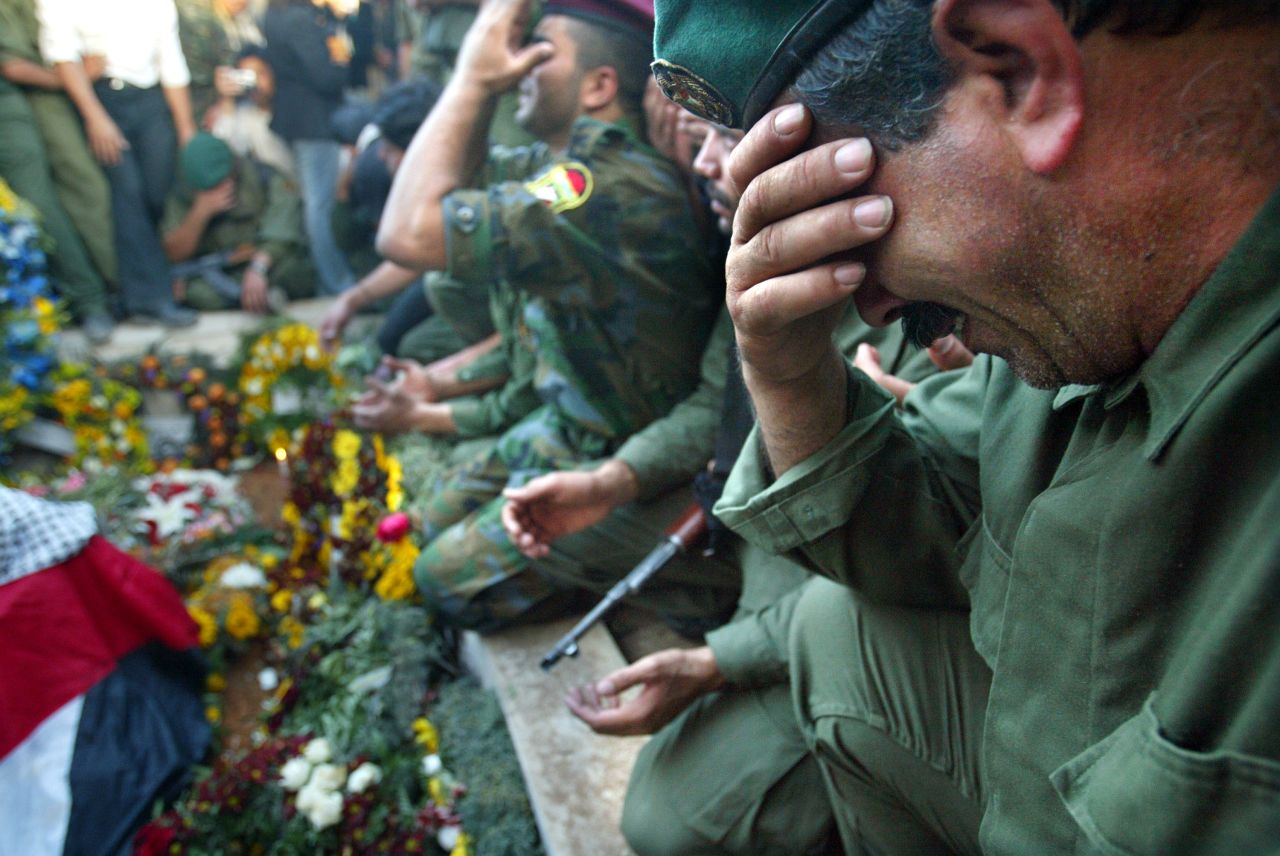
Yasser Arafat didn’t just die. He kind of vanished into a cloud of medical jargon and geopolitical finger-pointing that hasn't really settled, even decades later. If you ask a random person on the street in Ramallah, they’ll tell you he was murdered. Ask a former French intelligence officer, and they’ll likely shrug and point to a thick, inconclusive hospital folder.
The reality? It’s messy. If you enjoyed this piece, you should check out: this related article.
Most people think there’s a simple answer buried in a lab report somewhere. There isn't. When we talk about the Yasser Arafat death cause, we’re actually talking about three different versions of the truth—the French version, the Swiss version, and the Russian version.
The night it all started
It was October 12, 2004. Arafat was in his compound in Ramallah, basically living under siege. He sat down for dinner, and about four hours later, everything went south. He started vomiting. He had brutal abdominal pain and diarrhea. For another look on this story, refer to the recent update from The Guardian.
Initially, his doctors thought it was just the flu. You’ve had the flu; you stay in bed, you drink tea, you get better. But Arafat didn't get better. His blood platelets started plummeting. His health took a nosedive that eventually led to him being airlifted to the Percy Military Hospital in France.
By November 11, he was gone.
The official word from the French doctors at the time was a massive hemorrhagic stroke. This stroke was triggered by something called Disseminated Intravascular Coagulation (DIC). Basically, his blood-clotting system broke. But—and this is a big "but"—the doctors couldn't say why the DIC happened in the first place. They ruled out obvious things like cancer or a known infection. They just... stopped there.
The radioactive smoking gun
Fast forward to 2012. An Al Jazeera investigation changed the whole vibe of the story. They got a hold of Arafat’s personal effects—his toothbrush, his iconic kaffiyeh, his clothes. They sent them to the Institute of Radiophysics in Lausanne, Switzerland.
The scientists found polonium-210.
If that sounds familiar, it’s because it’s the same stuff used to kill the Russian defector Alexander Litvinenko in London. It’s terrifyingly lethal. A tiny speck can kill you, and it’s almost impossible to detect unless you’re specifically looking for alpha radiation.
When they exhumed Arafat’s body in November 2012, the Swiss team found polonium levels in his ribs and pelvis that were up to 18 times higher than normal. They said their findings "moderately support" the theory that he was poisoned.
Why didn't everyone agree?
This is where the politics of science gets weird. Three teams looked at the same samples:
- The Swiss: Said poisoning by polonium was likely.
- The French: Claimed the polonium was "environmental." They argued that radon gas in the soil naturally decayed into polonium after he was buried.
- The Russians: Basically threw their hands up. They said there wasn't enough evidence to call it poisoning, even though they found some polonium too.
Honestly, it’s a bit of a stalemate. The Swiss team, led by Francois Bochud, pointed out that the polonium on Arafat’s clothes (which weren't in the dirt) was also sky-high. That kind of pokes a hole in the "it was just the soil" argument.
What the medical records actually show
If you dig into the 558-page French medical report, it’s a story of a 75-year-old man whose body just gave up. He had an "unidentified infection."
There were rumors, of course. For years, people whispered about AIDS. Some Israeli and French doctors suggested it because of the blood disorder and the way his immune system collapsed. But the records show he was tested for HIV and the results were negative. Plus, the sudden onset of the stomach issues doesn't really fit the typical progression of AIDS.
Then there’s the poisoning theory that doesn't involve radiation. Some experts, like Dr. Ashraf al-Kurdi (Arafat’s personal physician), were convinced it was a more "traditional" toxin. They argued that the French doctors' refusal to perform an autopsy at the time was the biggest mistake in modern Middle Eastern history.
Why it still matters today
The Yasser Arafat death cause isn't just a cold case for history buffs. It’s a core part of the Palestinian national narrative. To many, Arafat is a martyr who was taken out because he was an obstacle to certain political goals. To others, he was an aging leader who succumbed to the physical toll of living in a basement under military siege for years.
In 2015, French judges officially closed the murder investigation, saying there wasn't enough evidence to go to trial. In 2021, the European Court of Human Rights rejected an appeal from his widow, Suha Arafat, to reopen it.
The legal doors are mostly closed, but the scientific debate is still quietly humming in the background.
Actionable Insights
If you're trying to wrap your head around this, don't look for a single "Aha!" moment. Instead, look at the patterns:
- Follow the symptoms: The sudden onset of nausea and vomiting four hours after a meal is a classic "toxin" red flag, whether it's bacteria or something more sinister.
- Question the "Environmental" theory: If you're skeptical of the French report, look into the Swiss rebuttal regarding the polonium found on his personal items that never touched the grave soil.
- Acknowledge the gaps: The lack of an autopsy in 2004 is the single biggest reason we are still guessing today. Without fresh tissue samples from the moment of death, everything else is reconstruction.
- Understand the "Polonium Half-Life": Polonium-210 has a half-life of 138 days. By the time they exhumed him eight years later, most of the original substance would have decayed, making the 2012 tests incredibly difficult to interpret.
The mystery of how Yasser Arafat died is likely to remain just that—a mystery. You have to weigh the high levels of a rare radioactive isotope against the messy, inconclusive medical reality of an old man in a high-stress war zone. Sometimes the "smoking gun" is just too cold to trigger a conviction.
What to look for next
Keep an eye on any potential declassification of intelligence documents from that era, specifically from 2003-2004. While the forensics have reached their limit, the paper trail in government archives often takes 25 to 30 years to emerge. We might be closer to the "who" than the "how" as we approach the late 2020s.