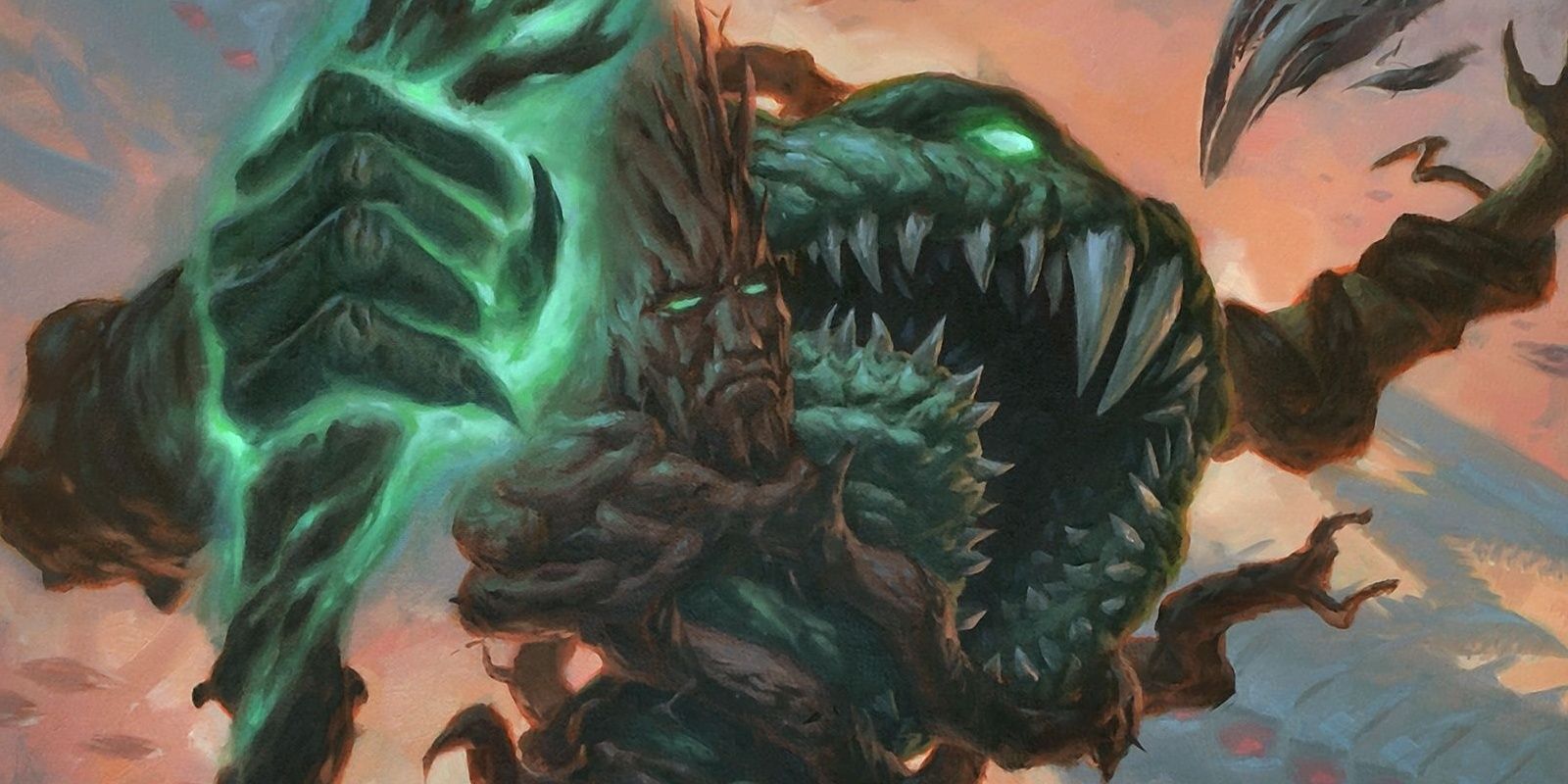
Let’s be real. If you saw a 18/6 stat line on a card back in the day, you’d assume it was some unplayable ten-mana draft chaff or a weird silver-bordered joke. But Yargle and Multani exists. It’s black, it’s green, and it has more raw power than an Eldrazi titan. Honestly, the first time this card was spoiled for March of the Machine, the community basically collectively lost its mind because the math just didn't seem right. Eighteen power? On a creature that costs six mana?
It’s a vanilla creature. No trample. No ward. No fancy "enters the battlefield" trigger that draws you half your deck. Just a massive, horrifying Frog Spirit Elemental that wants to turn your opponents into a fine paste.
What Most People Get Wrong About Yargle and Multani
Most players look at this card and laugh. They see a "meme" commander. They think, "Oh, it’s just a big vanilla stick, I’ll just chump block it with a 1/1 squirrel." That is a massive mistake. In the world of Yargle and Multani MTG strategy, the card isn't really a creature; it’s a payload. You aren't playing this to fairly turn it sideways every turn. You are playing it to exploit the fact that Magic: The Gathering has dozens of cards that care specifically about how much power a creature has.
Think about Rishkar's Expertise. You pay six mana to draw cards equal to the greatest power among creatures you control. With this frog on the board, you’re drawing eighteen cards. For six mana. That’s not a meme; that’s a game-ending level of card advantage.
The same goes for cards like Greater Good. You sacrifice Yargle and Multani to draw eighteen cards and discard three. You’ve just filtered your entire deck for the cost of one creature. People focus so much on the lack of keywords that they miss the sheer utility of having a nuclear-grade stat line sitting in the command zone.
The Math of a One-Shot Kill
In Commander, you need 21 commander damage to knock someone out. Yargle and Multani starts at 18. This means any tiny buff—a Giant Growth, a Rancor, or even just a +1/+1 counter from a Great Henge—puts them into one-shot territory.
- Tainted Strike: For a single black mana, you give it +1/+0 and Infect. Since you only need 10 poison counters to win, and this frog hits for 19 with the buff, the game ends instantly.
- Chandra's Ignition: If you’re playing this in a deck with access to red (like a Zipoy or Jodah build), casting this on your frog deals 18 damage to every other creature and opponent.
- Jarad, Golgari Lich Lord: This is the classic "fling" strategy. You spend three mana to sacrifice Yargle and Multani, and every opponent loses 18 life. If they’ve taken even a tiny bit of chip damage earlier in the game, they are dead.
Why the Lore Actually Makes Sense
Some Vorthos (lore fans) were annoyed by this pairing. Why would Multani, the protector of Yavimaya and a literal avatar of nature’s soul, team up with Yargle, a gluttonous, mindless spirit from the Urborg swamps?
The flavor text actually spells it out. During the Phyrexian invasion, the stakes were "the end of everything." Multani’s daughter, Muldrotha, convinced him that Urborg’s "strange ways" were necessary. It’s a "the enemy of my enemy is my friend" situation. If the Phyrexians win, there is no nature for Multani to protect and no spirits for Yargle to eat.
The contrast in their "dialogue" is peak Magic humor. Multani gives this grand, rumbling speech about alliances and the merit of Urborg. Yargle’s response? "Gnshhagghkkapphribbit."
Building the Deck: It’s All About "The Scam"
If you’re building Yargle and Multani MTG in paper or on Arena (where it’s a house in Brawl), you have to embrace the "scam" style of play. Because the frog has no protection, your opponents will try to kill it the second it touches the grass.
You need a heavy package of one-mana protection spells. I’m talking Tamiyo's Safekeeping, Tyvar's Stand, and Malakir Rebirth. These don't just keep the frog alive; they often provide the tiny power boost needed to reach that 21-damage threshold.
Essential Synergies You Shouldn't Skip
- Traverse the Outlands: You cast this for five mana and go get eighteen basic lands. You basically thin your entire deck and ensure you never miss a land drop for the rest of human history.
- Selvala, Heart of the Wilds: Tap her to add eighteen green mana to your pool. It’s essentially a ritual that lets you cast your entire hand in one go.
- Disciple of Bolas: Sacrifice the frog, gain 18 life, and draw 18 cards. It’s almost impossible to lose a game of Commander after that much value.
- The Skullspore Nexus: If someone does manage to kill your commander, this artifact creates an 18/18 fungus token. It keeps the pressure on without you having to pay the commander tax immediately.
The Reality Check: Is It Competitive?
Let’s be honest. In high-power cEDH, Yargle and Multani isn't going to top the charts. It’s too slow, and it lacks the inherent value of something like Kinnan or Nadu.
However, at a "Power Level 7 or 8" table? It is terrifying. It forces the entire table to play differently. They can't tap out. They can't leave themselves open for even one turn. The psychological pressure of an 18-power creature in the command zone is a weapon in itself. You aren't just playing Magic; you’re playing a horror movie where the monster is a giant frog.
Practical Next Steps for Players
If you want to start winning with the big frog, start by picking up the "power matters" staples. Focus on Rishkar's Expertise, Greater Good, and Jarad, Golgari Lich Lord. Don't overcomplicate the deck with too many fancy combos. Your goal is simple: ramp hard, cast the frog, and then use a "fling" or "draw" effect to turn that 18 power into an insurmountable lead.
You should also look into Surrak and Goreclaw. Giving the frog haste and trample the moment it hits the board is the difference between a funny meme and a winning board state. Grab a copy of Rogue's Passage too—sometimes, you just need to walk through the front door.