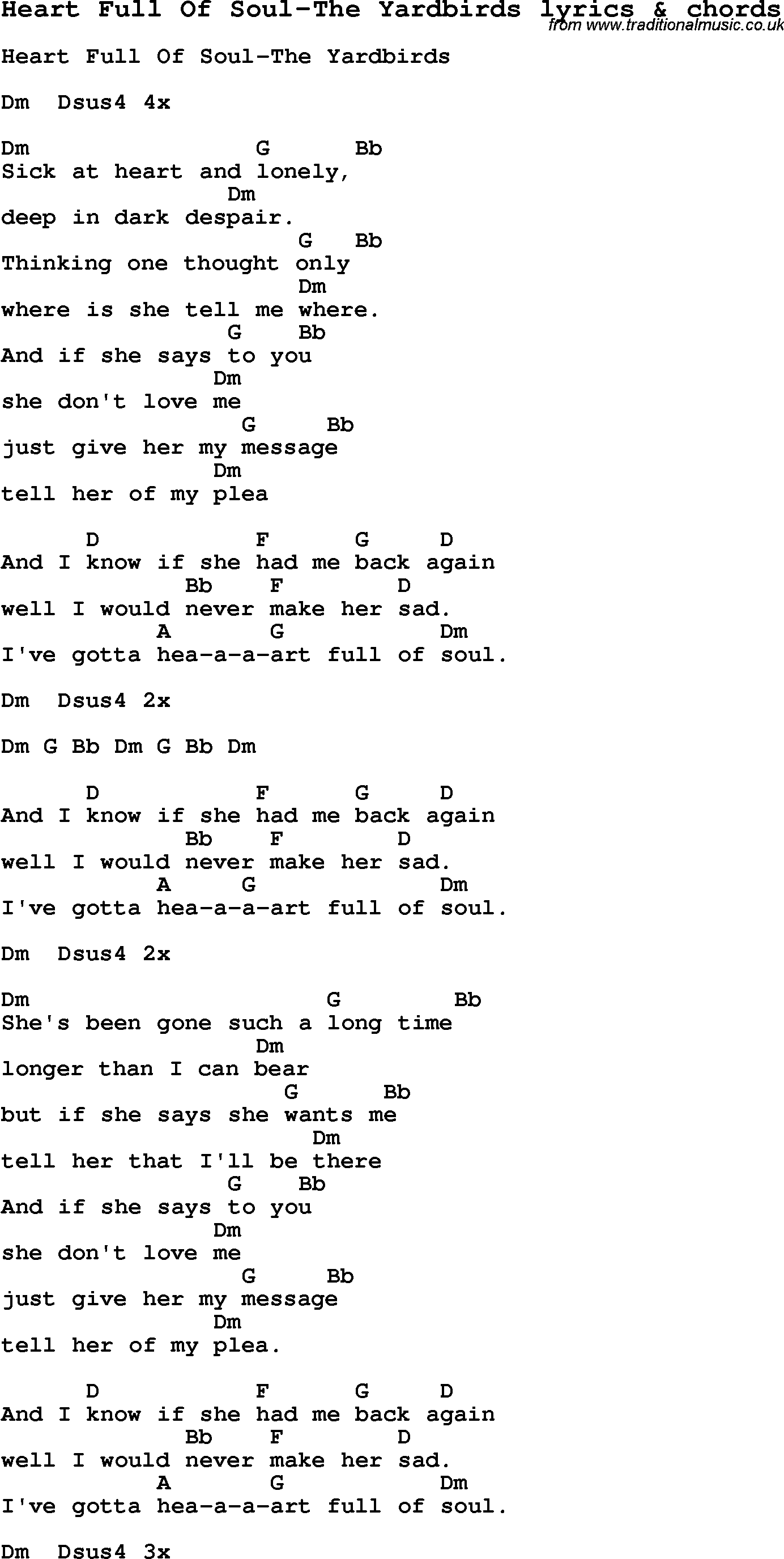
You're driving late at night, and that buzzing, snake-charmer guitar riff kicks in. It sounds like it’s coming from another planet, or maybe just a really loud garage in 1965 London. Most people know the riff of "Heart Full of Soul" by heart, but the Yardbirds Heart Full of Soul lyrics are where the real heavy lifting happens. They aren't just filler words. They tell a story of absolute, gut-wrenching desperation that most of us have felt at some point—that moment when you realize someone is gone and you’d basically trade your kidneys to get them back.
Honestly, the song is a masterclass in economy. It doesn't use big, flowery metaphors. It just hits you.
The Story Behind the Heart Full of Soul Lyrics
The track was written by Graham Gouldman. If that name sounds familiar, it's because he eventually became a founding member of 10cc. But back in the mid-60s, he was this teenage songwriting prodigy working in a men's clothing shop by day and cranking out hits by night. He’d already handed The Yardbirds "For Your Love," which was the song that famously made Eric Clapton quit the band because it was "too poppy."
Gouldman has a gift for writing about longing without being cheesy.
When you look at the opening lines—"Sick at heart and lonely / Deep in dark despair"—you aren't looking at poetry that needs a degree to decode. It’s blunt. It’s raw. The narrator is "thinking one thought only," which is a perfect description of that obsessive loop your brain enters after a breakup. You know the one. Where every street corner and every song on the radio reminds you of them? Yeah, that.
A Plea Through a Third Party
One of the most interesting things about the lyrics is the "messenger" trope.
"And if she says to you / She don't love me / Just give her my message / Tell her of my plea"
The narrator isn't even talking to the girl directly. He’s talking to a friend, or maybe a stranger, begging them to be an intermediary. It adds a layer of pathetic vulnerability (in a good way) to the song. He's too broken or too far away to speak for himself. He’s sending out a distress signal through anyone who will listen.
That "Sitar" Sound and the Lyrics' Atmosphere
The Yardbirds originally tried to record this with an actual sitar player. It was 1965, and everyone was getting into "Eastern" sounds. But the sitar sounded thin and weird on the demo. Jeff Beck, who had just replaced Clapton, stepped up and decided to mimic the sitar sound using a fuzz box and some aggressive string bending.
This change in instrumentation completely transformed how we hear the Yardbirds Heart Full of Soul lyrics. The "Eastern" vibe makes the lyrics feel more mystical and haunting. When Keith Relf sings about being "lonely" and "sick at heart," that buzzing guitar in the background makes it sound like he's lost in a desert or a fog. It’s atmospheric as hell.
Key Lyric Breakdown
- "She's been gone such a long time / Longer than I can bear": This is the peak of the song's tension. It captures that feeling where time stops moving when you're grieving a relationship.
- "I would never make her sad": The classic "I've changed, I promise" lie we all tell ourselves. It makes the narrator human. He's desperate and willing to say anything to get another chance.
- "I got a heart full of soul": The title line. It’s a bit of a contradiction. "Soul" usually implies depth and richness, but here it feels like a heavy burden. His heart is so full of "soul" (emotion/pain) that it's weighing him down.
Why It Mattered in 1965 (And Why It Still Does)
Back then, pop songs were mostly about "I love you, let's hold hands." The Yardbirds were pushing into darker territory. They were basically inventing "Raga Rock" and psychedelic rock on the fly.
The lyrics aren't just about a breakup; they're about the weight of existing after that breakup. Gouldman’s writing style often leaned into this sort of melancholic pop. Think about "Bus Stop" which he wrote for The Hollies—it’s sweet but has that same British rainy-day vibe.
Comparing Versions
If you haven't heard the Graham Gouldman demo version, go find it. It's much more of a folk-pop tune. It’s catchy, sure, but it lacks the "danger" of the Yardbirds' version. The Yardbirds took a well-written pop song and turned it into a piece of gothic rock 'n' roll.
Then you have the Rush cover from their Feedback EP. Geddy Lee brings a different kind of energy to those lyrics. It’s more of a tribute, but it proves that the core songwriting—the lyrics and that basic melody—is strong enough to survive different genres.
Actionable Takeaways for Music Nerds
If you’re a fan of this era or a songwriter yourself, there’s a lot to learn from how this song was put together.
- Check out Graham Gouldman's other 60s hits. If you like the "Heart Full of Soul" vibe, listen to "Evil Hearted You" (also by The Yardbirds) and "No Milk Today" by Herman's Hermits. You'll start to see his fingerprint everywhere.
- Listen for the Fuzz. Focus on Jeff Beck's guitar work during the verses. See how it interacts with the vocal lines. It doesn't just play over the lyrics; it creates the "room" the lyrics live in.
- Analyze the Simplicity. Try writing a poem or a song using only the most basic words you can think of. "Heart," "Soul," "Sad," "Gone." Notice how much more impact they have when you don't hide behind "fancy" language.
The Yardbirds Heart Full of Soul lyrics remain a benchmark for British Invasion songwriting. They remind us that sometimes, the simplest way to say "I'm miserable" is the most effective. It's a two-minute and forty-second masterclass in heartbreak that doesn't waste a single syllable.
Next time it comes on the radio, don't just air-guitar to the riff. Listen to Keith Relf’s voice. He sounds like a man who is genuinely at the end of his rope, and that's why we’re still talking about it sixty years later.



