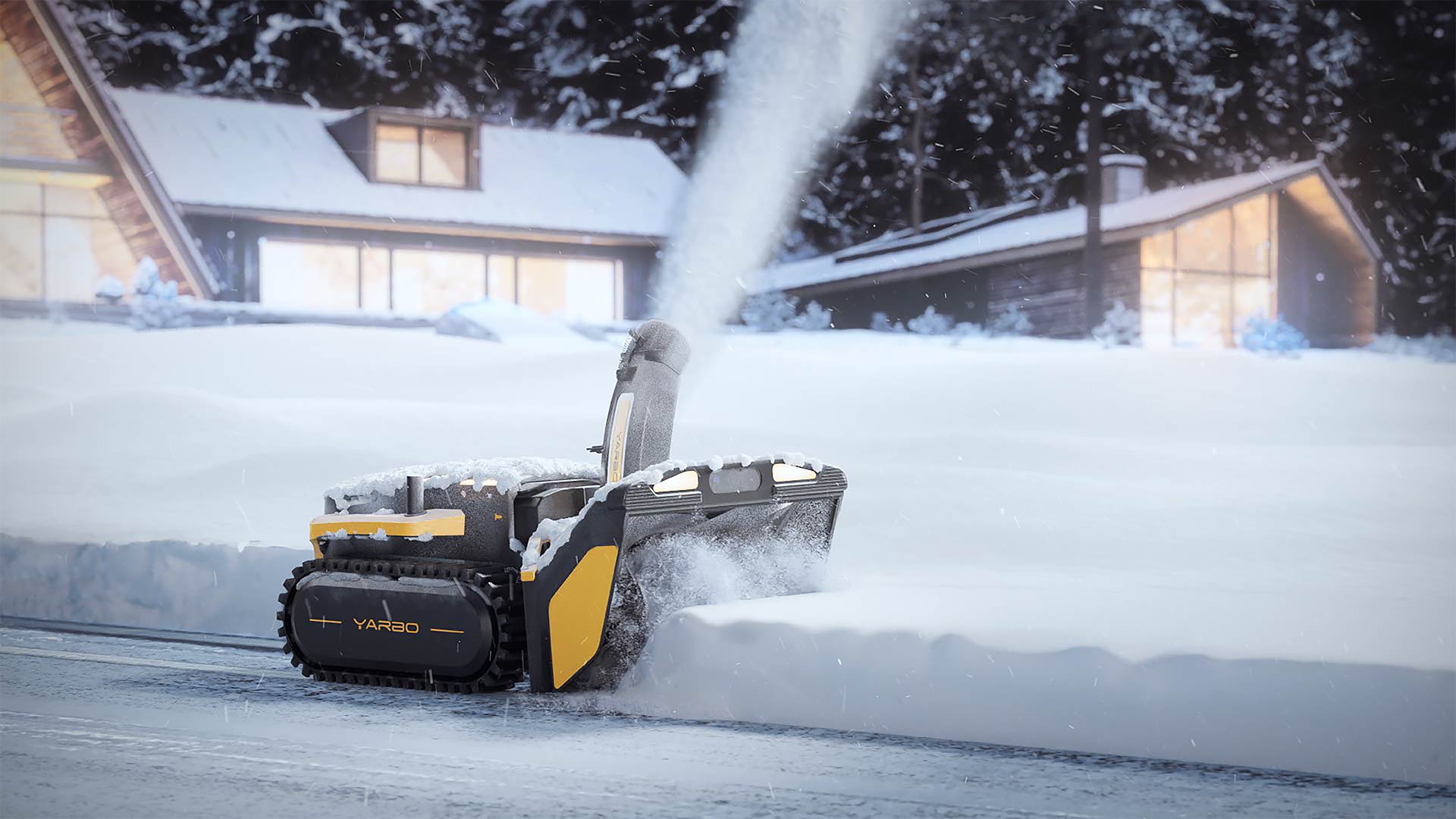
Winter is a special kind of misery if you’re the one holding the shovel at 5:00 AM. We’ve all been there. You’re shivering, your back is screaming, and the plow just pushed a fresh mountain of slush right back onto your driveway. It sucks. Honestly, that's why the idea of a Yarbo snow blower robot sounds like a fever dream from the future. A machine that just wakes up, rolls out of the garage, and nukes the snow while you’re still under the covers?
Sign me up.
But here’s the thing: social media makes these robots look like flawless terminators of ice. The reality is a bit more... human. I’ve been tracking the Yarbo ecosystem since its early Kickstarter days, and with the 2026 M Series now hitting the pavement alongside the heavy-duty Core, there is a massive gap between the "cool gadget" hype and what actually happens when six inches of wet, heavy "heart-attack" snow hits a driveway in Minnesota.
The Modular Hook: It’s Not Just a Snow Blower
Most people think they’re buying a robot snow blower. You aren't. You’re basically buying a tiny, autonomous tank called the "Core" and then slapping a blower on its face.
The Yarbo system is modular. That’s the big sell. In the summer, it’s a lawn mower. In the fall, it’s a leaf blower or a collector. Come December, you swap the deck for the two-stage snow blower module. It’s a clever way to justify the price tag—which, let’s be real, is steep. You're looking at anywhere from $4,500 to $7,000 depending on the bundles.
Why two-stage? Because single-stage blowers are basically glorified fans. Yarbo uses an auger to chew the snow and an impeller to launch it. We're talking a 24-inch clearing width and the ability to chuck snow up to 40 feet. It’s beefy. But power isn't the problem most users face.
The "No Wires" Magic (and the Reality Check)
If you’ve ever seen a Roomba, you know they usually need a "home." Old-school robot mowers needed a literal wire buried around your property. Yarbo doesn't do that. It uses RTK-GPS.
Basically, it talks to satellites to figure out where it is within a couple of centimeters.
This is great because you don't have to dig up your yard. You just "drive" the robot around with an app—sorta like a video game—to map your driveway. But—and this is a big "but"—GPS needs a clear view of the sky. If you have a narrow driveway sandwiched between a tall house and a line of massive oak trees, the signal might get wonky.
The 2026 models have tried to fix this by adding LiDAR and more "vision" (cameras). They call it sensor fusion. It’s meant to help the robot "see" where it is even if the satellites are being shy. Does it work? Mostly. But don't expect it to navigate a pitch-black, tree-covered maze without a few hiccups.
Traction: The Silent Dealbreaker
Snow is slippery. Groundbreaking stuff, I know.
But for a 200-pound robot, traction is everything. Yarbo uses rubber tracks instead of wheels. In theory, this gives it the grip of a bulldozer. In practice, ice is still ice.
Early users figured out pretty quickly that if the robot starts spinning its tracks on a frozen incline, it doesn't just get stuck—it can actually chew up your driveway surface. A lot of owners end up buying the optional "ice spikes" (basically studs for the tracks). If you have a steep driveway, these aren't optional; they're mandatory. Without them, you’ll find your $5,000 robot doing a sad, slow slide into your neighbor's mailbox.
What Actually Happens in a Blizzard?
One thing people get wrong is the "one and done" mentality. You can't let a foot of snow dump on the ground and then expect Yarbo to go out and clear it in one shot. It’s an electric robot, not a 12-horsepower gas beast.
The secret to success with the Yarbo snow blower robot is "staying ahead of the storm."
You set it to start clearing once there’s an inch or two on the ground. It goes out, clears, comes back to charge, and goes out again. It’s a war of attrition. If you wait until the storm is over and the snow has turned into a solid block of ice, the robot is going to struggle.
The Battery Trade-off
Let’s talk about the cold. Batteries hate it. Yarbo has built-in heaters to keep the cells from freezing, but the physics are still there: cold air equals less range. On a "light" day, you might get 2 hours of runtime. In a sub-zero blizzard clearing heavy slush, that might drop significantly.
The charging time is also a factor. If the robot spends 3 hours clearing and then 2 hours charging while the snow is falling at 2 inches per hour, you’re losing ground. This is why the 2026 M Series offers different battery sizes (10Ah vs 20Ah). If you have a massive three-car driveway, don't cheap out on the battery. You'll regret it the first time the machine dies halfway through a job.
The Clogging Problem
Wet snow is the enemy of all blowers. Even the big gas ones clog. Yarbo has a "smart" chute, but it isn't magic.
If the temperature is hovering right around freezing and the snow is basically mashed potatoes, the chute will clog. Some users have taken to spraying the inside of the chute with non-stick cooking spray or ceramic coatings. It sounds silly, but it works. Honestly, for a high-tech robot, sometimes the best solution is a $5 can of PAM.
Is It Ready for Your Driveway?
I wouldn't recommend this for everyone.
If you live in an area with occasional light dustings, it's overkill. If you have a tiny, complex yard with a bunch of random lawn ornaments and narrow paths, the robot might spend more time "recalculating" than actually blowing snow.
However, if you have a large, relatively open driveway and you’re tired of paying a plow guy $75 every time it snows, the math starts to make sense. Over five years, the "ROI" (return on investment) is actually pretty decent. You’re saving thousands on seasonal contracts, and more importantly, you’re saving your Saturday mornings.
Critical Next Steps for Prospective Owners
Before you drop five grand on a robot, you need to do some "boring" prep work.
- Check your Signal: Take your phone out to the middle of your driveway. Do you have a clear, unobstructed view of the sky? If you're under a heavy canopy or tucked between tall buildings, look into the Yarbo "HaLow" signal boosters or the LiDAR-equipped M20i models specifically.
- Map the "No-Go" Zones: You need to be meticulous with the app. If there’s a spot where your driveway meets a delicate flower bed, mark it as a hard boundary. The robot is heavy; if it "overshoots" a turn, it will crush your prize-winning tulips.
- Plan the Power: The docking station needs a dedicated outdoor outlet. It also needs to be in a spot where the robot can easily return to it even when there’s a bit of accumulation. Don't put the dock at the bottom of a hill where snow naturally drifts.
- Maintenance isn't Zero: You still have to check the auger for rocks, clear out the occasional ice jam, and swap the modules. It's "hands-off," not "brain-off."