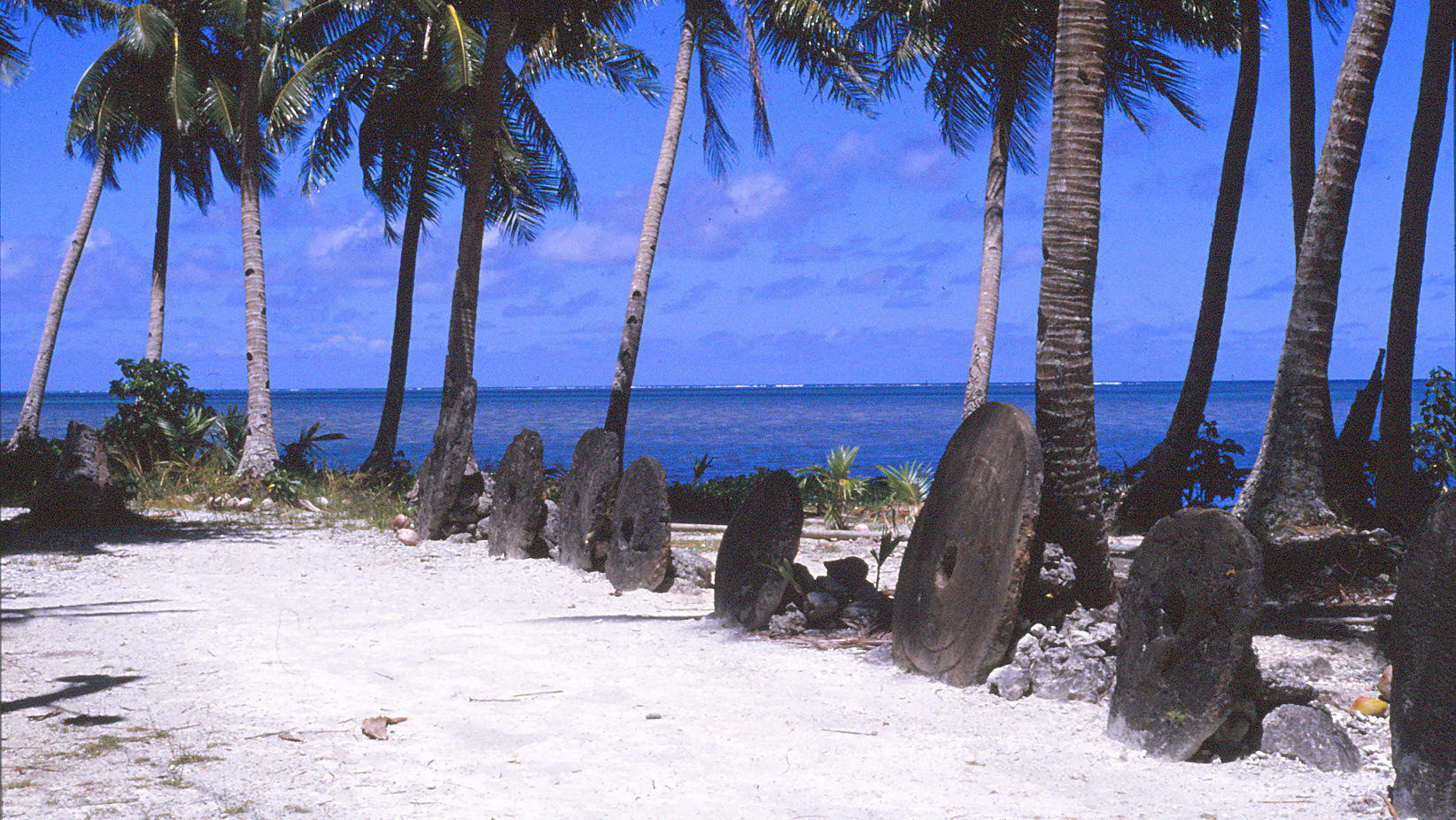
You’re walking through a dense, humid jungle on a tiny island in Micronesia and you stumble upon a massive, donut-shaped limestone disc leaning against a palm tree. It’s taller than you. It weighs four tons. This isn't a discarded monument or a primitive wheel. It’s cash. It is literally a coin, and for the people of Yap, it’s been the backbone of their economic life for centuries.
Most people call it stone money of yap, but locally, these discs are known as Rai. They are easily the most inconvenient physical currency ever devised by human beings. You can’t put them in your pocket. You can’t exchange them at a vending machine. In fact, for the really big ones, you don’t even move them when they change owners. They just sit there, moss-covered and stoic, while the village simply "knows" who owns which one.
Honestly, it sounds like a joke until you realize that Yapese stone money actually functions almost exactly like a modern digital ledger. It’s a physical blockchain, invented hundreds of years before Satoshi Nakamoto ever typed a line of code.
How Stone Money of Yap Actually Works (and Why It’s Not Just "Rocks")
The value of a Rai stone isn't based on its weight or even its size, though those things help. It’s all about the story.
Imagine a group of Yapese sailors paddling 250 miles across the open Pacific in outrigger canoes to the island of Palau. Once there, they had to negotiate with local chiefs to quarry limestone—a material not found on Yap. Then, they had to carve these massive discs using nothing but shell tools and fire. Finally, they had to lash the stones to rafts and tow them back across the treacherous Philippine Sea.
Many died. Some stones were lost to the depths.
Because of this, the "price" of a stone is tied to its history. If a famous navigator brought it back, the value goes up. If people died during the expedition, the value skyrockets. It’s a proof-of-work system. You aren't just trading limestone; you’re trading the blood, sweat, and risk it took to get that limestone onto the island.
The most fascinating part is the ownership. Because these things are gargantuan, they stay put. If I "buy" your house using a massive Rai stone that’s sitting in your front yard, we don’t move the stone. We just tell the village. Everyone acknowledges that the stone now belongs to me. Even if it stays in your yard for the next fifty years, it’s mine.
There is even a legendary story—documented by anthropologist William Henry Furness III in his 1910 book The Island of Stone Money—about a stone that fell overboard during a storm. The crew saw it sink to the bottom of the ocean. They got back to Yap and explained what happened. The village elders decided that since the stone was definitely there (just underwater) and the intent was honest, the stone still counted as currency. That family remained wealthy for generations based on a giant rock that nobody had seen in decades.
That is the definition of a decentralized ledger.
The Captain O’Keefe Incident and Inflation
Economic systems are fragile. The stone money of Yap worked perfectly until a shipwrecked Irish-American captain named David O'Keefe showed up in the late 1800s.
O'Keefe saw an opportunity. He realized the Yapese wanted these stones more than anything else. So, he traded them modern tools—iron chisels and sturdy ships—in exchange for copra (dried coconut meat). With O'Keefe's help, the Yapese could suddenly produce stones much faster and much larger than ever before.
But there was a catch.
Because these "O'Keefe stones" were easier to make, the village elders deemed them less valuable than the old stones carved with shell tools. It was a classic case of inflation. The supply increased, the "work" required decreased, and the value shifted. This period created a fascinating hierarchy in Yapese currency:
- Old, small stones: Hand-carved, extremely high value.
- Medium stones: Moderate value, often used for marriage gifts or land disputes.
- New, massive stones: Impressive to look at, but often viewed with a bit of skepticism by traditionalists.
You can still see these stones today in "stone money banks" throughout the villages. They aren't behind vaults. They’re just lined up along the paths.
Why This Matters to You Today
Why are we talking about 500-year-old rocks in 2026? Because the stone money of Yap proves that money is an illusion we all agree to participate in.
Whether it’s a piece of paper with a president’s face, a gold bar, a Bitcoin, or a three-ton limestone disc, money only works if there is social consensus. The Yapese have maintained that consensus for a millennium. They didn't need a central bank. They just needed a community that remembered the truth.
In a world where we are increasingly moving toward digital assets and "invisible" wealth, the stones of Yap are a physical reminder of what currency actually is: a record of human effort and social trust.
Actionable Insights for the Curious
If you’re planning to visit Yap or just want to understand this better, keep these points in mind:
- Respect the "Banks": If you visit Yap, the stones are not climbing structures. They are active currency. Treating them like a playground is a massive sign of disrespect to the local culture.
- The Value is Verbal: You cannot determine a stone's worth by looking at it. You have to ask about its lineage. In Yapese culture, the oral history of the stone is the stone.
- Cultural Preservation: Unlike many ancient traditions, the use of Rai stones for ceremonial exchanges—like settling a major dispute between villages or a high-level marriage—is still very much alive.
- Economic Lesson: If you’re an investor, study the Yapese system. It’s the purest example of how scarcity and "cost of production" dictate long-term value.
Go to the village of Tamil or the stone money bank in Rull. Look at the stones. Don’t just see the limestone; see the centuries of navigation, the risk of the open sea, and the incredible power of a community's shared memory. That is what real money looks like.