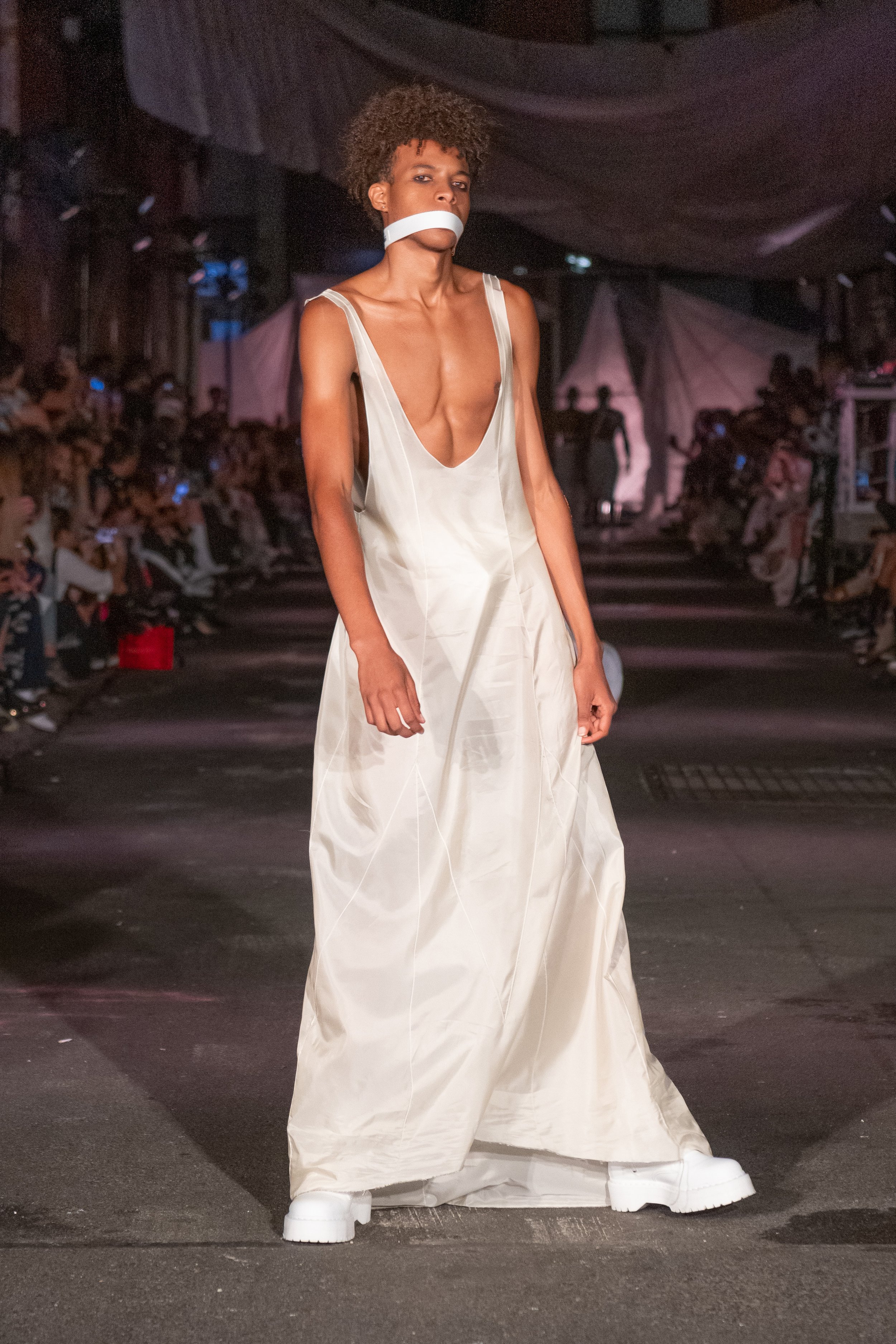
He showed up in all white. Every single day. In a world of fast-fashion trends and neon-soaked runways, Swiss designer Yannik Zamboni walked onto the set of Making the Cut Season 3 looking less like a contestant and more like a visitor from a very chic future.
Most people watching the first episode probably thought he was a "one-trick pony." An artist? Sure. A viable business partner for a global giant like Amazon? That seemed like a stretch. But then he won. And he didn't just win by playing it safe; he won by refusing to budge on a philosophy that most corporate executives would find terrifying.
The Strategy Behind the "All White" Aesthetic
When Yannik Zamboni first hit the screen, the judges—including the legendary Heidi Klum and the notoriously outspoken Jeremy Scott—were skeptical. You could see it in their faces. They were looking for the next big commercial hit. Zamboni was handing them deconstructed, genderless, monochromatic conceptual art.
Why white? It wasn't just a gimmick. Yannik has been vocal about the fact that color is a distraction. By stripping away the "noise" of bright patterns, he forced the judges to look at the architecture of his clothes. He wanted them to see the seams, the cut, and the raw construction. It was a ballsy move. Honestly, if his tailoring hadn't been flawless, he would have been sent home in week two.
But it worked. By the time the "Winter Wear" and "Festival" challenges rolled around, the panel realized that his "limitations" were actually his greatest strength. He wasn't just making clothes; he was building a brand identity that was impossible to ignore.
Yannik Making the Cut: The Million-Dollar Moment
The finale of Making the Cut is unlike any other fashion competition. It’s not just about a final runway; it’s about a business pitch. You have to convince a panel of experts that you can turn $1 million into a sustainable, scalable empire.
Yannik’s brand, Maison Blanche, was founded in 2020 during the height of the pandemic. He came into the competition with a "do or die" mentality. He’s admitted in interviews that his business was struggling before the show. He needed the cash, but more importantly, he needed the platform.
What the Judges Loved (and Feared)
- The "Accessible" Look: This is where most avant-garde designers fail on this show. Yannik figured out how to translate a strapless deconstructed trench coat into a hoodie that someone would actually buy on Amazon.
- Sustainability: He wasn't just greenwashing. He talked about circular fashion and vegan materials with a level of technical detail that proved he knew his supply chain.
- Gender Neutrality: Long before it became a corporate buzzword, Yannik was designing for the person, not the gender. He basically told the judges that the 1920s were over and it was time for fashion to catch up.
When Tim Gunn announced him as the winner, it felt like a shift in the show's DNA. Previous winners like Jonny Cota and Andrea Pitter had more traditional "commercial" appeal. Yannik was the first truly "anti-fashion" winner to take the crown.
The Amazon Breakup: A Lesson in Brand Integrity
Here is the part people usually miss. After winning the $1 million and launching his co-brand, Rare/Self, with Amazon, things didn't stay "happily ever after."
By mid-2024, Yannik confirmed that he had parted ways with Amazon. It sounds crazy, right? Walking away from the biggest distribution engine on the planet? But for Yannik, the "Making the Cut" journey was always about more than just sales.
He realized that his values—specifically his commitment to circular, plastic-free, and fair-wage production—didn't align with the high-volume, high-speed requirements of a massive marketplace. He called his own early belief that he could change Amazon from the inside "naive." It takes a lot of guts to win a reality show and then tell the sponsors their model doesn't work for your soul.
Why Maison Blanche Still Matters Today
Since his win, Yannik hasn't faded into the background like some reality stars. He’s doubled down on the New York Fashion Week scene, debuting collections like "BACK" that continue to poke at social taboos.
He’s moved his production to things like made-to-order knits to eliminate waste. This is the real "making it." It's not the trophy; it's the fact that he used the $1 million to buy his independence. He's currently looking for new investors who share his vision of a vegan, circular fashion future, proving that the hustle never actually stops just because the cameras do.
Actionable Takeaways for Aspiring Creatives
If you’re looking at Yannik’s trajectory as a blueprint, here is how you actually apply his "maverick" approach to your own work:
- Define Your "Non-Negotiables": Yannik didn't compromise on genderless design even when judges pushed for more "traditional" silhouettes. Know what part of your work is not for sale.
- Master the "Translation": You can be as weird as you want, but you have to show people how to use your work. Yannik's ability to create a "commercial" version of a "runway" look is why he won.
- Use the Platform, Don't Let it Use You: Take the prize, take the fame, but have an exit strategy if the partnership starts to dilute your brand's core mission.
- Focus on the "Why": People don't buy white clothes; they buy Yannik's vision of a socio-political revolution through fabric. Sell the story, not just the product.
The real story of Yannik making the cut isn't about a guy who got a big check. It's about a designer who used a mainstream stage to prove that "abnormal" is actually the new standard. Whether he’s skating through the streets of Zurich or backstage in Manhattan, he's still the guy in all white, refusing to blend in.



