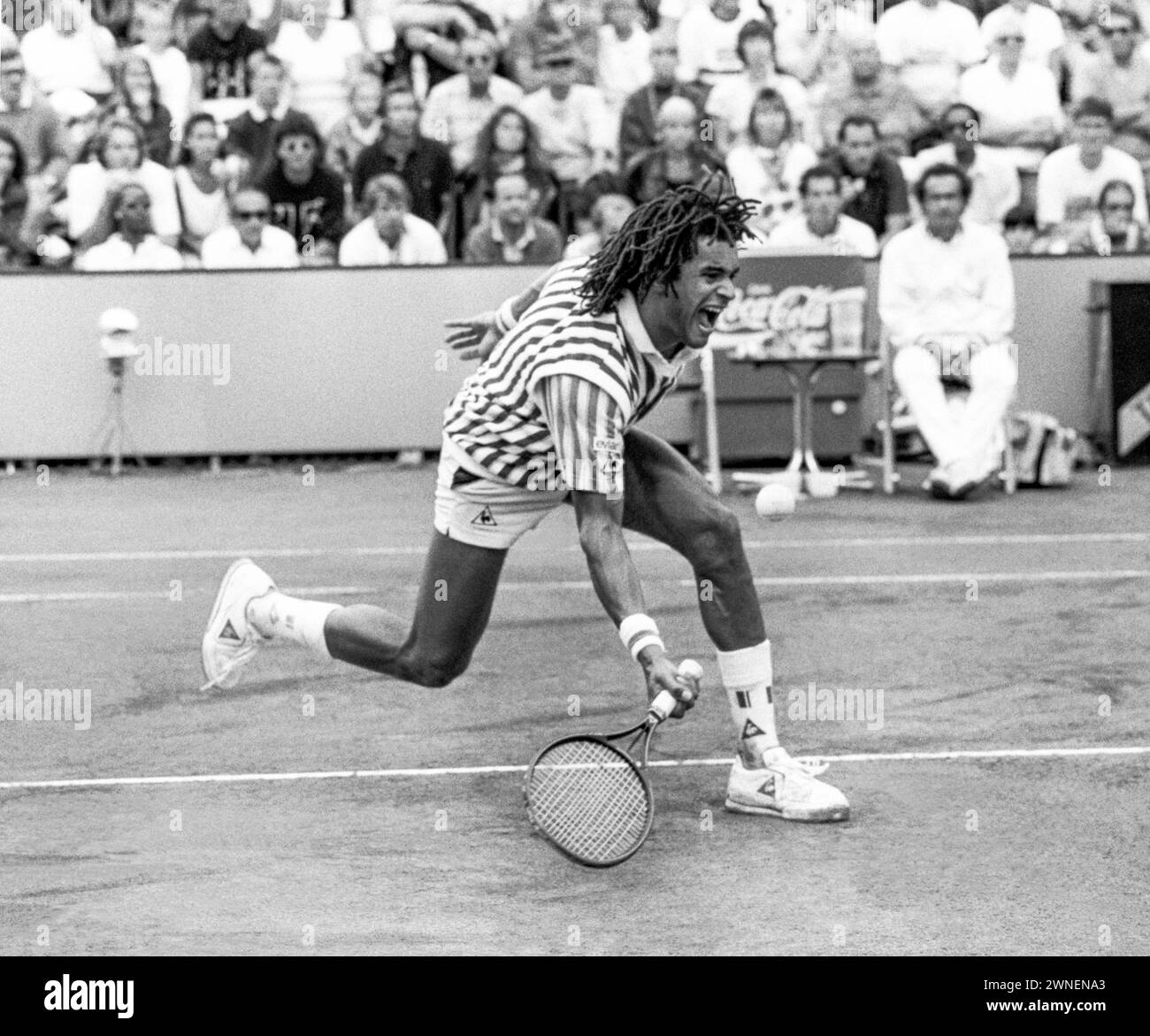
It is a specific kind of pressure. You are 23 years old. You are playing on the burnt-orange clay of Roland Garros, and an entire nation is basically holding its collective breath because they haven't seen one of their own win this thing in 37 years. That was the reality for Yannick Noah in June 1983.
When he finally forced Mats Wilander to miss that last forehand return, the explosion of sound wasn't just a cheer. It was a release. Noah didn't just win a tennis match; he became a permanent fixture in the French psyche. Even now, decades later, he remains the last Frenchman to lift that Musketeers' Trophy.
The Day Yannick Noah Broke the Curse
People talk about "home-field advantage," but in tennis, it can be a cage. By the time the 1983 final rolled around, the French public was desperate. Marcel Bernard had won it in 1946, and since then? Nothing.
Noah went into that final as the number six seed. He wasn't the "sure thing." But he was playing with a kind of kinetic, almost chaotic energy that the more clinical players couldn't handle. He’d already dismantled Ivan Lendl in the quarterfinals—a match where he actually won the fourth set 6-0. Honestly, Lendl rarely got embarrassed like that.
In the final against Wilander, Noah didn't play "safe" clay-court tennis. He was a serve-and-volleyer on dirt. That's supposed to be suicidal. Yet, he stormed the net 103 times in that match. He won 69% of his first-serve points by just being physically overwhelming.
The scoreline reads 6-2, 7-5, 7-6. It looks straightforward on paper. It wasn't. When his father, Zacharie Noah, famously jumped from the stands to embrace him on the court, it signaled the birth of a legend that would eventually outgrow the sport of tennis entirely.
A Game Built on Pure Athletics
If you watch old clips of Noah, the first thing you notice isn't the technique. It's the hair—the iconic dreadlocks—and the way he moved. He was 6'3" and played like a basketball player who wandered onto a tennis court by mistake but decided to dominate it anyway.
He didn't have the cleanest groundstrokes. In fact, some analysts back then thought his return of serve was actually one of the worst in the top 100. It was loopy. It was mechanical. On grass, this killed him. It’s why he never really made a dent at Wimbledon. But on clay? He had time. He would loop those shots, wait for a short ball, and then explode toward the net.
His overhead was arguably the best the game has ever seen. If you tried to lob him, you were basically just giving him a highlight reel moment.
Beyond the Court: The Music and the Captaincy
Most athletes retire and open a tennis academy or do some light commentary. Noah? He went and became a chart-topping pop star.
In 1991, right around the time he was captaining the French Davis Cup team to a massive upset over the U.S. (led by Pete Sampras and Andre Agassi), he released "Saga Africa." It wasn't a vanity project. The man has put out over a dozen albums. He sold out the Stade de France with 80,000 fans in 2010.
Think about that. Imagine John McEnroe or Boris Becker suddenly having a string of number-one radio hits. It sounds ridiculous, but for Noah, it worked because he was always more of a "personality" than a "technician."
The Captain Who Actually Led
Noah’s legacy as a captain is arguably just as strong as his playing career. He had this weird, mystical ability to make players believe they were better than they were.
- He led France to Davis Cup titles in 1991, 1996, and 2017.
- He took the Fed Cup (now Billie Jean King Cup) title in 1997.
He wasn't just sitting on the bench giving tactical advice about cross-court backhands. He was managing egos, singing with the team in the locker room, and creating a "tribal" atmosphere that made the French squad feel invincible.
What Most People Get Wrong About His Success
There’s a common misconception that Noah was a "one-hit wonder" because he only won one Grand Slam. That's a bit of a lazy take.
He reached World No. 3 in singles. He was World No. 1 in doubles. He won 23 singles titles and 16 doubles titles. He wasn't just a flash in the pan; he was a consistent force in the 80s who just happened to be peak-performing in an era of monsters like McEnroe, Connors, Lendl, and a young Wilander.
He also fundamentally changed the image of the sport. Before Noah (and his mentor Arthur Ashe), tennis was still struggling with its "country club" reputation. Noah brought a soul, a reggae-influenced vibe, and an unapologetic Black identity to a space that hadn't always been welcoming.
The Humanitarian Side: Fête le Mur
If you want to know what Yannick Noah is doing in 2026, you look at Fête le Mur. He started this foundation in 1996 with a simple goal: bring tennis to the "banlieues" (the underprivileged suburbs) of France.
It’s not about finding the next pro. It’s about using the sport as a way to build self-esteem. They work with over 13,000 kids a year across 140 different sites. For Noah, this isn't a PR move. It's a full-circle moment for a kid who was discovered in Cameroon by Arthur Ashe and given a racket that changed his life.
Actionable Insights for Tennis Fans and Players
If you're looking to take something away from the Noah era, it's not "grow dreadlocks and hope for the best." It's about unconventional strategy.
- Own the Net: Even on modern slow courts, the intimidation factor of a constant net presence is massive. Noah proved you don't need "perfect" groundstrokes if you have "perfect" positioning.
- Mental Leadership: If you are coaching or leading a team, Noah’s Davis Cup runs show that emotional connection often outweighs technical drills.
- Multi-Dimensionality: Don't let your sport be your entire identity. Noah’s transition into music and philanthropy made him a more balanced (and frankly, more interesting) human being, which likely helped him handle the pressure of his playing days.
Noah’s story is a reminder that you don't need to be the most "perfect" player to be the most "important" one. He remains a hero in France not just for the trophy he won in 1983, but for the way he refused to stay inside the lines of what a tennis player was supposed to be.
To truly understand his impact, go back and watch the 1983 final. Look at his face when his father hits the court. It wasn't about the points; it was about the moment.