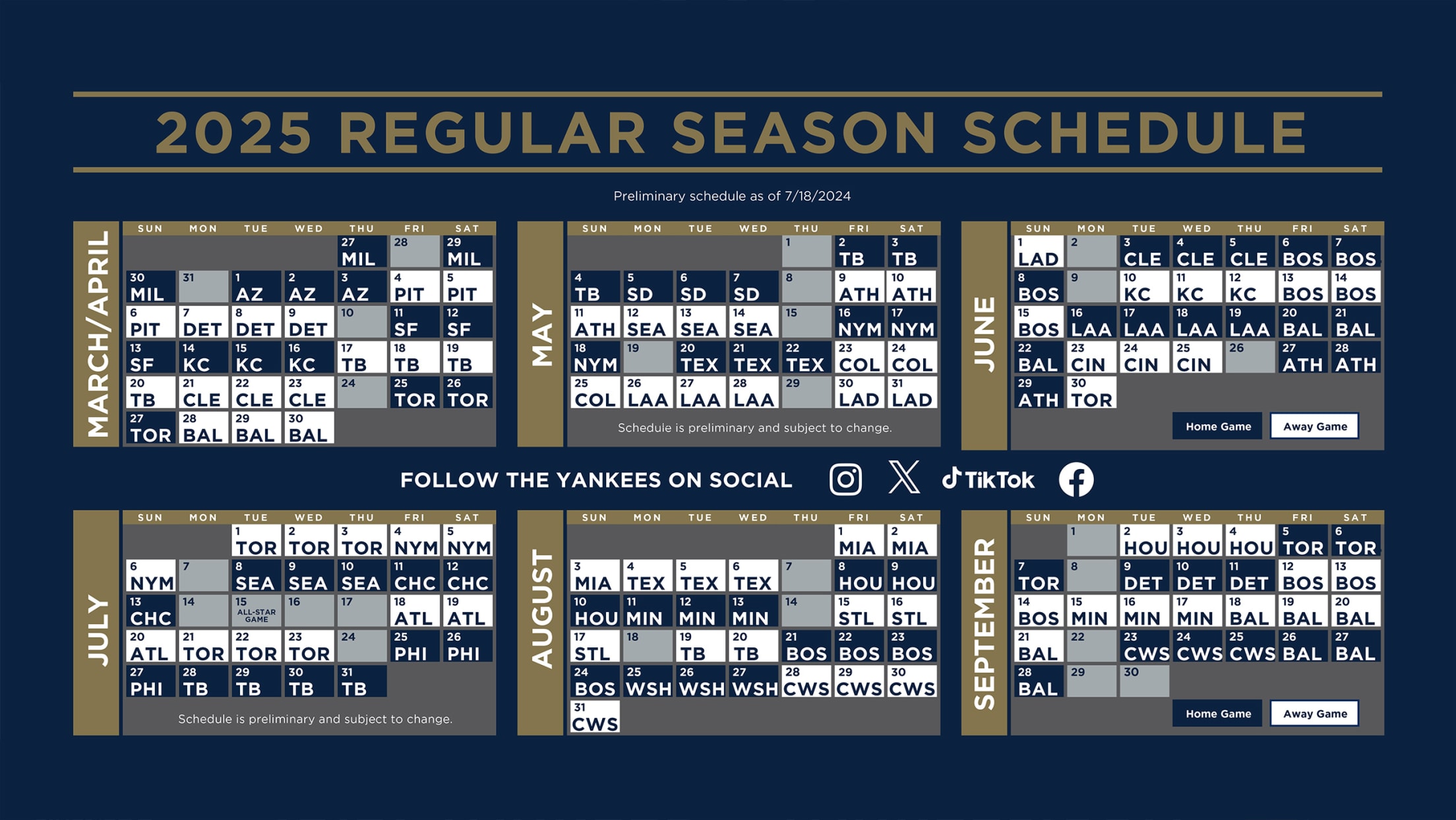
The 2026 season isn't just another year of baseball in the Bronx; it’s basically a historical anomaly. If you’ve been looking at the Yankees regular season schedule, you probably noticed something weird right off the bat. The Yankees are actually kicking things off in San Francisco. Not just as a standard road trip, but as a standalone "Opening Night" on Wednesday, March 25.
It is officially the earliest Opening Day in the history of Major League Baseball.
Honestly, it feels a bit strange to have the Pinstripes starting on the West Coast for a single-game spotlight at Oracle Park. Usually, we’re used to that crisp March air in the Bronx or maybe a warm-up in Florida, but this year the schedule-makers went for a coastal clash. After that one-off in San Fran on the 25th, they take a breather on the 26th while everyone else plays, then finish the series on the 27th and 28th.
That Brutal West Coast Start
The opening stretch is a bit of a grind. After the Giants, they hop over to Seattle for three games from March 30 to April 1. It’s a lot of travel before the team even smells the grass at Yankee Stadium.
You finally get the Home Opener on Friday, April 3. The Miami Marlins are coming to town for a three-game set. If you're looking for tickets, the 1:35 PM ET start time on that Friday is the one everyone is circling, but don't sleep on the rest of that homestand. The Athletics follow them into town for a three-game series from April 7 to April 9.
Rivalry Week and the Subway Series
One thing about the 2026 Yankees regular season schedule that stands out is "Rivalry Weekend." MLB is really leaning into the regional heat from May 15 to May 17. The Yankees are headed to Queens to face the Mets at Citi Field.
Wait.
There’s a second half to that. The "Subway Series" isn't just a May thing this year. The Mets come to the Bronx in September. Specifically, they play at Yankee Stadium from September 11 to September 13. This is actually a big deal because it marks the 25th anniversary of 9/11. It’s only the second time these two teams have played each other on that specific date, with the last time being the 20th anniversary back in 2021.
When it comes to the Red Sox, the schedule is scattered but intense.
- First meeting: At Fenway Park, April 21–23.
- First Bronx visit: June 5–7.
- Summer heat: Back at Fenway, June 25–28.
- The August showdown: At Yankee Stadium, August 28–30.
That August series is part of a massive 10-day homestand where the Yankees host Toronto, Houston, and Boston in succession. If the AL East race is tight, that stretch is basically where the season will be won or lost.
Holidays and Special Commemorations
If you like planning your summer around the ballgame, the 2026 calendar is pretty friendly for home games. The Yankees are at the Stadium for some of the biggest dates on the MLB calendar.
Jackie Robinson Day falls on April 15, and the Yankees will be hosting the Los Angeles Angels. Lou Gehrig Day is June 2, with Cleveland coming to the Bronx. Even Independence Day is a home game—Minnesota visits on July 4.
The road holidays are a bit different. They’ll be in Milwaukee for Mother’s Day (May 10) and Kansas City for Memorial Day (May 25). That Memorial Day game is actually an ESPN exclusive at 3:30 PM ET, featuring a heavy-hitter matchup between Aaron Judge and Bobby Witt Jr.
The Weird Scheduling Glitches (Thanks, World Cup)
You might see some odd gaps in the 2026 Yankees regular season schedule, and you can blame soccer for that. With the FIFA World Cup hitting North America, MLB had to adjust for stadiums that share parking or infrastructure with soccer venues.
The Yankees don’t have a World Cup stadium in their backyard (MetLife is the host, not the Stadium), but their opponents do. For example, when they travel to Philadelphia in late July, things might feel a bit more crowded than usual. The All-Star Game is also in Philly this year on July 14 at Citizens Bank Park, so the mid-summer break has a very Mid-Atlantic feel to it.
Finishing the Fight
The "dog days" of August are actually when the Yankees have their longest homestands. They have two different nine-game stretches at Yankee Stadium.
- August 3–13: Cards, Braves, and Mariners.
- August 21–30: Blue Jays, Astros, and Red Sox.
September is usually where the wheels can come off, but the schedule-makers gave the Yankees a bit of a gift at the end. They close the season with a six-game homestand. Tampa Bay comes in from September 22 to 24, and then the Baltimore Orioles arrive for the final three games of the year, September 25 to 27.
Having the O's at home to finish the year is a double-edged sword. If the division is on the line, the Bronx will be electric. If they've already clinched, it’s a victory lap. Either way, it’s better than finishing on the road in a dome.
Actionable Next Steps for Fans
If you're planning to follow the 2026 Yankees regular season schedule closely, you should start by looking at the "Mastercard Value Games." The Yankees usually offer tickets in the Terrace, Grandstand, or Bleachers for under $10 for specific dates if you use a Mastercard. Those tend to go fast once the individual game tickets hit the primary market.
Also, keep an eye on the "Pinstripe Pass" options if you're a casual fan just looking to get into the building. It’s basically a standing-room-only ticket that comes with a drink, and for those high-profile series against the Dodgers (July 17–19) or the Red Sox, it’s often the only affordable way to get inside the gates without paying a massive premium on the resale market.
Plan your travel for that late-July road trip to Chicago (White Sox and Cubs) early, as that 10-game trip is the longest of the year for the team and a favorite for fans traveling to see the Yanks in historic Wrigley Field.