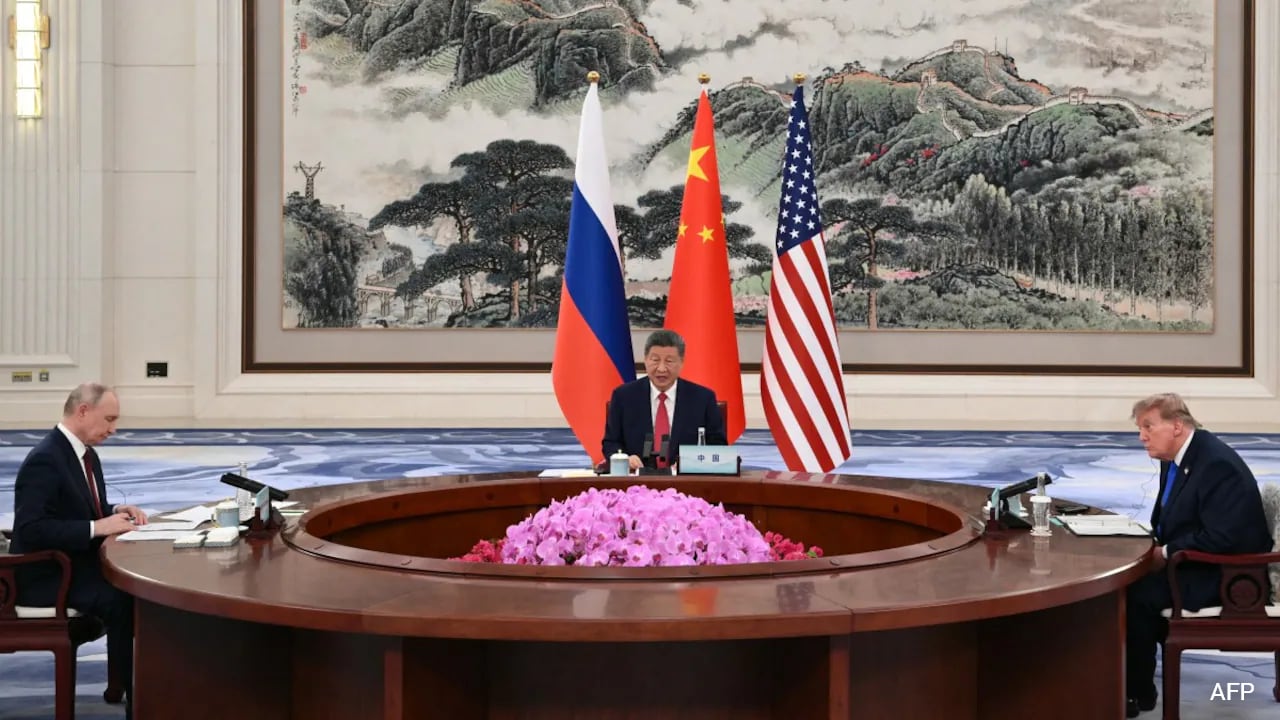
Cable news anchors love a clean visual. Put Xi Jinping, Donald Trump, and Vladimir Putin in the same room in Beijing, slap a graphic reading "Three Nuclear Powers at One Table" across the bottom of the screen, and watch the ratings climb. Pundits will immediately call it a historic breakthrough. They will compare it to Yalta. They will whisper about a new global order forged through sheer force of personality.
They are completely wrong.
A trilateral summit between Washington, Beijing, and Moscow is not a masterstroke of statecraft. It is a theatrical trap designed to flatter American vanity while handing China and Russia the exact structural concessions they have spent twenty years trying to extract. If you think putting three strongmen in a room solves nuclear proliferation or ends proxy wars, you do not understand how modern deterrence works. You are watching a magic show and applauding the distraction while the magician empties your pockets.
The Myth of Great Man Diplomacy
The lazy consensus in foreign policy circles assumes that global conflicts are just giant interpersonal misunderstandings. According to this logic, if you lock the decision-makers in a room without their bureaucratic handlers, they will cut a pragmatic deal over steak and baijiu.
I have spent two decades watching mid-level diplomats and corporate risk teams get burned by this exact delusion. They mistake personal rapport for aligned national interests. When a leader smiles for the cameras in the Great Hall of the People, analysts back in Washington rewrite their risk models overnight. Six months later, when the promised concessions fail to materialize, those same analysts act shocked.
States do not have friends. They have permanent interests, structural vulnerabilities, and domestic constituencies that limit what any single leader can actually give away.
Look at the mechanics of what happens when an American president travels to Beijing to meet both Xi and Putin simultaneously. Before a single word is spoken behind closed doors, the optics have already decided the winner. By traveling to China for a three-way summit, Washington validates Beijing as the central clearinghouse of global power. It places the United States on equal footing with a declining regional aggressor in Moscow and an ascending hegemon in Beijing, framing the world not as a rules-based international order, but as a three-way syndicate dividing up spheres of influence.
Why Trilateralism Breaks American Leverage
In bilateral negotiations, the United States holds asymmetric advantages. Washington can play Beijing’s economic reliance on Western consumer markets against Moscow’s desperate need for dual-use industrial components. It can isolate Russia while negotiating guardrails with China.
Put all three at the same table, and that leverage evaporates instantly.
- The Two-Against-One Dynamic: Xi and Putin have spent the last several years building a "no-limits" partnership rooted in a shared desire to dismantle American influence. At a trilateral table, Washington does not face two independent actors. It faces a coordinated bloc. Every American demand gets double-teamed.
- The Illusion of Equivalence: Nuclear parity is a mathematical reality between Washington and Moscow, and a rapidly approaching reality with Beijing. Political equivalence is a choice. Treating Putin’s war economy and Xi’s mercantilist state as moral equals to a constitutional republic legitimizes their domestic authoritarianism.
- The Distraction From Deterrence: Summits create a false sense of security. When leaders announce a vague "framework for strategic stability," lawmakers in Washington inevitably ask why they need to fund submarine production or modernize the aging land-based missile fleet.
What "Strategic Stability" Actually Means in Beijing and Moscow
When Western journalists hear the phrase "nuclear talks," they picture arms reduction treaties like START. They imagine inspectors counting warheads and dismantling silos.
That is not what Xi or Putin is bringing to the table.
As nuclear strategists like Thomas Schelling demonstrated decades ago, deterrence is not about eliminating weapons; it is about managing the credibility of threats. Today, the three powers are locked in what experts call the "three-body problem" of nuclear strategy. During the Cold War, deterrence was a two-player chess match between the US and the USSR. If one side built a missile shield, the other built more missiles. The math was predictable.
Adding China’s rapid nuclear expansion—which the Pentagon projects will cross 1,000 operational warheads by 2030—breaks the math entirely. If the United States reduces its arsenal to match Russia, it leaves itself vulnerable to a combined Sino-Russian force. If it builds up to deter both simultaneously, it triggers an unchecked arms race.
Neither Xi nor Putin wants to cap their nuclear growth right now. Russia relies on nuclear saber-rattling to compensate for the conventional degradation of its army in Ukraine. China is actively sprinting toward nuclear parity to deter American intervention in the Taiwan Strait.
When Beijing and Moscow agree to sit at a table in China to discuss nuclear issues, their goal is not disarmament. Their goal is to freeze American missile defense capabilities in the Indo-Pacific and restrict the deployment of conventional intermediate-range missiles in Japan and the Philippines. They want to trade empty promises of "dialogue" for concrete restrictions on American military hardware.
Dismantling the Common Misconceptions
If you follow the mainstream coverage of a potential Xi-Trump-Putin summit, you will run into the same three talking points repeated endlessly. Every single one of them is flawed.
"Talking to adversaries is always better than isolation."
This sounds mature and responsible, which is why politicians love saying it. In practice, unconditional high-level summits reward bad behavior. When a state invades its neighbor, threatens nuclear escalation, or coerces democracies through trade embargoes, granting its leader a photo-op with the President of the United States is a massive diplomatic gift. Talking through backchannels—intelligence chiefs, ambassadors, deputy ministers—is essential for preventing accidental war. Elevating those talks to a presidential spectacle without pre-negotiated, verifiable concessions is diplomatic malpractice.
"A deal could split Russia away from China."
This is the "Reverse Nixon" fantasy that refuses to die in Washington think tanks. Proponents argue that Trump could offer Putin a deal in Eastern Europe to peel Moscow away from Beijing, just as Richard Nixon exploited the Sino-Soviet split in 1972.
The flaw in this comparison is glaring. In 1972, China and the Soviet Union were actively fighting border skirmishes and terrified of a Soviet nuclear strike on Beijing. Nixon did not create the split; he walked through a door that history had already blown off its hinges. Today, Russia and China have no border disputes, complementary economies—Russian energy and raw materials feeding Chinese manufacturing—and a shared ideological enemy in the United States. Putin knows that Washington’s political commitments change every four years. Beijing’s commitment to the regime in Moscow is generational. Putin will gladly take American concessions, pocket them, and remain firmly aligned with Xi.
"Personal chemistry between strongmen cuts through red tape."
Strongmen respect power, not flattery. Both Xi and Putin are products of ruthless bureaucratic systems—the Chinese Communist Party and the KGB—where personal warmth is viewed as a vulnerability to be exploited. They view Western leaders who rely on personal rapport as amateurish and easily manipulated. While an American president might leave a meeting believing he has established a personal bond that guarantees peace, Xi and Putin leave the exact same meeting analyzing his psychological weak points for the next round of coercion.
The Quiet Cost to American Alliances
The real audience for a summit in Beijing is not the American public. It is Tokyo, Seoul, Taipei, Warsaw, and Canberra.
America’s greatest asymmetric advantage over both China and Russia is not its aircraft carriers or its GDP. It is its network of treaty alliances. Neither Beijing nor Moscow has true allies; they have transactional clients and nervous neighbors. Washington has wealthy, technologically advanced nations that willingly host American troops and integrate their militaries with the Pentagon.
That entire network runs on a single currency: trust. Specifically, the trust that Washington will not cut a side deal with authoritarian rivals behind its allies' backs.
Imagine a scenario where the leaders of the US, China, and Russia announce a joint communiqué in Beijing promising "mutual respect for core security interests." To an American voter, that sounds like harmless diplomatic boilerplate. To a policymaker in Taipei or Tokyo, "core security interests" is Beijing’s exact euphemism for absorbing Taiwan and pushing the US Navy out of the First Island Chain.
The moment allies suspect Washington is willing to trade their sovereignty for a headline-grabbing summit with Xi and Putin, the alliance system begins to fracture. Japan and South Korea start quietly debating their own nuclear weapons programs. European capitals hedge their bets by signing independent trade deals with Beijing. By chasing the illusion of a grand bargain at a single table, Washington risks shattering the very coalition that keeps China and Russia contained.
The Honest Downside of Refusing the Table
Walking away from summitry is not without risk. If the United States refuses to engage in high-level trilateral theater, critics will rightly point out that the risk of miscalculation remains dangerously high. Without direct leader-to-leader communication, a minor collision between a Chinese fighter jet and an American surveillance plane over the South China Sea, or a stray Russian missile landing in NATO territory, could spiral out of control before bureaucrats can get each other on the phone.
Furthermore, refusing to sit down hands Beijing and Moscow an easy propaganda victory across the Global South. They will paint Washington as an obstinate warmonger afraid of diplomacy, while portraying themselves as the responsible adults trying to broker global peace.
Those are real costs. Anyone claiming otherwise is selling a fantasy.
However, in geopolitics, you never get to choose between a good option and a bad option. You choose between a bad option and a worse one. Enduring temporary propaganda hits in the Global South is vastly preferable to legitimizing spheres of influence and eroding the nuclear umbrella that keeps East Asia and Europe stable.
How Real Deterrence Actually Works
If a flashy three-way summit in Beijing is the wrong move, what does actual, effective statecraft look like? It is boring, slow, and completely unsuitable for cable news chyrons.
- Separate the Tracks: Never negotiate with Beijing and Moscow in the same room. Keep Russia isolated through targeted economic pressure and military support for its neighbors, while engaging China strictly on bilateral terms where American economic and technological leverage is strongest.
- De-escalate Through Quiet Channels: Maintain ironclad, 24/7 military-to-military hotlines and quiet intelligence backchannels. Use them to manage crises and prevent accidental escalation, without turning them into public relations spectacles.
- Negotiate From Deployed Strength: Arms control treaties only happen when adversaries realize they cannot win an arms race. Ronald Reagan did not get Mikhail Gorbachev to sign the Intermediate-Range Nuclear Forces Treaty by hosting friendly summits first; he got it by deploying Pershing II missiles in Europe and proving that the Soviet Union could not outspend the West. Washington must rebuild its defense industrial base and harden its Pacific bases before expecting Beijing to take nuclear caps seriously.
- Keep Allies in the Room: Before any American official discusses regional security with Xi or Putin, Washington must establish a unified front with Tokyo, Seoul, and Brussels. If Beijing wants to talk about security in Asia, Japan and Australia belong at that table far more than Russia does.
Stop Confusing Motion With Progress
History is littered with famous summits that looked triumphant in the moment and catastrophic in hindsight. Munich in 1938. Yalta in 1945. Vienna in 1961, where Nikita Khrushchev sized up a young John F. Kennedy, decided he was weak, and promptly ordered the construction of the Berlin Wall and the deployment of nuclear missiles to Cuba.
Photographers love it when three powerful men shake hands under bright lights. Markets might even rally for forty-eight hours on the hope of reduced geopolitical tension.
Do not fall for it. Peace is not a photo opportunity in Beijing. Peace is the quiet, expensive, unglamorous maintenance of a balance of power that makes aggression suicidal. Until Washington remembers that distinction, every seat it takes at Xi and Putin’s table will cost more than it is worth.