The wind off the Indian Ocean doesn’t just blow against the Western Australian coast; it scours it. On a normal Tuesday morning, the beach belongs to the salt-crusted locals, the low-gliding pelicans, and the predictable scurry of sandpipers.
Then came the giants.
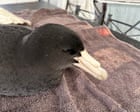
They looked like broken umbrellas at first, dark shapes crumpled where the foam meets the wet sand. But umbrellas don’t breathe. When the wildlife officers approached, the sheer scale of the creatures hit them like a physical blow. These weren't local gulls. These were creatures of the deep, dark Southern Ocean—beings that spend their entire lives navigating the brutal, freezing currents around Antarctica.
Brown skuas. Giant petrels.
To see one from a distance during a massive southern storm is a rare treat for a seasoned birdwatcher. To find them stranded, lethargic, and grounded on the warm sands of Western Australia is something else entirely. It is a biological anomaly.
It is a warning written in feathers and bone.
The Nomads of the Great Southern Void
To understand why a team of hardened field biologists felt a cold spike of dread at this sight, you have to understand what these birds actually are. They are not backyard fliers. They are the apex wanderers of the planet's most inhospitable latitudes.
Consider the giant petrel. With a wingspan stretching nearly seven feet, it is a creature built for the tempest. They do not fly so much as they harvest the energy of oceanic gales, dynamic soaring for thousands of miles without a single flap of their wings. They sleep on the wing. They drink seawater, excreting the excess salt through specialized tubes on their bills. Land is an afterthought, a temporary necessity reserved exclusively for the frantic weeks of the breeding season on sub-Antarctic islands.
The brown skua is no different. Powerful, aggressive, and highly intelligent, it is the raptor of the southern seas. It thrives where human life ends.
When creatures built for the screaming sixties—the notoriously violent latitudes of the southern hemisphere—end up sitting passively on a sunny beach near Perth, the narrative of the ecosystem has broken. It is the equivalent of finding a polar bear wandering through a European forest. It tells you, without words, that something has gone profoundly wrong out in the empty spaces of the map.
The Detective Work in the Dust
The immediate fear among the veterinary scientists who took in the disoriented arrivals wasn't just that the birds were sick. The fear was what they might be carrying.
In the tight-knit community of avian researchers, a shadow has been looming for years. Highly Pathogenic Avian Influenza, specifically the H5N1 strain, has been tearing through global wildlife populations with catastrophic efficiency. It had already marched through Europe, the Americas, and even crept into the sub-Antarctic islands, decimating colonies of elephant seals and fur seals alongside hundreds of thousands of seabirds.
Australia had remained a fortress. Isolated by vast oceans and strict biosecurity, the continent's unique wildlife had bypassed the worst of the global panzootic.
The arrival of the skuas and petrels felt like the breach of the fortress walls. These birds are scavengers. In the sub-Antarctic, they feed on dead seals and penguins. If H5N1 had broken out in their breeding grounds, these specific individuals could be the highly mobile vectors bringing the destruction straight to Australian shores.
The atmosphere inside the decontamination units was tense. Every swab taken from the nostrils and cloacas of the massive birds felt like defusing a bomb. A single positive result would mean the clock had run out for Australia’s isolated black swans, its unique penguins, and its commercial poultry industries.
The labs ran the tests. The scientists waited.
The results came back negative for avian influenza.
The collective exhale could be heard across the state's conservation departments. But the relief was short-lived. A negative test didn't solve the mystery; it merely shifted the nature of the threat. If they weren't dying of a viral plague, why were the masters of the ocean falling out of the sky?
The Invisible Starvation
The truth was visible only when you lifted the birds. A giant petrel should feel dense, a heavy muscle packed beneath waterproofing grease and thick down. These birds felt like kites made of balsa wood and silk.
They were starving.
To understand how an animal that can fly across an ocean starves to death, you have to look beneath the surface of the water. The southern oceans are changing. Marine heatwaves—periods where sea surface temperatures spike far above historic averages—are no longer anomalies. They are becoming the baseline.
When the water warms, the entire delicate architecture of the marine food web shifts. Krill, the microscopic engine of the southern ecosystem, dives deeper or dies off. The small fish that feed on the krill scatter. The squid follow the cold water down into the depths.
For a seabird that relies on skimming the surface or diving just a few meters deep, the ocean suddenly becomes a desert. The food is still there, perhaps, but it is locked away behind a barrier of warm water, out of reach.
The birds fly further. They use more energy. They burn through their fat reserves, then their muscle tissue. Eventually, the internal calculus fails. They run out of fuel mid-ocean. With no strength left to battle the headwinds, they are swept north, carried by forces they usually command, until they dump heavily onto the foreign, hot sands of the Australian coast.
The Cost of Survival
In the rehabilitation centers, the human element of this crisis took shape. Wildlife volunteers, accustomed to treating injured kangaroos or local seabirds, found themselves face-to-face with creatures of the deep ocean.
Feeding a sick giant petrel is not a gentle affair. These are formidable predators with razor-sharp hooks at the end of their massive bills. They defend themselves with a foul, oily stomach projection that smells of rotten fish and old iron.
Yet, the caretakers persisted. They wore heavy welder's gloves and protective visors. They blended nutrient-rich fish slurries, gently tubing the mixture down the long throats of the birds, trying to trick their shut-down digestive systems back into operation.
Every day was a gamble against organ failure. For some, the intervention came too late. Their systems were too degraded, their muscles too wasted to recover. But a few began to fight back. The dull glaze in their dark eyes gave way to the sharp, fierce glare of a wild predator. They began to snap at the gloves. They began to try and spread those immense wings inside the narrow confines of the recovery pens.
The Horizon Awaits
The ultimate goal of wildlife rehabilitation is always release, but with pelagic birds, the process is fraught with existential irony. You can heal the wings, you can pack the frame with fish fat, but you are ultimately sending them back out into the same empty desert that broke them in the first place.
On a rocky headland, far from the crowds, a transport box was opened.
The giant petrel didn't hesitate. It lumbered forward on legs that are awkward on land, its massive webbed feet slapping the stone. Then, facing into the stiff coastal breeze, it opened its wings. The wind caught the feathers, lifting the heavy body effortlessly.
With two deep, powerful strokes, the bird cleared the surf line. It settled low over the water, tilting its body to skim mere inches above the crests of the waves, instantly reclaiming its identity as a creature of the wind.
The humans watched from the cliff until the dark shape blended entirely into the gray expanse of the sea. There were no cheers, only a quiet, contemplative silence. The bird was gone, back to the wild southern latitudes, carrying with it the heavy mystery of an ocean in transition.