Silence.
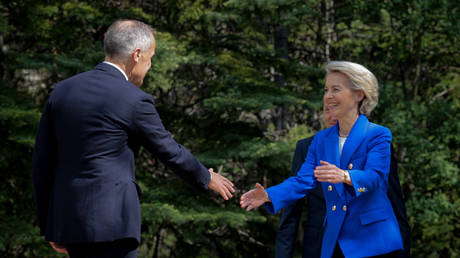
In the sterile, oak-paneled corridors of international diplomacy, silence is rarely an accident, and when European Commission President Ursula von der Leyen stood before the Canadian Parliament in Ottawa, the gap between her soaring rhetoric and the cold reality of transatlantic trade policy became an audible, uncomfortable hum that echoed far beyond the limestone walls of Parliament Hill.
To understand why a speech given in the crisp Canadian air matters to a machinist in Stuttgart, a lithium miner in northern Quebec, or a family trying to afford groceries in Lyon, you have to strip away the flags and the polite applause. You have to look at what happens when high-minded European ambition collides with the stubborn physics of global economics.
For years, I watched policy briefings unfold in Brussels from the back rows of press rooms that smelled faintly of burnt espresso and damp wool. You learn quickly in those rooms that the grander the vocabulary, the thinner the actual agreement underneath. When politicians start talking about shared destiny and unbreakable bonds without mentioning tariffs, supply chain quotas, or regulatory exemptions, something is stuck in the gears.
Von der Leyen arrived in Canada carrying a heavy briefcase of European anxieties. Europe is squeezed. On one side sits a belligerent Russia that shattered decades of cheap energy assumptions; on the other sits a fiercely protectionist United States pouring hundreds of billions of dollars into green subsidies through the Inflation Reduction Act, vacuuming up European factories and capital in the process. Caught in the middle, Brussels needed a win. It needed raw materials. It needed Canada.
The Architecture of a Polite Standoff
Consider a hypothetical scenario to see the friction clearly. Imagine a mid-sized battery manufacturer in Munich—let us call him Lukas—who spent the last decade believing the European Union’s green transition would be built on predictable rules and steady partnerships. Suddenly, Lukas realizes the cobalt, nickel, and lithium he needs to keep his assembly line moving are locked in a global bidding war. Washington is offering massive tax credits to anyone who builds on North American soil. Beijing already controls the lion's share of global mineral refining.
So Lukas looks to Brussels for help. And Brussels looks to Ottawa.
Canada sits atop one of the richest geological treasure chests on earth, packed with the exact critical minerals required to power electric vehicles, wind turbines, and grid-scale batteries. On paper, the marriage between European industrial engineering and Canadian natural resources looks effortless. Both sides share democratic values, legal norms, and a historic trade agreement—the Comprehensive Economic and Trade Agreement, or CETA—that has been provisionally in force since 2017.
Yet, when the cameras rolled in Ottawa, the power play stumbled over the details.
Words failed the EU boss not because she lacked eloquence, but because rhetoric cannot override domestic self-interest. While von der Leyen spoke of deepening cooperation on clean technology and critical raw materials, the underlying realities told a far messier story. Ten European Union member states still had not fully ratified CETA years after its signing, held hostage by local agricultural lobbies, regional parliaments, and lingering public skepticism over trade courts.
Walking into Ottawa to ask for preferential access to Canadian resources while your own house has yet to finish ratifying the last major deal is a difficult hand to play. Canadians noticed. Politicians in Ottawa, facing their own domestic pressures over inflation, housing costs, and regional economic disparities, were in no mood to simply hand over strategic assets in exchange for lofty European speeches.
Why Diplomatic Friction Hits Kitchen Tables
It is tempting to dismiss diplomatic theater as a distant game played by people in tailored suits who never worry about the price of heating oil. I used to think that way, until I spent a winter reporting from an industrial town in northern Germany where a single chemical plant employed a third of the local workforce. When trade negotiations stall in Brussels or Ottawa, that plant does not immediately close. Instead, an investment decision gets quietly postponed. A planned expansion moves to Texas. Three years later, the local bakery closes because fewer shift workers stop by at dawn.
That is the invisible stake behind von der Leyen’s Canadian trip.
When people ask why Europe cannot simply buy minerals on the open market, the answer lies in how concentrated global supply chains have become. According to data from the International Energy Agency, China processes roughly 60 to 90 percent of the world's lithium, cobalt, and rare earth elements. Relying on a single geopolitical rival for the building blocks of the twenty-first-century economy is a vulnerability Europe can no longer afford, especially after learning the painful lesson of relying on Russian natural gas.
Think of the global economy right now like a massive electrical grid during a summer heatwave. Every major power—Washington, Brussels, Beijing—is cranking its industrial air conditioning to full blast at the exact same moment. The wires are overheating. To keep their own lights on, countries are hoarding transformers and cutting off neighbors.
In that environment, the United States passed the Inflation Reduction Act, offering massive subsidies tied to North American manufacturing and free-trade partners. Because Canada shares a deeply integrated supply chain with the United States, Canadian minerals naturally qualify for those American incentives. Europe, initially shut out of those subsidies, found itself watching its own green-tech companies pack their bags for North America.
Von der Leyen’s trip to Ottawa was an attempt to pry open a side door into that North American ecosystem. By forging a closer raw-materials partnership with Canada, Brussels hoped to secure guaranteed supply lines without having to match Washington dollar-for-dollar in subsidies—money the European Union simply does not have in a centralized treasury.
The Weight of Unkept Promises
Listen closely to how diplomatic pushback actually sounds. Nobody stands at a podium and shouts that a deal is dead. Instead, they talk about "ongoing consultations," "mutual respect for regulatory frameworks," and "alignment of standards."
In Ottawa, the friction surfaced around two core issues: energy and trade ratification.
Following Russia's invasion of Ukraine, European leaders scrambled across the globe begging for liquefied natural gas to replace lost Russian pipelines. Canada, one of the world's largest energy producers, seemed like an obvious savior. Yet Canadian Prime Minister Justin Trudeau poured cold water on the idea of rushing new East Coast export terminals, questioning whether there was a strong "business case" for building massive fossil fuel infrastructure that would take years to complete—just as Europe pledged to phase out fossil fuels altogether.
It was a devastatingly logical point, and it exposed a deep contradiction at the heart of European policy. Brussels wanted Canada to absorb the immense upfront capital risk of building new energy export capacity while simultaneously insisting that Europe’s demand for that very fuel would shrink within a decade.
When von der Leyen shifted the conversation toward hydrogen and critical minerals, the ghost of that earlier skepticism lingered in the room. Building a mine in the Canadian Shield takes anywhere from ten to fifteen years, billions of dollars in capital, environmental reviews, and complex negotiations with Indigenous communities whose lands hold those deposits. It is gritty, capital-intensive work that cannot be accelerated by a European Commission press release.
The Illusion of Transatlantic Unity
There is an uncomfortable truth that Western leaders rarely admit in public: shared values do not erase competing balance sheets.
For decades after the Cold War, transatlantic diplomacy operated on autopilot. Trade grew, tariffs fell, and politicians could rely on familiar scripts about the rules-based international order. I remember attending transatlantic forums in the late 2010s where speakers could fill forty-five minutes simply by invoking the spirit of cooperation without naming a single concrete policy mechanism.
Those days are gone.
Today, industrial policy has returned with a vengeance. Every major economy is using state power to protect domestic jobs, secure strategic resources, and dominate emerging technologies. In this harder, sharper world, diplomacy requires hard currency—tariffs lowered, capital committed, regulatory red tape actually cut.
Von der Leyen’s vulnerability in Ottawa stemmed from the structural limits of her own office. As President of the European Commission, she represents twenty-seven distinct nations with wildly different economic priorities. France wants protection for its farmers and nuclear industry; Germany wants open export markets for its automakers; Poland and the Baltic states prioritize security above all else. Crafting a bold, decisive trade offer that satisfies all twenty-seven capitals simultaneously is like trying to steer a supertanker with twenty-seven different captains yelling commands at the helm.
When she stood in Canada, she could offer vision, moral clarity on supporting Ukraine, and institutional goodwill. What she could not offer was a unified, nimble European market ready to write blank checks or sweep away agricultural protectionism overnight.
What Happens When the Applause Fades
The danger of a misfired diplomatic power play is not immediate collapse; it is slow drift.
If Europe fails to lock in reliable, commercially viable partnerships with resource-rich democracies like Canada, European manufacturers will make their own choices. They will quietly shift research budgets to Boston, battery plants to Ontario, and assembly lines to Michigan, where the subsidies are clear and the raw materials are already next door.
You can see the early tremors of that shift in the quarterly earnings calls of major European industrial firms. Executives who once spoke proudly of European manufacturing heritage now speak calmly, almost clinically, about "geographic diversification" and "regionalized supply chains." Behind those sanitized corporate phrases lies a simple reality: capital flows where the friction is lowest.
Admitting this is unsettling, especially for anyone who believes in the strength of democratic alliances. It would be comforting to believe that a stirring speech in Ottawa could align the economic interests of two continents. But trade is built on contracts, mines, ports, and ratified treaties—not applause lines.
Until Brussels resolves its own internal contradictions—ratifying the deals it has already signed, aligning its green regulations with the messy realities of resource extraction, and putting real capital on the table—speeches in foreign parliaments will continue to ring hollow.
Late that afternoon in Ottawa, after the motorcades pulled away from Parliament Hill and the television crews packed up their tripods, a light freezing rain began to fall over the Ottawa River, coating the iron railings along the banks in a thin, stubborn sheet of ice that no amount of warm breath could melt.