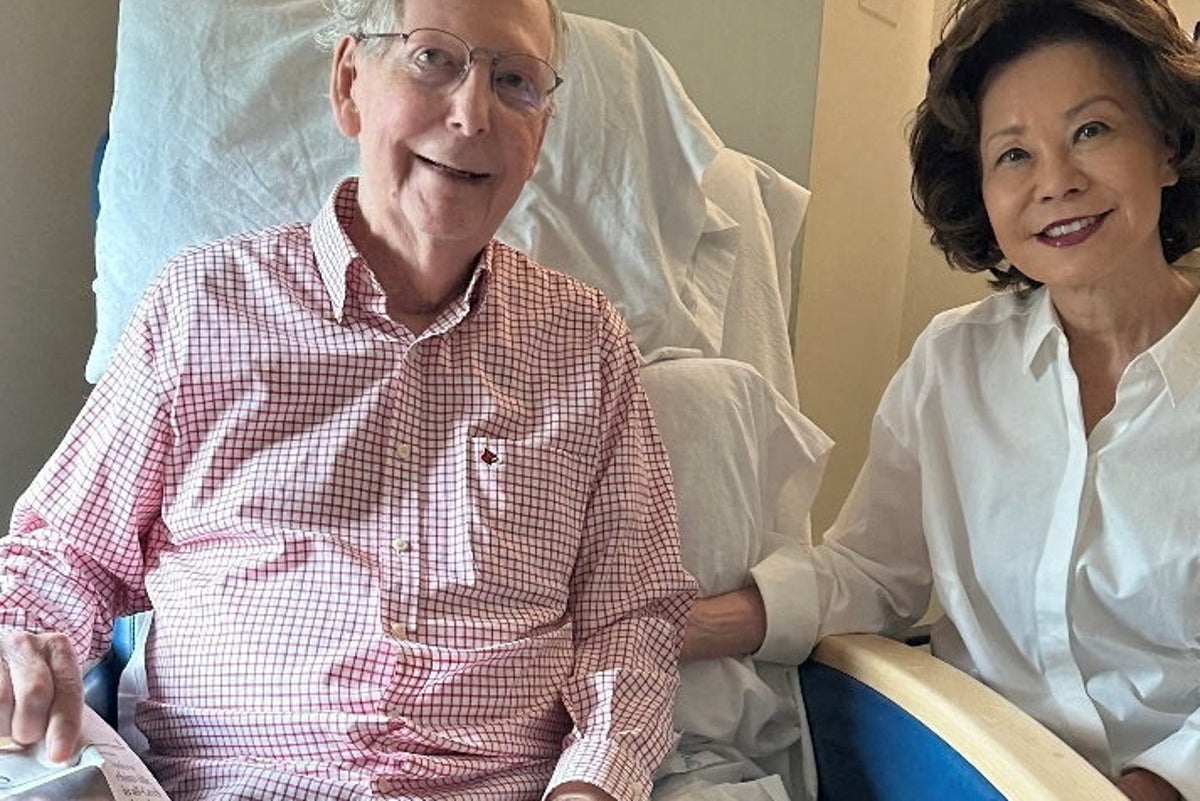
The camera does not capture the chill in the air. It only captures the contrast.
On a gray afternoon, a woman steps through the heavy glass doors of a rehabilitation facility. She is wrapped in a beige trenchcoat, buttoned high. A dark mask covers her nose and mouth. Her sunglasses shield her eyes from the sudden, sharp glare of a lens she knew would be waiting for her.
To the photographer, she is a paycheck. To the political commentators, she is a symbol. To the dark, hyperactive corners of the internet, she is a puzzle piece to be violently forced into a pre-existing picture.
But beneath the heavy fabric, beneath the layers of protection and the silence of a waiting sedan, she is simply a human being trying to survive the quiet aftermath of a storm.
This is Elaine Chao.
To the world, her identity is defined by the powerful men and institutions around her. She is a former cabinet secretary. She is the wife of Mitch McConnell, the long-serving senate leader whose physical frailty has itself become a matter of intense public scrutiny. Yet, in this fleeting moment caught on a telephoto lens, she is stripped of her titles. She is reduced to a silhouette.
Almost instantly, the digital machine begins to churn. Within hours of the image appearing online, the theories emerge. They spread like wildfire through dry brush. It is not a recovery; it is a cover-up. The mask is not for health; it is to hide a body double. The trenchcoat is not for warmth; it is a disguise.
We have forgotten how to look at a person and see a human being. Instead, we see a character in a sprawling, paranoid fiction of our own making.
The Weight of the Unseen
Consider what it means to heal in public.
For most of us, recovery is a private affair. It is a slow, messy process of physical therapy, quiet afternoons, and the slow mending of bones or spirit. We wear our oldest, most comfortable clothes. We do not brush our hair. We allow our faces to show the exhaustion of the struggle. We do not have to worry about how our limp will be interpreted on a late-night forum.
Now, imagine that every step you take is graded on a curve of political theater.
If you walk too slowly, you are weak. If you cover your face, you are hiding a secret. If you look tired, it is proof of a grand conspiracy.
The human body is remarkably fragile. It breaks. It ages. It requires maintenance, time, and occasionally, the intervention of specialists behind the closed doors of a rehabilitation clinic. Chao, who has spent decades navigating the highest corridors of power, is not immune to the simple, stubborn realities of biology. She has faced immense personal tragedy, including the sudden, devastating loss of her sister in a horrific accident. Grief, much like physical illness, leaves a physical mark. It bends the shoulders. It makes the light hurt your eyes.
Yet, the internet demands that there be no grief, no illness, no ordinary human vulnerability. Every event must be a chess move.
This is the real cost of our modern information ecosystem. We have traded empathy for entertainment. We watch the lives of public figures not with a sense of shared humanity, but with the cold, analytical detachment of a detective looking for clues at a crime scene.
The Architecture of Paranoia
Why is it so hard to believe that an older woman leaving a medical center might want to wear a mask and a coat?
The answers lie in the way we have trained ourselves to interact with reality. In a world where everything feels manufactured, we assume that authenticity is a lie. We look at a straightforward image—a recovering woman trying to avoid a cold or a photographer—and we find it too boring. It lacks narrative tension. It does not satisfy our craving for drama.
So, we invent a plot.
We tell ourselves that the mask is a shield against recognition, ignoring the fact that she is one of the most recognizable women in political history and that a trenchcoat in a parking lot is hardly an invisibility cloak. We dissect the angle of her head, the fold of her sleeves, the way her shoes strike the pavement. We turn a mundane departure into an escape scene from a spy thriller.
But the truth is far more quiet. And far more fragile.
The truth is that the human body eventually demands a reckoning. No amount of political power, no amount of wealth, and no amount of influence can protect a person from the slow, steady wear of time and grief. When we refuse to see that truth, we are not exposing a conspiracy. We are exposing our own deep, terrifying fear of our own vulnerability.
We project our fears onto her. If she can break, if she can look frail, if she can require the assistance of a rehab clinic, then so can we. And that is a reality many find too difficult to face.
The Silence of the Aftermath
The car door closes. The sedan pulls away from the curb, leaving the photographers and the speculators behind in the dust.
Inside the vehicle, away from the lenses and the whispered questions, the noise of the internet does not exist. There is only the hum of the engine and the quiet rhythm of a journey home.
We will likely never know the specific details of what brought her to that facility, nor should we. Some parts of a life must remain behind closed doors, sacred and untouched by the collective hunger of the public square.
But as the image of the woman in the trenchcoat fades from the news cycles, replaced by the next viral outrage, the question remains. What do we lose when we refuse to allow our leaders, our opponents, and our public figures to simply be human?
We lose the ability to see ourselves in them. We lose the capacity for grace. We build a world made of mirrors and smoke, where every gesture is a deception and every illness is a plot point. And in that cold, sterile space, the one thing we truly end up hiding is our own humanity.