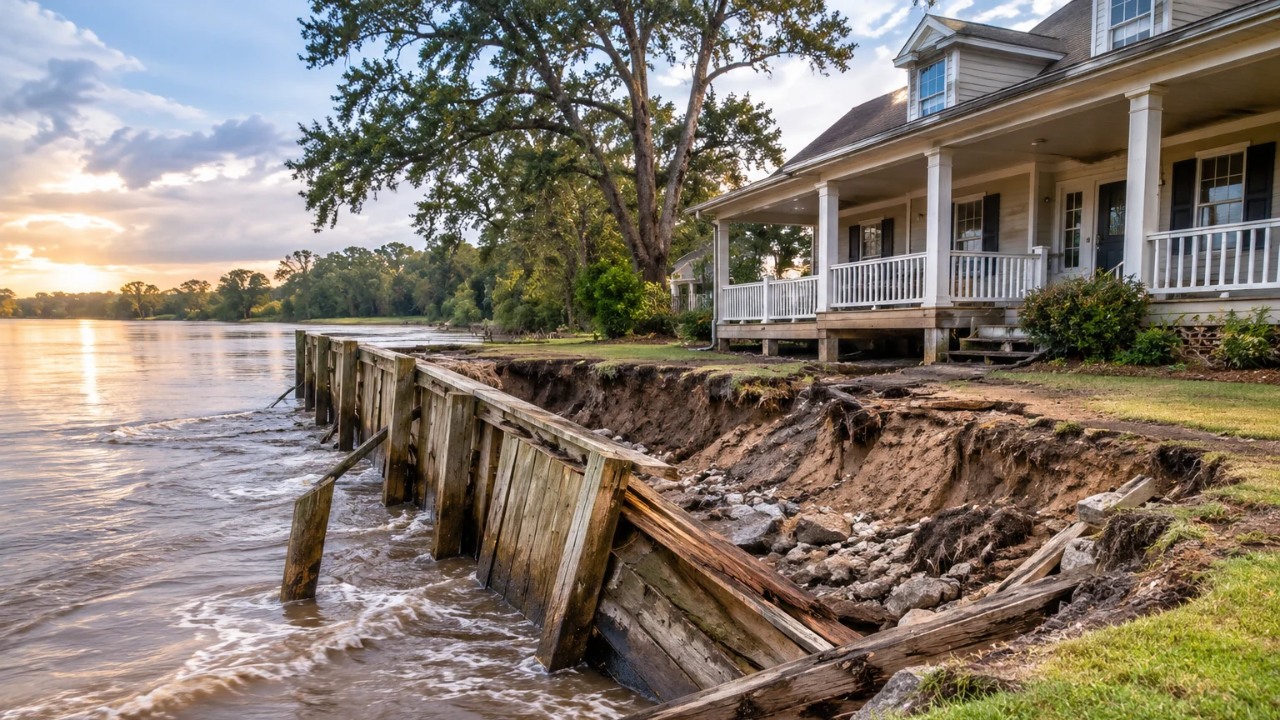
Every local news outlet loves a David-versus-Goliath payout story. A Louisiana homeowner spends $32,500 on a river barrier, the wall fails, her house shifts, and a judge hands her nearly $450,000. The headlines practically write themselves. Homeowner vindicated. Bad contractor punished. Justice served.
Except that narrative is a comforting lie.
When a residential foundation shifts because a retaining structure collapsed, a $450,000 judgment is not a windfall. It is barely a down payment on a nightmare that never really ends. Mainstream coverage treats construction litigation like a lottery ticket, framing the final dollar amount as a victory lap while completely ignoring the brutal math of civil engineering, legal collection, and structural entropy.
If you own waterfront property, or if you work anywhere near residential infrastructure, celebrating this verdict misses the entire point. The real story is not that the legal system worked. The real story is how a $32,500 quote was a guaranteed structural failure before the first shovel ever hit the dirt.
The $32,500 Delusion
Let’s look at the numbers with cold, sober eyes. In Louisiana—where alluvial soils, high water tables, and hydrostatic pressure turn every excavation into a battle against physics—$32,500 buys you almost nothing in heavy marine construction.
A proper engineered bulkhead or retaining wall along a moving waterway requires geotechnical soil borings, structural engineering stamps, deep-driven pilings, deadman anchors, and proper drainage weep systems. Depending on linear footage and soil composition, legitimate riverfront stabilization routinely runs into the six figures. When a contractor quotes $32,500 to hold back a river and support the lateral load of a residential structure, they are not giving you a bargain. They are selling you a cosmetic fence disguised as civil engineering.
I have walked dozens of failed residential sites across the Gulf Coast after heavy rain events. Almost every single one shares the exact same autopsy report. The homeowner shopped on price. The contractor skipped the geotechnical engineer to keep the bid low. They sank shallow timber or thin vinyl sheets without adequate tie-backs, ignored subsurface water movement, and prayed the river wouldn't rise.
Physics does not care about your budget. Water weighs 62.4 pounds per cubic foot. When soil behind a wall becomes saturated and cannot drain, that weight turns into relentless lateral hydrostatic pressure. Without deep tie-backs anchored into stable soil strata far behind the failure plane, the wall rotates outward. Once the retaining wall moves, the soil wedge supporting the home’s foundation loses its lateral confinement. The earth slides toward the water, and the house goes with it.
Why $450,000 Barely Covers the Bleeding
The media stops reading the story the second the judge bangs the gavel. They see $32,500 spent and $450,000 awarded, and their brains do lazy arithmetic: She made over $400,000 in profit.
That is pure fantasy. Anyone who has actually navigated construction defect litigation knows how fast half a million dollars evaporates.
First, look at the legal haircut. Most plaintiffs cannot afford to pay a construction litigator $450 an hour out of pocket for three years while experts depose each other. They take the case on contingency. Standard contingency fees jump from 33% to 40% the moment a case goes to trial. Right off the top, $150,000 to $180,000 vanishes into the law firm's operating account.
Next come the litigation costs, which are separate from attorney fees. You cannot prove a wall failed improperly without forensic structural engineers, geotechnical drilling crews, surveyors, and expert witnesses billing $300 to $500 an hour for reports and courtroom testimony. In a multi-year foundation case, hard litigation costs easily consume another $40,000 to $75,000.
Now look at what is left—roughly $200,000 to $250,000—and compare it against the actual cost of fixing the catastrophe.
- Demolition and Extraction: You cannot build a new wall over a failed one. You have to extract twisted, leaning pilings and unstable debris from active mud without triggering a secondary landslide.
- Engineered Marine Stabilization: Now you have to build the wall that should have been built the first time, except the site conditions are infinitely worse because the soil shear strength has already been compromised.
- Foundation Underpinning: A shifted house does not magically level itself. You need helical piers or concrete push piers driven to load-bearing strata beneath the home, followed by hydraulic jacking to lift the structure back to grade.
- Interior Reconstruction: Lifting a shifted house cracks drywall, snaps plumbing lines under the slab, warps door frames, and ruins flooring.
By the time the engineers, foundation specialists, and general contractors finish, that $450,000 judgment is gone—and the homeowner might still be writing checks out of their own savings to finish the kitchen.
And that assumes the contractor actually has $450,000 to pay.
The Paper Judgment Trap
Here is the dirty secret of residential construction lawsuits that reporters never mention: winning in court and collecting a dime are two entirely different sports.
Contractors who bid $32,500 for complex marine work rarely carry robust general liability policies with completed-operations coverage that applies to faulty workmanship. In fact, standard Commercial General Liability (CGL) policies routinely exclude the cost of repairing the contractor's own defective work. While resulting damage to the home might trigger coverage, insurance carriers fight those claims with armies of coverage counsel, often forcing settlements for pennies on the dollar.
If the insurer walks away, the homeowner is left chasing the assets of a small LLC. Half the time, the contractor dissolves the company, shifts their trucks to a new entity, and leaves the plaintiff holding a $450,000 piece of paper worth less than the ink printed on it.
Dismantling the Myth of "Licensed and Insured"
When stories like this circulate, the standard consumer advice is always the same: Make sure your contractor is licensed, bonded, and insured.
That advice is dangerously naive.
A state contractor's license proves someone passed a basic business and law exam and met minimal financial net-worth thresholds. It does not prove they understand soil mechanics, pore water pressure, or slope stability. Carrying general liability insurance only means they have a policy to cover accidental damage—like dropping a tree limb on your roof—not that they possess the engineering competence to alter the topography of a riverbank.
Furthermore, a standard surety bond for a residential contractor in states like Louisiana is often capped at $10,000 to $25,000. If they destroy your property to the tune of half a million dollars, a $15,000 license bond is an insult.
The Questions Waterfront Buyers Refuse to Ask
If you are looking at buying property on a river, bayou, lake, or coastal canal, stop asking realtors if the bulkhead looks good. Realtors sell aesthetics; they do not read soil reports. Start asking the questions that actually protect your net worth.
"Who designed the retaining structure, and where are the stamped drawings?"
If a contractor says they "don't need an engineer because they've been building walls for twenty years," walk away immediately. Twenty years of doing something wrong is just twenty years of bad habits. Any wall holding back more than three to four feet of soil—especially near moving water—requires a licensed Civil or Geotechnical Engineer (PE) to calculate lateral earth pressures and specify embedment depths.
"How does water get out from behind this wall?"
Water is the enemy. A solid barrier without hydro-static relief is just a dam waiting to burst. Look for weep holes backed by geotextile filter fabric and clean aggregate drainage stone. If the design relies entirely on holding water back rather than letting groundwater drain safely through the wall, it will fail.
"What happens if the river drops rapidly?"
Engineers call this rapid drawdown. When river levels are high, water pushes against the front of the wall, helping support it. When floodwaters recede quickly, the water outside drops, while the soil behind the wall remains completely saturated and heavy. Most residential walls fail not at peak flood, but three days after the water goes down. If your contractor looks confused when you mention rapid drawdown, fire them before they unload their excavator.
How to Actually Protect Waterfront Property
If you want to stabilize shoreline without ending up in a three-year courtroom brawl, flip the traditional residential construction model upside down. Never hire a contractor to design and build a marine barrier. Separate the brain from the muscle.
- Hire the Geotechnical Engineer First. Before you talk to a single marine contractor, pay $3,000 to $6,000 for an independent geotechnical engineering firm to drill soil borings along your shoreline. They will tell you where the clay, sand, and organic muck sit, and they will give you the exact depth required to hit stable load-bearing soil.
- Pay for Structural Plans. Have a structural engineer draw the exact specifications: piling diameter, material grade, embedment depth, tie-rod spacing, and deadman anchor locations.
- Bid the Plans Apples-to-Apples. Now take those stamped blueprints to three marine contractors. Because every contractor is bidding on the exact same engineering specifications, you eliminate the "cheap shortcut" bid. If one bid comes in 40% lower than the others, you know immediately they are planning to cut corners on material thickness or piling depth.
- Demand Third-Party Inspection. Pay your engineer an extra $1,500 to visit the site while the pilings are being driven. Once a piling is in the ground, nobody can tell if it is 20 feet deep or 12 feet deep. Having the engineer verify embedment depth in real time is the single highest-ROI insurance policy you can buy.
The Brutal Trade-Off Nobody Wants to Hear
Doing this the right way comes with an uncomfortable catch: it costs a fortune upfront, and it kills the romantic fantasy of cheap waterfront living.
Spending $15,000 on engineering, soil testing, and inspections before a single board is nailed in place feels painful. Watching your total project budget balloon from $32,500 to $140,000 makes you question whether the river view is even worth it. Sometimes, the honest engineering answer is that the bank is too unstable to save economically, and the smartest financial move is to sell the property or move the structure back from the edge.
Nobody puts that in a feel-good news segment.
Courts can award damages, attorneys can issue press releases, and judges can sign orders for $450,000. None of it puts the dirt back under your house. When you build on the edge of moving water, gravity and hydraulics write the only laws that matter—and they never settle out of court.