Silence.
That is the first sound you notice when a utility flips the switch on a high-voltage circuit across a dry California canyon. No hum from the refrigerator in the hallway. No soft click of the thermostat adjusting to a gusty afternoon. No white noise from the box fan trying to push warm air across a bedroom. Just the dry scrape of eucalyptus leaves against a corrugated roof and the sudden, hollow weight of a house going dark. Meanwhile, you can read similar stories here: What Really Happens When We Walk Away From a Burning Ridge.
I have stood on a porch in Northern California during a red-flag wind event, tasting ash on my tongue hours before a single column of smoke broke over the nearest ridge. Your eyes scan the horizon out of sheer muscle memory. Your ears strain for sirens that haven't started yet. And in the back of your mind, a quiet, uneasy arithmetic begins: if the power goes out because of high winds, what happens when the wind pushes a wildfire into a neighborhood that already has no lights, no cell towers with full backup batteries, and no time to spare?
On paper, a headline like California wildfires spread amid strong winds; over 150,000 customers without power reads like a routine dispatch from a state perpetually on edge. Numbers do that. A hundred and fifty thousand customers sounds like an abstract ledger entry—a row in a utility outage tracker or a line in a morning briefing. Yet behind every single account number is a household trying to decide whether to stay, pack, pump water, or drive into a wall of smoke. To see the complete picture, check out the detailed article by Associated Press.
To understand why wind-driven wildfires and mass power shutoffs feel so personal—and so maddeningly trapped—we have to look past the ticker tape and follow the people caught between two hazards at once.
The Cruel Bargain in the Dark
Consider a hypothetical family—let us call them the Nguyens, living in a foothill town where oak woodlands meet suburban cul-de-sacs—during a severe offshore wind event. This scenario is invented to illustrate a real operational dilemma faced across California's wildland-urban interface, not an account of a single real-world household.
At 2:15 p.m., gusts whip down the canyon at fifty miles an hour, stripping moisture from cured grass and chaparral in minutes. A utility control room in San Francisco or Los Angeles watches real-time wind speeds, humidity drops, and fuel dryness climb past safety thresholds. Operators face an agonizing choice. Leave high-voltage lines energized in hurricane-force gusts, and a falling branch or wind-slapped conductor could spark a fast-moving brush fire. Cut power to protect the grid from becoming an ignition source, and more than 150,000 customers lose electricity right as danger peaks.
For the Nguyens, the alert arrives on a phone with thirty-eight percent battery. Within twenty minutes, the lights flicker and die.
Now the contradictions pile up. Without grid power, an electric garage door refuses to budge unless someone knows where the red release cord hangs and has the strength to pull it against a heavy spring. Cordless landlines go dead when neighborhood nodes run down. Cell service slows to a crawl or drops out entirely if nearby sites lose backup generators. A neighbor down the street relies on a home oxygen concentrator or a refrigerated insulin supply; another has a well pump that cannot lift water without electricity.
Why does shutting off the power create so many secondary problems when wildfire risk is already high? Because modern life assumes electricity is always there when emergencies strike. When a wildfire spreads amid strong winds, people need real-time evacuation orders, lit streets, working traffic signals, air filtration, and water pressure. Cutting power removes the exact infrastructure many households lean on to stay informed and mobile—even when that shutoff is done specifically to keep a power line from starting a fire in the first place.
That is the bitter paradox at the heart of California's wind-and-fire seasons. Engineers call it risk mitigation. Residents living in the dark with a go-bag by the front door call it holding your breath.
How Wind Turns a Spark Into a Sprint
Firefighters have a saying that sounds simple until you watch a hillside ignite: fuels, topography, and weather decide how a fire behaves, and wind is the one that changes the clock.
When air is calm, a wildfire often creeps—consuming litter on the forest floor, curling around tree trunks, giving crews time to anchor a containment line and build a scratch line with hand tools or bulldozers. Add strong downslope or offshore winds—the kind that funnel through mountain passes and compress as they drop toward the coast—and the physics flip overnight.
Strong winds do three things at once. First, they tilt flames forward over unburned vegetation ahead of the fire front, preheating grass, brush, and timber through radiation and convection so they ignite almost instantaneously. Second, they feed oxygen directly into the combustion zone, turning smoldering pockets into roaring runs that can race up steep slopes at blinding speed. Third, they loft burning embers—firebrands—hundreds of yards or even miles ahead of the main flame front.
I remember watching a light rain of glowing embers drift across a dry pasture during a wind-whipped afternoon years ago. There was no towering wall of flame right in front of us yet, just an orange-gray haze and little red sparks landing in dry thatch like cigarettes tossed from a moving car. A fire does not have to march across your lawn to reach your house when the wind is carrying fire through the air. A single ember tucked under a wooden deck, inside an unscreened attic vent, or against dry mulch can start a spot fire miles from where the main blaze started.
That ember transport is why evacuation orders during windy wildfire events often come with little warning. A fire that looks distant on a map at noon can jump a creek, cross a highway, and threaten a subdivision before dusk. When over 150,000 customers are simultaneously without power, getting word to everyone—especially older residents, visitors unfamiliar with local roads, or people without reliable mobile reception—becomes a race against both wind speed and fading batteries.
Inside the Control Room and Along the Line
It is easy to cast utilities and emergency managers as villains when the power goes out and smoke darkens the sky. It is just as easy to treat fire crews as superheroes who can out-muscle any gust. Both shortcuts miss the real mechanics of how these crises unfold.
Think of the electric grid like a vast spiderweb stretched across mountains, valleys, and desert passes. Every strand carries high-voltage current. When dry brush brushes a line, or a tree limb snaps in a sixty-mile-per-hour gust, or hardware fails under mechanical strain, an electrical arc can throw sparks straight into bone-dry tinder. Over California's history, wind-driven wildfires ignited by or interacting with utility infrastructure have caused devastating losses of life, homes, and ecosystems.
Utility meteorologists and system operators monitor wind gusts, humidity, and fuel moisture around the clock to decide when Public Safety Power Shutoffs—or circuit recloser settings that keep lines from automatically re-energizing after a fault—are warranted. When they shut power off across tens of thousands of homes and businesses, they are trying to prevent a catastrophic ignition during peak wind hours.
Yet every shutoff carries a human cost. Families throw out hundreds of dollars of spoiled groceries. Small businesses close their doors mid-shift. Medical baseline customers face real health risks if backup batteries run low. Even after winds ease, crews cannot simply flip every switch back on in seconds; line workers must patrol miles of rugged terrain—sometimes on foot or by helicopter—to inspect wires and poles for damage before safely restoring power.
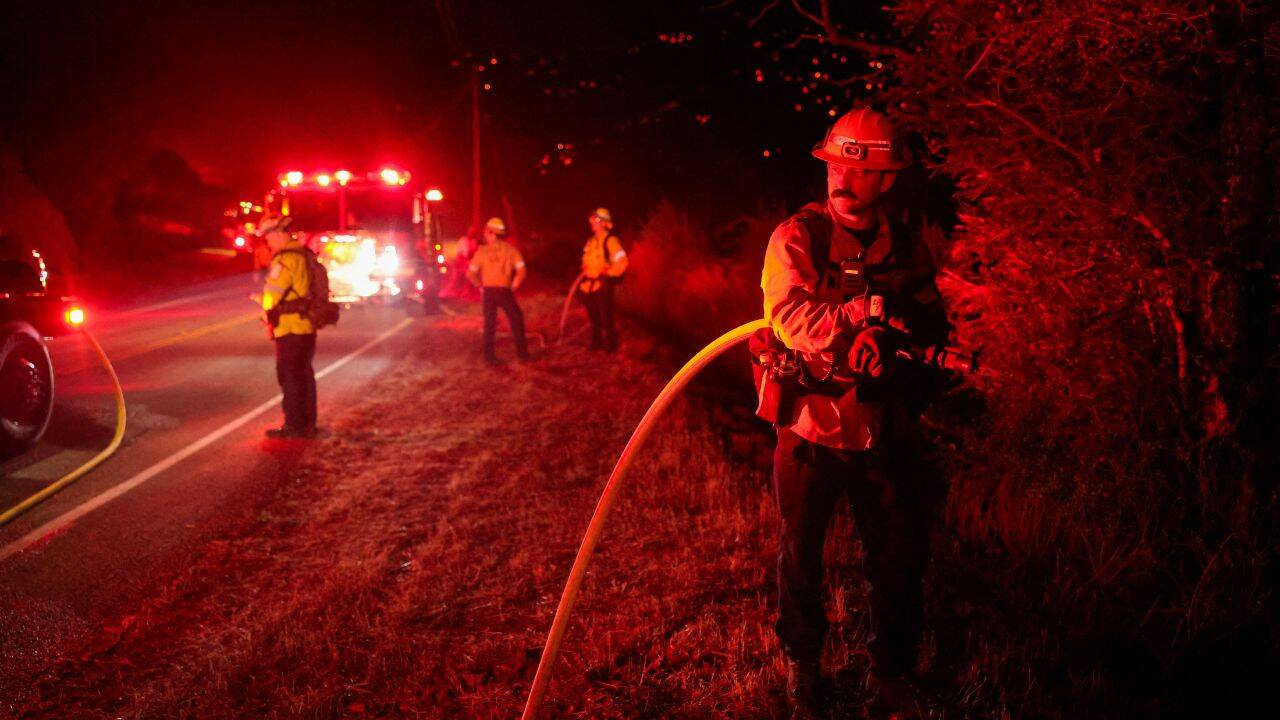
Meanwhile, Cal Fire, U.S. Forest Service crews, municipal firefighters, and mutual-aid engines work the fire lines under conditions that test every piece of gear and every ounce of endurance. High winds ground air tankers and helicopters when turbulence makes low-level drops too dangerous. Smoke chokes canyons, shrinking visibility to a few car lengths. And if a fire ignites where power is already out, responders are navigating dark neighborhoods, downed limbs, and congested two-lane roads while trying to keep residents ahead of the flames.
What People Actually Ask When the Sky Turns Brown
When wind picks up and outage alerts start chiming, questions come fast—not academic questions, but practical ones that shape what you do in the next ten minutes.
One of the first things people ask is whether they should leave before an official evacuation order is issued. There is no single rule that fits every canyon, because leaving too early on a false alarm wastes energy, while waiting for a formal knock on the door can put you in gridlock if a wind-driven fire erupts nearby. Emergency officials generally urge residents in high-fire-severity zones to pay close attention to local alerts, know at least two routes out, keep gas tanks at least half full, and prepare to leave early when winds are severe—especially if you have mobility limits, pets, livestock, or medical needs that take extra time.
Another common question is why power outages can last even after the wind dies down. Restoration is not a single lever. Even when gusts subside, lingering hot spots, fallen trees, damaged crossarms, or high fire danger in adjacent zones can keep circuits off until inspections are complete. A circuit might be de-energized for safety during peak wind, then held off while crews verify lines are intact and safe to re-energize without sparking a new fire.
People also wonder how a home without power can stay safer if smoke or embers arrive. Simple physical steps matter enormously when electricity fails: closing windows and exterior doors tightly, shutting dampers on fireplaces, moving flammable outdoor items like patio cushions and stacked firewood away from walls, and running a portable battery-powered or rechargeable radio so you are not dependent on cell towers alone. A car in the garage can even serve as a makeshift charging station for a phone in a pinch—provided the garage door is open and you never run the engine inside an enclosed space.
Why This Keeps Happening—And What Changes It
California has always had fire. Indigenous communities used intentional burning for generations to shape landscapes and reduce fuel loads, and seasonal winds have swept across the state long before power lines crossed a single ridge. What has changed is the collision of hotter, drier extremes, decades of dense fuel accumulation in many forests and brushlands, expanding development along wildland edges, and an aging, complex electrical grid built for a different climate reality.
Hardening that grid takes years and billions of dollars: covering overhead wires with thicker insulation, installing covered conductors, undergrounding lines in the highest-risk corridors, adding microgrids and battery storage so critical facilities can island themselves, and deploying weather stations and fault-detecting sensors that spot trouble faster. Communities are adapting too—clearing defensible space around homes, retrofitting vents with ember-resistant mesh, creating community resource centers during outages, and rethinking evacuation bottlenecks.
None of those fixes flips on overnight. When over 150,000 customers lose power while strong winds push wildfires across dry terrain, the gap between long-term infrastructure upgrades and today's reality is measured in sweat, worry, and split-second choices.
A single dry leaf skitters across a dark driveway, pushed by a gust that smells faintly of scorched sage. Somewhere miles away, sirens rise and fall over a ridge hidden behind a curtain of amber smoke, while on a quiet street with no porch lights on, a neighbor stands by the front window with a flashlight in one hand and a packed bag by her boots, watching the sky change color.