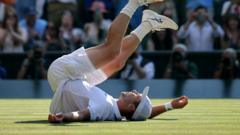
Wimbledon likes to pretend it is the final bastion of sporting civility. The All England Club wraps itself in pristine white clothing rules, quiet please signs, and the polite consumption of strawberries and cream. But don't let the immaculate grass fool you. Beneath that manicured surface lies a chaotic laboratory of raw human emotion, high fashion defiance, and theatrical beef.
The official trophies tell only half the story. The history books record who held the silver gilt cup or the Venus Rosewater Dish, but they miss the cultural shifts. They miss the moments that made you spill your drink on the couch or yell at your television screen.
We need to talk about the real highlights. The outfits that caused boardroom panic, the celebrations that rubbed opponents the wrong way, and the drama that kept us awake long past a sensible bedtime. These are the alternative awards that define what SW19 really feels like when the polite facade cracks.
The Best Celebration Award Goes to the Ultimate Villain Arc
Novak Djokovic knows exactly how to play a crowd. He has spent a career turning hostile stadiums into his personal fuel sources. His violin celebration became the definitive image of recent tournaments, a masterclass in psychological warfare masquerading as a sweet family tribute.
Every time Djokovic won a grueling match, he stood on the grass, raised his racket to his chin, and mimed playing a violin. He told journalists it was a nod to his daughter Tara, who recently started learning the instrument. It is a lovely sentiment. It is also a brilliant piece of performance art that completely infuriates a crowd that spent four hours cheering for his downfall.
The beauty of the gesture lies in its ambiguity. Is it a wholesome dad moment? Is it a sarcastic serenade to the fans who booed his double faults? It is both.
Tennis celebrations usually fall into predictable buckets. Players collapse to the ground like they have been shot, or they pump a fist while staring at their coach box. Djokovic chose a theatrical routine that forces the audience to decide if they are being complimented or mocked. It is petty, beautiful, and deeply memorable. He transformed Centre Court into a concert hall where he holds the only bow.
The Fashion Award for Breaking Rules Without Getting Fined
The Wimbledon clothing policy is notoriously strict. It is not just white; it is explicitly "almost entirely white." Officials check the undergarments of teenagers and measure the width of colored trims with literal rulers.
Jannik Sinner found the ultimate loophole by changing the game before he even struck a ball. He did it on the walk to the court.
Walking onto Centre Court carrying a custom, monogrammed luxury duffel bag was a stroke of marketing genius that completely bypassed the dress code. The bag did not violate the clothing policy because it was luggage. Yet, it shattered the visual tradition of players carrying standard, oversized tennis brand racket bags that look like neon spaceships.
This move opened the floodgates for corporate luxury to invade the most conservative square mileage in sports. It proved that you do not have to dye your hair or wear wild patterns to disrupt tennis culture. You just need a smart lawyer and a high-end fashion contract.
On the women's side, the shifts were more functional but equally impactful. The rule change allowing female players to wear dark-colored undershorts removed a massive layer of anxiety surrounding periods. It was a practical correction to a archaic system. The result was a tournament where players could focus entirely on their movement rather than worrying about wardrobe malfunctions on global television.
The Pure Unfiltered Drama Award
The absolute peak of tension did not happen during a standard baseline rally. It boiled over when Djokovic faced Holger Rune, creating an atmosphere so thick you could cut it with a knife.
The Centre Court crowd spent the evening chanting the young Dane's last name. To the casual observer, it sounded exactly like booing. To Djokovic, it was an insult disguised as support. After securing the win, he did not offer a polite cliché during his on-court interview. He went straight for the jugular.
He wished the fans a good night, then pointedly told them that he knows the difference between a chant and an insult. He dragged his syllables out, mocking the crowd by repeating their own noises back to them. It was a staggering moment of live television. Most athletes nod, smile, and thank the crowd for the incredible energy. Djokovic looked a stadium full of wealthy ticket holders in the eye and told them they could not cross him.
Tennis needs this edge. The sport spends too much time trying to look like a country club mixer. When you get two hyper-competitive individuals fighting for millions of dollars and historic legacies, things should get messy. That match reminded everyone that respect is earned on both sides of the net, and the crowd is not immune to getting called out.
The Emotional Core of the Tournament
You cannot discuss SW19 without talking about the heavy, tear-soaked farewells that anchored the fortnight. Andy Murray’s final moments on the grass alongside his brother Jamie provided a stark reminder of why we care about these athletes in the first place.
Murray’s body has been failing him for years. Everyone watching knew his career was crossing the finish line. The emotional tribute video featuring comments from his fiercest rivals felt like a collective exhale for British tennis. It was raw, uncomfortable, and completely authentic. There were no polished public relations scripts, just a stubborn icon crying on a folding chair while an entire nation stood on its feet.
Contrast that with the quiet heartbreak of players fighting through injuries in the early rounds. Tennis is an isolating sport. When a hamstring snaps or a wrist gives out, there is no team bench to carry you off. You sit alone with your thoughts while a trainer pokes at your joint. Those quiet moments of realization, where a player realizes four months of preparation just evaporated in a single split second, are the true shadow of the tournament.
How to Apply These Lessons to Your Own Tennis Viewing
If you want to truly appreciate the next iteration of the grass-court season, you have to stop watching the ball. The ball is predictable. The physics of a yellow fuzzy sphere hitting a string bed will always make sense. The human beings running after it do not.
- Watch the box, not the court. The player's support box tells you everything about the tactical reality of a match. Watch the coaches' body language during a changeover. If they look panicked, their player is already mentally cooked.
- Track the surface degradation. The grass changes completely from Monday of week one to Sunday of week two. The baseline turns to dust, changing the bounce and forcing players to alter their footwork completely. The true masters are the ones who can adjust to playing on dirt by July.
- Listen to the sound of the ball. The acoustic difference between a clean strike from a top-five player and someone ranked outside the top fifty is staggering. On Centre Court, a elite forehand sounds like a gunshot.
The real theater of tennis is found in these details. It is found in the subtle psychological shifts, the defiance of rigid traditions, and the moments where the pressure becomes too heavy to bear. The trophies will gather dust in a museum, but the memory of a player fighting the crowd, the rules, and their own body stays around forever.