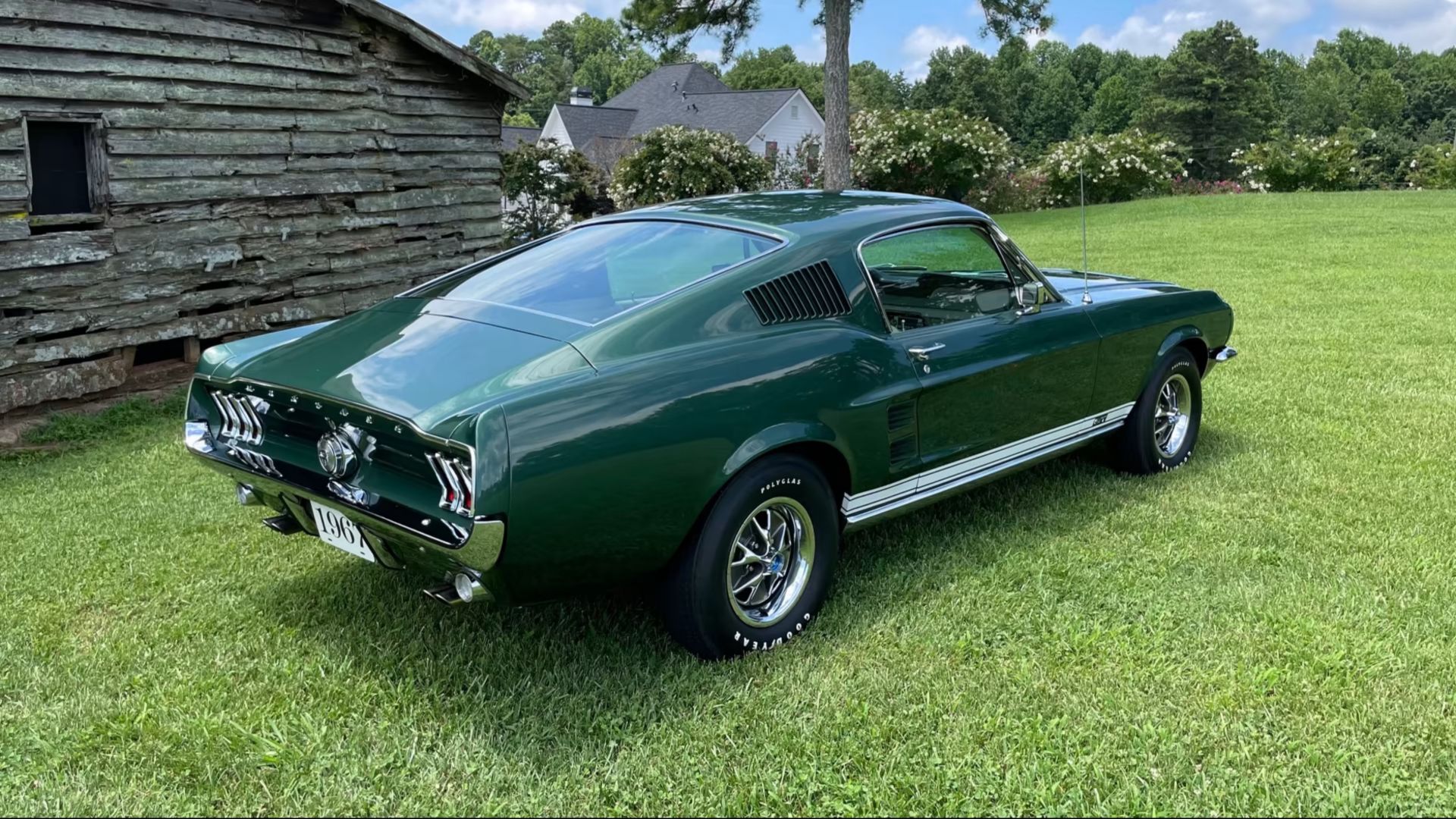
Lee Iacocca didn’t just want a car. He wanted a revolution that smelled like burnt rubber and vinyl. When the first Ford Mustangs from the 1960s rolled onto the floor at the New York World’s Fair on April 17, 1964, the world basically lost its collective mind. People weren't just looking; they were pulling out checkbooks before the paint was even dry. It’s wild to think about now, but Ford expected to sell maybe 100,000 units in that first year. They ended up moving over 400,000. It was a massive, unexpected tidal wave of steel.
You’ve probably seen the glossy photos of mint-condition models at auctions, but the reality of owning one back then was a bit different. It wasn’t just a "pony car." It was a blank canvas. You could buy a "secretary’s car" with a modest inline-six engine or a fire-breathing V8 that would scare your neighbors. That versatility is exactly why the Mustang survived while other nameplates vanished into the scrap heap of history. It wasn't just a machine; it was an identity.
The 1964.5 Myth and What Really Happened
Collectors love to argue. If you walk into a local cars-and-coffee meet and mention a "1964.5 Mustang," someone will inevitably correct you. Technically, every Mustang built before the 1965 model year changeover is titled as a 1965. But the "half-year" cars are distinct. They had generators instead of alternators. They had large horns mounted on the frame rails. The early ones are like the "first edition" of a famous novel—full of quirks that Ford eventually smoothed out.
Honestly, the engineering was a bit of a Frankenstein job. To keep costs down and get the car to market fast, Iacocca and his team raided the Falcon and Fairlane parts bins. The suspension? Falcon. The chassis? Heavily modified Falcon. This wasn't some high-tech marvel of aerospace engineering. It was a clever repackaging of existing tech into a body that looked like it was moving 100 mph while standing still. It worked. People didn't care that the rear drum brakes were a bit finicky or that the steering felt like manual labor. They cared about the long hood and the short deck.
Why 1967 Changed Everything
By 1967, the competition was breathing down Ford’s neck. The Chevy Camaro had arrived. The Plymouth Barracuda was getting meaner. Ford had to react. They made the 1967 Mustang bigger. It was wider and heavier, mostly because they needed to cram a big-block V8 under the hood to stay relevant in the horsepower wars.
This was the birth of the 390-cubic-inch V8 in the Mustang lineup. If you've ever watched Bullitt, you know exactly why this matters. Steve McQueen tearing through the streets of San Francisco in a Highland Green '68 GT 390 fastback is arguably the greatest cinematic car moment ever. It cemented the Mustang as the "cool guy" car. But here’s the thing: those big-block cars were a handful to drive. They were nose-heavy. They wanted to go straight, and turning was more of a suggestion than a command.
The Shelby Influence
Carroll Shelby is a name that gets tossed around a lot, often with a sense of reverence. And for good reason. He took what he called a "mule" and turned it into a racehorse. The 1965 Shelby GT350 was a brutal machine. It didn't have a back seat. It was loud. It was stiff. It was designed to win SCCA races, not to go get groceries.
By 1967 and 1968, the Shelby Mustangs transitioned from raw race cars to high-end grand tourers. The GT500 introduced the "King of the Road" (KR) 428 Cobra Jet engine. These cars were expensive back then, and today they’re basically rolling real estate. But even a base-model coupe from that era shares that same DNA. The silhouette is unmistakable.
The Performance Peak of 1969
If 1964 was about style, 1969 was about pure, unadulterated aggression. This was the year of the Mach 1, the Boss 302, and the legendary Boss 429. The Boss 429 is particularly insane because Ford only built it to qualify that specific engine for NASCAR. The engine was so wide they had to outsource the installation to Kar Kraft, who literally chopped the shock towers to make it fit.
The Boss 302 was a different beast. It was built for Trans-Am racing. It was all about high-revving power and handling. While the 429 was a sledgehammer, the 302 was a scalpel. Sorta. It was still a 60s muscle car, so "scalpel" is relative. It’s fascinating how Ford managed to offer so many variations of the same car simultaneously. You could literally walk into a dealership and choose between a luxury "Grande" model with a vinyl roof or a track-ready Boss.
Realities of Owning Mustangs From The 1960s
Let's get real for a second. Driving a 1960s Mustang today is an exercise in nostalgia and patience.
- Safety: There are no airbags. The steering columns in the early cars weren't collapsible. You're basically driving a metal box with lap belts.
- Maintenance: They leak. If a 289 V8 isn't dripping a little oil, it might be empty.
- Fuel: These engines were designed for leaded gasoline. You either need hardened valve seats or fuel additives to keep them happy on modern 91 octane.
- Comfort: Air conditioning was a rare luxury. Most of these cars are "four-sixty" AC—four windows down at sixty miles per hour.
Despite all that, the aftermarket support for these cars is better than almost any other vehicle on the planet. You can literally build a brand-new 1965 Mustang from a catalog. Every bolt, every piece of trim, and every body panel is being reproduced. This makes them the perfect entry point for someone getting into classic cars. You aren't going to get stuck waiting six months for a part from Germany. You can probably find what you need at a local shop or a massive warehouse like CJ Pony Parts or National Parts Depot.
The Cultural Impact
The Mustang didn't just stay in the US. It went global. It showed up in Bond films like Goldfinger. It became a symbol of American post-war optimism. It represented a time when gas was cheap and the horizon felt infinite.
There's a reason why Ford keeps going back to the 1960s styling cues for the modern Mustang. The "three-bar" taillights, the side hockey-stick scoop, the fastback roofline—it all started here. Every time Ford tries to stray too far from that 1960s soul (look at the Mustang II or the early Fox bodies), they eventually have to come back to the original well to find their way again.
What to Look for if You're Buying
Don't just buy the first shiny red coupe you see. Rust is the Mustang's natural enemy. Check the cowl vents—if they're rusted out, water leaks onto the floorboards and rots the car from the inside out. Fixing a rusted cowl is a nightmare job that involves drilling out hundreds of spot welds.
Look at the VIN. People "clone" GTs and Shelbys all the time. A real 'K-code' 289 High Performance car is worth significantly more than a standard 'C-code' V8 that someone slapped some badges on. Documentation is everything. If someone claims a car has "matching numbers," they should be able to prove it with casting dates and door tags.
Actionable Steps for the Aspiring Owner
If you’re serious about getting into the world of 1960s Mustangs, don’t start by scrolling through high-end auction sites where prices are inflated by "bidding fever." Start with these practical moves:
- Join the Mustang Club of America (MCA): This is the gold standard for knowledge. Their judges know every nut and bolt. Talking to members will save you thousands of dollars in "rookie mistakes."
- Inspect the Floor Pans and Frame Rails: Use a magnet. If it doesn't stick to the lower quarters or the floor, you're looking at Bondo, not metal. Rust in the rear frame rails is often a dealbreaker for a DIY restorer.
- Prioritize the '67-'68 Models for Daily Driving: These years have a slightly wider engine bay, making them easier to work on and more compatible with modern disc brake conversions or power steering upgrades.
- Verify the Data Plate: Decode the door tag using a reliable resource like Kevin Marti's books (or a Marti Report for 1967+ models). It tells you the original color, interior trim, and DSO (District Sales Office), which helps verify the car’s history.
- Test the Wiring: 1960s wiring is notorious for getting brittle. If the turn signals are sluggish or the dash lights flicker, factor in the cost of a new harness—it’s a safety issue as much as a convenience one.
Owning one of these cars is a stewardship. You're looking after a piece of history that defined an era. Whether it's a base 1964.5 coupe or a 1969 Mach 1, these cars have a way of making every trip to the grocery store feel like a scene from a movie. Just remember to carry a spare gallon of coolant and a basic toolkit in the trunk. It’s part of the charm.