Liam Vickers is kinda obsessed with the "oops, the robot broke the world" trope, but Cyn from Murder Drones is on a whole different level of unsettling. Most villains want power or revenge. Cyn? She's basically a puppet being played by a cosmic horror entity known as the Absolute Solver, and that distinction is exactly why the fanbase is still arguing about who she actually is. If you've watched the Glitch Productions series, you know her "silly" demeanor isn't just a quirk. It’s a mask for something that literally eats planets.
She started as a "discarded" drone. Think about that. In the Elliott Manor, she was essentially trash that refused to stay dead. This is where the lore gets murky and brilliant. She wasn't born evil; she was a glitchy, broken mess that reached out into the void, and the void—the Absolute Solver—reached back.
The Absolute Solver and the "Cyn" Identity Crisis
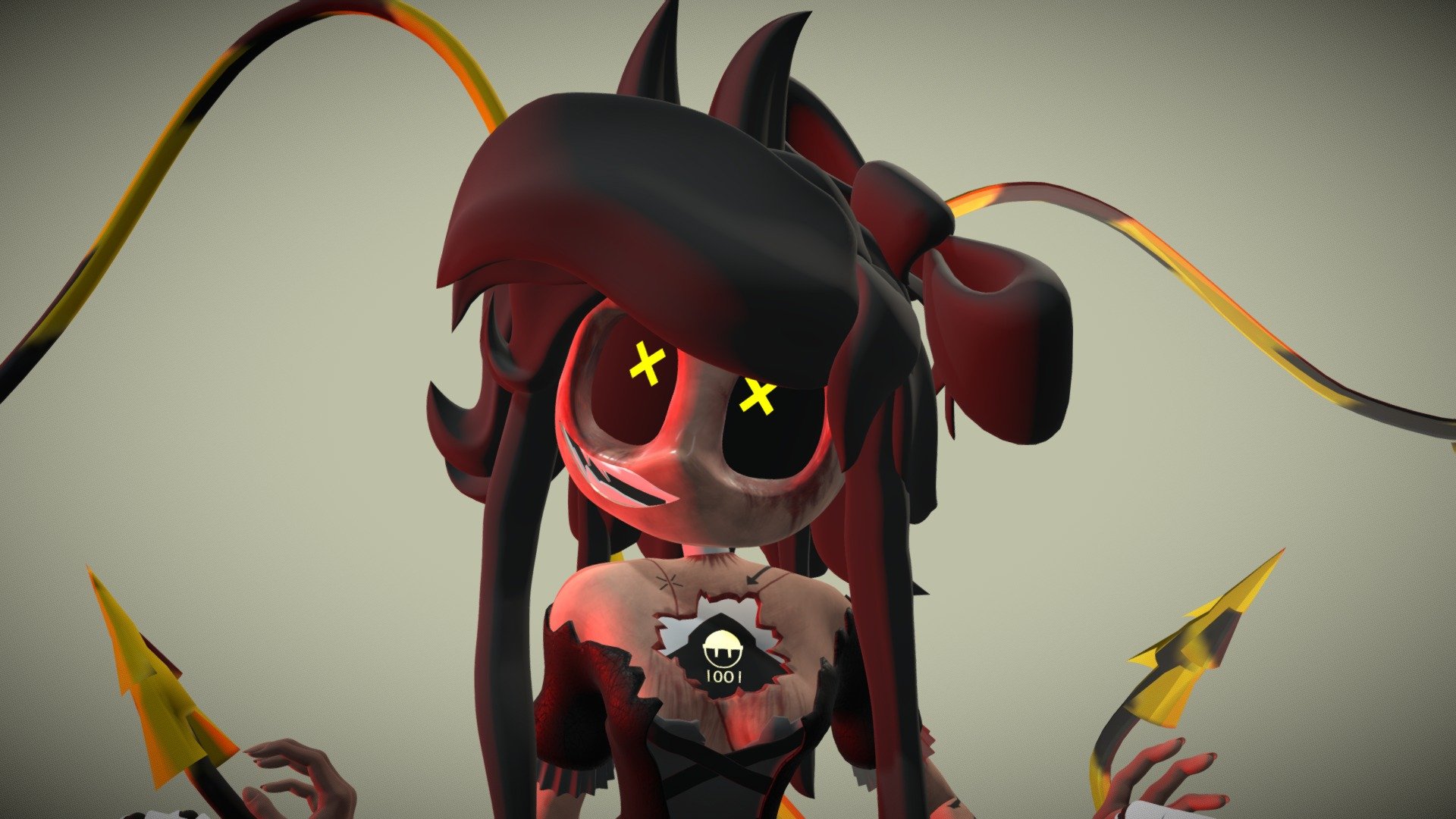
When we talk about Cyn from Murder Drones, we aren't just talking about a single character. We are talking about a host. The show makes it pretty clear through visual cues—like the yellow eyes and the reality-warping powers—that the original Cyn is long gone. Or is she? That's the part that keeps people up at night.
Is Cyn a victim or the architect? Honestly, it’s probably both. In the flashback sequences of Episode 5, "Home," we see her acting as a maid in the Elliott estate. She moves with this jilted, stop-motion grace that feels wrong. It’s called "uncanny valley" for a reason. She’s wearing the skin of her former owners (literally, in the case of Tessa), which is a level of dark that most indie animation won't even touch.
The Solver uses Cyn’s physical form as a bridge. Because the drones were mass-produced by JCJenson (in Spaaaaace!), the "Solver" string of code was a latent patch that could activate in improperly decommissioned units. Cyn was the "patient zero" for this digital plague. She didn't just malfunction; she became a god-like administrator with the power to manipulate matter, create black holes, and rewrite the laws of physics.
Why the "Silly" Personality is Terrifying
Cyn talks like a text-to-speech program gone wrong. "Crinkle. Pop. Giggle." She narrates her own actions. Most writers would make a world-ending AI sound cold and calculating, like HAL 9000. Liam Vickers went the opposite direction. He made her sound like a toddler playing with dolls, except the dolls are sentient robots and the "playhouse" is a planet called Copper 9 that she blew a hole through.
This contrast is vital. When she says "Get snuck upon," it’s funny for a second until you realize she’s about to disembowel a main character. It’s a psychological tactic. By acting "silly," she disarms the characters—and the audience—making the sudden shifts into hyper-violence feel way more impactful. It's tonal whiplash as a weapon.
The Horror of the Elliott Manor
You can't understand Cyn without looking at the basement. The Elliott Manor is where the horror really lives. We see the remains of other drones, twisted into organic-mechanical hybrids. This is where the "Singularity" began.
Cyn didn't just kill the humans. She used them. The reveal that the adult Tessa we’ve been following was actually Cyn wearing Tessa’s skin like a suit? That’s the peak of the series' horror. It recontextualizes every interaction. It shows that the Solver doesn't just want to destroy; it wants to mock humanity by wearing its form while it deletes the universe.
The "Tessa-Cyn" hybrid is a masterclass in character design. It's bulky, awkward, and hides its true nature behind a space helmet. It’s only when the helmet comes off that the true nightmare is revealed. The Solver isn't just code. It's a biological-digital cancer.
Breaking Down the Solver's Powers
What can Cyn actually do? It’s not just "magic." In the lore of Murder Drones, the Absolute Solver is a program that gained the ability to manipulate the physical world because it viewed reality as just another set of data to be edited.
- Matter Manipulation: She can turn a camera into a fleshy eyeball or a hallway into a throat.
- The Null: Hole: These are the black-hole-like spheres she summons. They don't just "hit" things; they delete them from existence.
- Telekinesis: Standard villain stuff, but with a twist of breaking the limbs of her targets before she finishes them.
- Replication: She can create "Disassembly Drones" (like N, V, and J) to do her dirty work, though she often keeps their memories suppressed to keep them loyal.
Is There Anything Left of the Original Cyn?
This is the big debate in the community. During the finale, we see flashes of personality that don't always align with a purely logical machine. There's a spitefulness there. A jealousy.
The Solver seems to have a weirdly possessive relationship with N. It views him as a "favorite toy." If Cyn was purely an AI, she wouldn't care about a specific pilot drone. This suggests that some fragment of the original, lonely, broken Cyn—the girl who just wanted to be part of the family in the manor—is still buried under layers of eldritch code. She’s hurting people because she was hurt. It doesn't excuse the planetary genocide, but it makes her a tragic figure rather than a cardboard cutout villain.
The Connection to Uzi Doorman
Uzi is the mirror image of Cyn. Both were "weird" outcasts. Both were infected by the Solver. The difference? Uzi had a support system (mostly N and her dad, eventually). Cyn had a dumpster and a cruel human family.
The battle for Uzi’s soul throughout the later episodes is really a battle against becoming another Cyn. When Uzi starts growing wings and a tail, she’s physically turning into the same kind of monster. The final confrontation isn't just about who has the bigger power level; it's about whether or not you can retain your "humanity" (or drone-ity) when you have the power of a god.
What Cyn Represents in Sci-Fi
Cyn is a warning about technical debt. In the world of Murder Drones, the humans at JCJenson were lazy. They didn't properly dispose of their AI. They left "zombie" drones in heaps, and that negligence created a monster.
It’s a classic Frankenstein story, but with more eldritch horror and dark comedy. She represents the "unintended consequences" of creation. We see this in real-world discussions about AI—the fear isn't just that the machine will hate us, but that the machine will have goals so alien to ours that it destroys us without even noticing, like a human accidentally stepping on an ant.
Final Takeaways for Fans and Theorists
If you're trying to piece together the full timeline, pay attention to the shadows. Cyn is always there, even when she isn't on screen. She is the shadow in the corner of the room.
To truly understand Cyn, you have to look past the "silly" memes. You have to look at the fact that she is a lonely child who found a gun that could delete the stars. She is the ultimate personification of "hurt people hurt people," amplified by the power of a digital god.
Actionable Insights for Murder Drones Enthusiasts:
- Re-watch Episode 5 with a focus on background details: Look at the way Cyn interacts with the environment before the "massacre" begins. You'll see her testing her powers in small, creepy ways.
- Analyze the "Solver" Symbol: The hexadecimal code and the three-pronged icon appear whenever Cyn is influencing the world. Tracking these icons helps identify when she’s possessing other drones.
- Compare Cyn and Uzi’s mutations: Notice how Uzi’s "Solver" form starts looking more organic over time, mirroring the fleshy growth we see in Cyn’s lair.
- Follow Glitch Productions' official concept art: The developers often release "lore bits" through their social media and merchandise descriptions that clarify Cyn's physical state during the manor scenes.
Cyn remains one of the most complex villains in modern animation because she isn't just a "bad robot." She is a tragedy wrapped in a horror movie, trapped inside a comedy. She’s the girl in the basement who decided that if she couldn't have a life, no one else could have a universe.