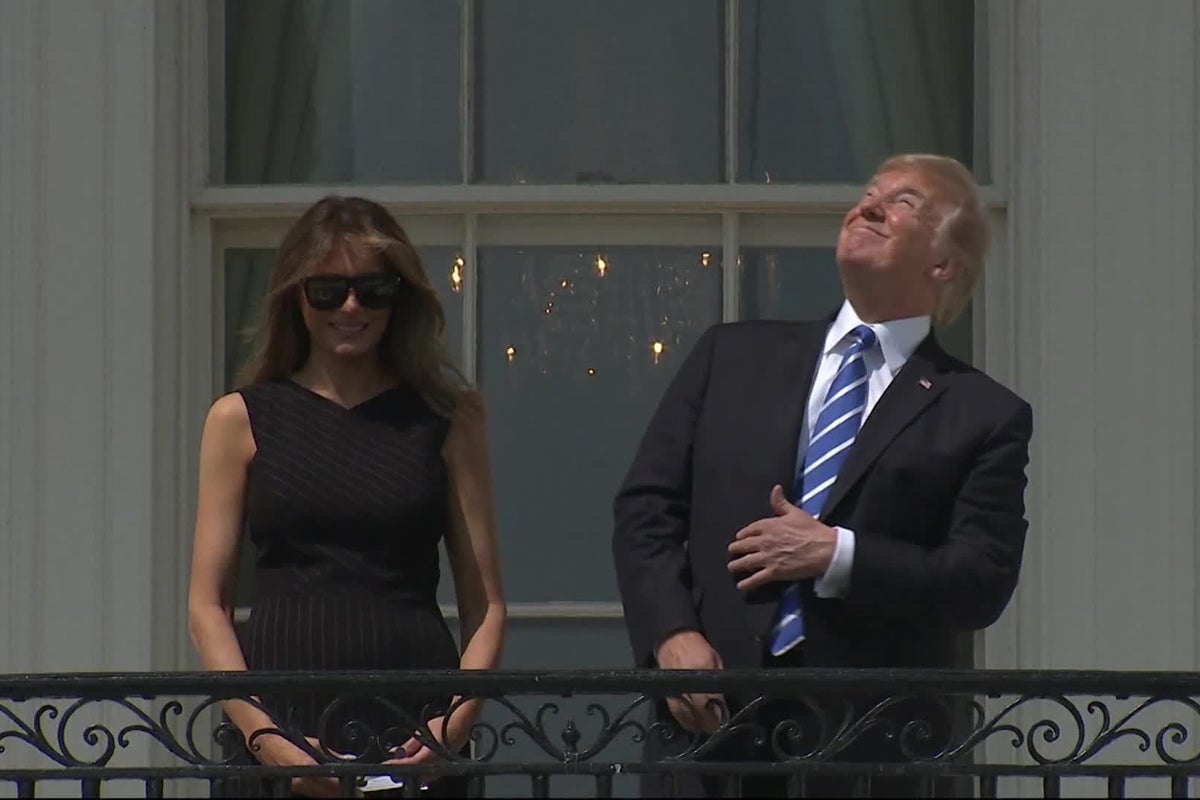
When an official government social media account drops a digital punchline targeting a former president using a recycled solar safety blunder, political communication has crossed a strange threshold. The White House digital operations team did not just share a meme on eclipse day. They weaponized historical irony. They reached back into the collective memory of the Trump administration to score a rapid-fire point while millions stared skyward.
This is the state of modern political warfare. Policy debates get buried beneath viral images, and administrative channels double as partisan meme factories.
Behind the laughter and the online engagement metrics lies a much sharper story about how state-sanctioned communication has evolved. The target was obvious. Donald Trump standing on a Truman Balcony in August 2017, briefly peering at a partial solar eclipse without protective eyewear before someone shouted to look away, remains an indelible image of the modern media cycle. When a total solar eclipse cut across North America years later, current administration handlers could not resist digging up the archive.
Yet viewing this purely as a cheeky social media stunt misses the structural shift happening inside government press offices. Political communication no longer waits for a formal press briefing or a carefully worded press release. It operates at the speed of internet culture. When the official White House accounts adopt the cadence of anonymous shitposters on social media, the boundary between institutional authority and partisan campaigning dissolves entirely.
The Evolution of Presidential Trolling
Digital strategists working inside government offices learned long ago that neutrality performs poorly online. Engagement algorithms reward conflict, snark, and provocation. If a government account posts a dry chart about eclipse safety guidelines, it vanishes into the algorithmic ether. If that same account posts a subtle jab at a political rival, it triggers a tidal wave of quote tweets, outrage, and viral amplification.
This tactic did not emerge in a vacuum. Both parties spent years turning institutional mouthpieces into weapons of psychological warfare.
Consider the escalation curve of political messaging over the past decade. Traditional press operations relied on dignity as a shield. Even during bitter partisan fights, institutional accounts maintained a veneer of civic detachment. That restraint eroded as campaigns realized that voters respond more strongly to emotional provocation than policy details.
The eclipse meme fits neatly into this playbook. It required zero production budget, drew instant media coverage, and forced opposition communications teams onto the defensive. Instead of talking about infrastructure spending or inflation metrics, political reporters spent hours dissecting whether an official government account crossed an ethical line by mocking a private citizen who happens to be running for office.
That is the trap. The distraction is the point.
The Attention Economy Inside the West Wing
Modern political operations function much like digital media startups. They monitor real-time sentiment dashboards, track viral trends, and measure success by impressions and shares. When a major public event occurs, teams scramble to capture narrative control before the window closes.
On eclipse day, the celestial event commanded global attention. Millions of screens flickered with maps, safety tips, and live streams. In that hyper-saturated environment, standing out requires disruption.
A standard safety advisory from NASA or the National Weather Service gets ignored. A clever callback to a viral presidential gaffe cuts through the noise instantly.
This creates a perverse incentive structure for public servants. Communications professionals whose salaries are paid by taxpayers find themselves rewarded for generating partisan friction. When the line between governing and campaigning disappears, every national holiday, natural phenomenon, and civic milestone becomes an opportunity for political theater.
Critics from both sides of the aisle frequently decry the degradation of public discourse. Yet neither party demonstrates any appetite for disarmament. When Republicans held power, their official channels frequently targeted political opponents with sharp internet humor. When Democrats took over, they refined the playbook. The tools change, but the objective remains constant: dominate the feed at all costs.
The Permanence of the Digital Record
What makes these digital jabs particularly potent is the permanence of online memory. The 2017 moment on the Truman Balcony was supposed to be a fleeting media blip. A minor faux pas amplified by cable news networks for twenty-four hours before fading away.
Instead, the internet cataloged it, weaponized it, and turned it into permanent folklore.
When the White House resurrected the imagery years later, they demonstrated how modern political campaigns weaponize time. History is no longer a sequence of static events found in textbooks. It is a searchable database of vulnerabilities, ready to be deployed whenever the algorithm demands a distraction.
Every gaffe, awkward stumble, and ill-advised glance is preserved in high-definition video. Political operatives maintain extensive internal libraries cataloged by keyword and emotion. Need a clip of a rival looking confused? It is tagged and ready. Need visual proof of an opponent ignoring scientific advice? The eclipse footage is right there.
This hyper-archivists' approach to politics changes how leaders behave in public. Spontaneity becomes dangerous. A simple, instinctive reaction to a bright light turns into a multi-year punchline that can be weaponized by the full weight of the federal government.
The Cost of Institutional Degradation
When official state channels act like partisan meme pages, public trust absorbs the collateral damage.
Citizens look to government agencies for reliable information during major events. Whether tracking a hurricane, managing a public health crisis, or sharing safety protocols for an astronomical event, the public needs to trust that the source speaks with sober authority.
When that same authority participates in internet trolling, the credibility barrier begins to crack. If the White House digital team is willing to mock a political opponent using official resources, how confident can the public be that emergency communications remain entirely free from partisan spin?
That is the quiet erosion happening beneath the surface of viral humor. Every time an institution trades its dignity for a quick round of online applause, it spends a little more of its dwindling reservoir of public trust.
The engagement numbers look great on a Friday metrics report. The retweets roll in by the tens of thousands. But somewhere out there, a citizen trying to find straightforward guidance on eye safety scrolls past the joke and wonders if anyone in Washington is taking their job seriously.
The eclipse passed. The shadow crossed the continent and receded back into the Atlantic. But the digital footprint left behind by the White House communications apparatus lingers, serving as a reminder that in modern politics, even the sun and moon are just props in an endless, grinding war for attention.


