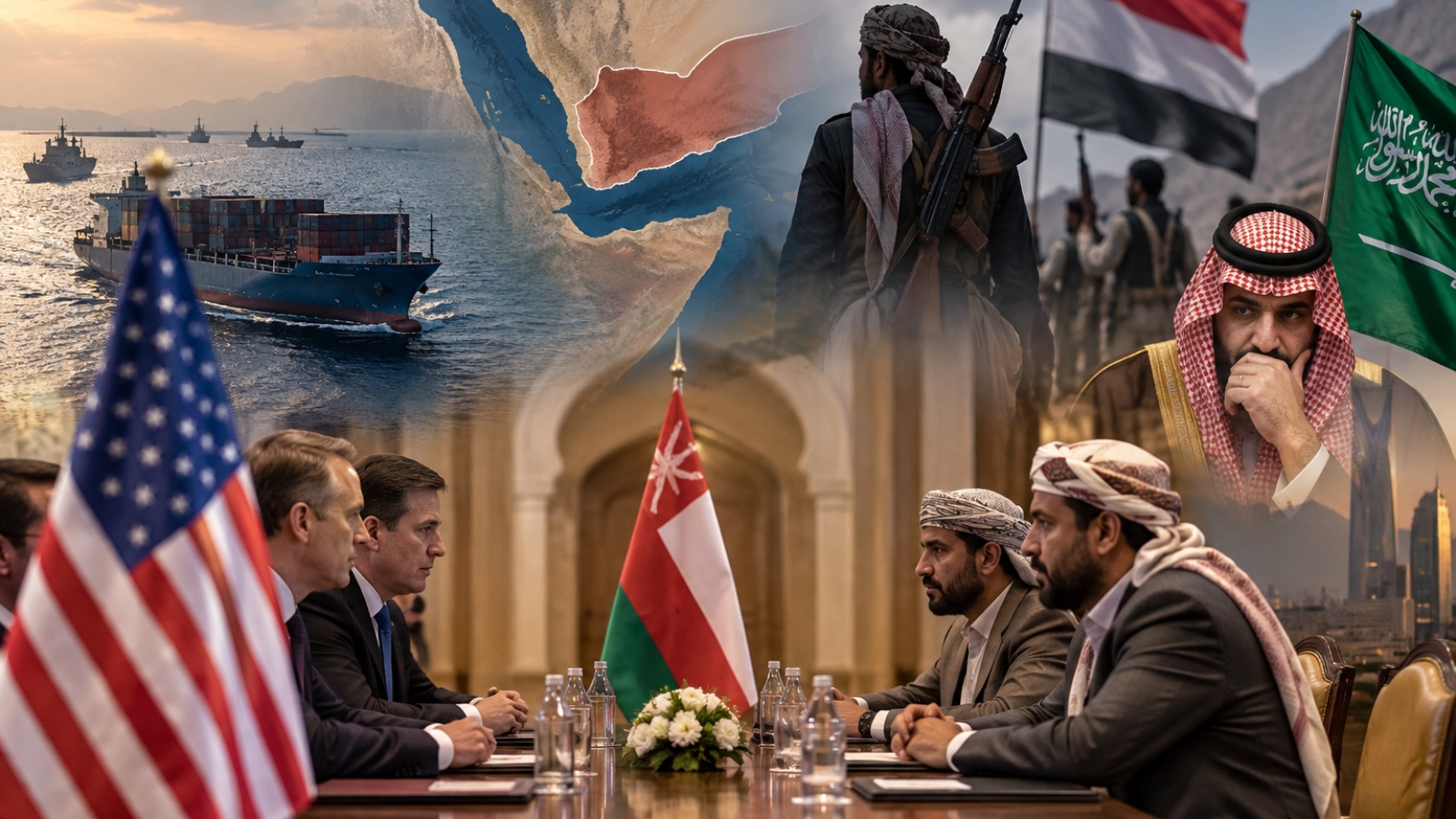
The air inside the concrete-walled corridor smelled of chilled desert dust and old parchment. Outside, the midday heat of Muscat hammered against the tinted glass of the diplomatic compound with a silent, blinding fury. But inside, the silence was heavier than the weather.
It was the quiet of a room holding its breath.
Across a polished mahogany table sat men whose names are rarely spoken aloud without a prefix of anxiety or an immediate security briefing. On one side, American diplomats carrying the quiet weight of Washington’s exhaustion. On the other, representatives of the Houthi movement—figures who, for years, have directed ballistic missiles and drone swarms across the Red Sea, cutting through global supply chains like a hot wire through nylon.
And hovering over every whispered sentence, uninvited yet profoundly present, was the shadow of Riyadh. Saudi Arabia, bruised by a decade of grinding proxy conflict, was looking for a way out. They needed a peace that didn't look like a surrender. They needed someone to talk to the people shooting at them.
Enter Oman.
For generations, the Sultanate has played the role of the quiet broker in a volatile neighborhood. They are the Swiss bankers of Middle Eastern diplomacy—unassuming, fiercely neutral, and trusted by everyone precisely because they belong to no one’s ideological crusade. When doors slam shut in Washington, Tehran, and Riyadh, the side door in Muscat remains quietly unlocked.
To understand why this secret meeting matters, you have to look past the sterile geopolitical readouts. You have to picture a cargo ship idling off the coast of Yemen, its crew staring out at a horizon where smoke from a drone strike still blackens the sunrise. You have to imagine a mother in a Riyadh high-rise checking her phone for air-raid alerts, wondering if the neighborhood truce will hold for another week.
War is often painted in broad strokes of strategy and ideology. But on the ground, it is an accumulation of exhaustion.
The Houthis arrived in Oman with a message for the United States, delivered not with revolutionary bluster, but with the calculated pragmatism of a faction that realizes governing a ruined country is infinitely harder than fighting a guerrilla war. They wanted sanctions recalibrated. They wanted humanitarian corridors widened. They wanted recognition that cannot be won on a battlefield.
And Washington, staring down a global inflation crisis driven in part by shipping lanes choked off near the Bab el-Mandeb strait, listened.
Consider what happens next when diplomacy replaces artillery. It is messy. It is deeply unglamorous. It involves men in grey suits arguing over port fees and customs clearances in Hudaydah while distant factions denounce the very talks keeping them alive.
Saudi Arabia’s calculus here is fascinating. For years, the kingdom pursued a muscular, uncompromising foreign policy designed to roll back Iranian influence on its southern border. But steel has a cost. Billions of dollars in defense expenditures, international reputational damage, and the constant, gnawing vulnerability of critical oil infrastructure forced a brutal reckoning in Riyadh. The crown princes and royal advisors realized a fundamental truth of modern conflict: you can win every tactical engagement and still lose the future.
Peace, it turns out, is cheaper than war. But it requires swallowing a bitter pill of compromise.
When the Saudi leadership turned to Oman to help facilitate a backchannel to their most intractable adversary, they were acknowledging a shift in regional gravity. They were admitting that the security umbrella of distant superpowers only goes so far when your own backyard is on fire.
This brings us to the human core of the Omani meetings. This is not just a chess match between empires and insurgencies. It is a desperate, grinding scramble to prevent a relapse into total catastrophe for millions of Yemenis who have known nothing but hunger, displacement, and fear for over a decade.
When a Houthi negotiator sits across from an American envoy, the conversation is nominally about maritime security and regional stability. But underneath the diplomatic jargon, it is about whether a school in Sanaa can get textbooks instead of sandbags. It is about whether a fisherman in the Red Sea can cast his net without a patrol boat mistaking his skiff for a threat.
The cynics will tell you that talks like these are mere theater. They will point out that ceasefires are routinely violated, that mistrust runs deeper than the bedrock of the Arabian Peninsula, and that neither side has fundamentally abandoned its ultimate ambitions.
They are right, of course. Trust is a scarce commodity in Muscat.
Yet history is rarely shaped by immediate perfection. It is forged in the awkward, stumbling transitional phases where enemies realize they can no longer afford to kill each other, but haven't yet figured out how to live next door.
As the sun began to dip below the jagged peaks of the Al Hajar mountains, casting long, bruised shadows across the Omani capital, the delegations packed their briefcases. No grand peace treaty was signed that afternoon. No flashing cameras captured a historic handshake on a manicured lawn.
There was only the quiet closing of a heavy door, the low hum of air conditioning, and the faint, persistent hope that somewhere in the desert dust, the bleeding might finally start to slow.