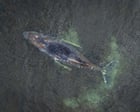
The North Sea is not a place for the gentle. It is a gray, churning expanse of cold salt and unpredictable currents, a basin that demands strength from everything that swims within it. But on a jagged stretch of the German coast near Schillig, the water retreated to reveal something that didn’t belong to the silt and the seagrass. It was a humpback whale. Massive. Dark. Silent.
It lay there like a fallen monument.
This wasn’t the first time the locals had seen this particular shadow on the sand. In fact, it was the third time in a single week that this animal had found itself pinned against the Earth, lungs compressing under the weight of its own majestic body. To the casual observer, it looks like a mechanical failure of nature—a navigational error or a simple stroke of bad luck. To the rescuers standing knee-deep in the freezing mud, it felt like a conversation with a creature that had lost its way in more ways than one.
The Weight of a Ghost
A humpback whale in the North Sea is an anomaly. These are travelers of the deep, masters of the wide Atlantic who usually bypass the shallow, treacherous bottleneck of the German Bight. When a juvenile whale—roughly seven meters long—wanders into these flats, it is entering a labyrinth of sandbanks.
Imagine walking into a room where the floor rises to meet the ceiling every six hours. That is the reality of the Wadden Sea.
When the tide goes out, the sea simply vanishes. One moment, you are buoyant, a weightless god of the ocean; the next, you are a prisoner of gravity. For a whale, gravity is the enemy. Without the support of the water, its internal organs begin to collapse. The very muscles that propel it through the abyss become a crushing burden.
The first time it happened, there was hope. Rescuers from the Wadden Sea National Park and local fire brigades worked with the frantic energy of people who believe they can cheat fate. They waited for the tide. They nudged. They watched as the water returned, lifting the leviathan, and they cheered as it vanished into the gray mist.
Then it came back.
The Human Mirror
There is a specific kind of exhaustion that settles into the bones of a rescue worker when they realize they are fighting a battle the subject doesn’t want to win. Or perhaps, a battle the subject is no longer capable of understanding.
Thomas, a hypothetical volunteer based on the dozens of real souls who stood in the wind that week, represents the human heart of this tragedy. He isn’t a scientist with a clipboard. He’s a man with a bucket and a wet blanket. He spent hours pouring seawater over the whale’s skin to keep it from cracking in the wind.
"You look into an eye the size of a dinner plate," he might tell you, "and you don't see a wild beast. You see an intelligence that is profoundly tired."
This is the invisible stake of wildlife rescue. We don't just save animals because we want to preserve biodiversity; we save them because we see our own fragility in them. We see the horror of being stranded. We recognize the desperation of being caught in a cycle of escape and return. When the whale drifted back onto the sand for the second time, and then the third, the narrative shifted from a rescue mission to a vigil.
The Science of Disorientation
Why does an animal return to the shore that nearly killed it?
Biologists point to a few cold, hard possibilities. The North Sea is a sensory minefield for a humpback. These animals navigate using a sophisticated internal compass, likely tied to the Earth's magnetic field. In the shallow waters of the German coast, where the floor is almost entirely sand and mud, sonar becomes muffled. The echoes don't return with the clarity of the deep ocean.
It is like trying to find your way through a hall of mirrors while wearing a blindfold.
Then there is the matter of health. A healthy whale has the power to fight a current. A sick or malnourished whale—perhaps one that hasn't found enough krill in these unfamiliar northern waters—becomes a leaf in the wind. It drifts. It settles. By the third stranding, the experts from the University of Veterinary Medicine Hannover began to suspect that the whale wasn't just lost. It was failing.
The logistics of moving a fifteen-ton animal are staggering. You cannot simply tow it by the tail; you risk dislocating its spine or drowning it as water is forced into its blowhole. You cannot lift it with a crane without specialized slings that don't exist on a remote beach in Lower Saxony. You are left with the tide. You are left with patience.
The Silence on the Sand
The third stranding was different. The atmosphere on the beach had curdled from frantic optimism into a somber, heavy realization. The whale lay near the Friedrich-August-Grootpolder. It was no longer thrashing. It wasn't fighting the mud. It seemed to have accepted the shore as its final resting place.
People often ask why we don't just "do something." We live in an era where we believe every problem has a technological solution. We have satellites that can read a license plate from space and vaccines that can be designed in a weekend. But against the slow, rhythmic pulse of the North Sea tides and the failing heart of a giant, we are remarkably small.
Euthanasia for a whale is a nightmare of its own. It requires specialized equipment and massive doses of chemicals that can then poison the ecosystem if the carcass isn't disposed of properly. The alternative is to let nature take its course—a phrase that sounds poetic until you are the one standing in the rain, listening to the labored, wet gasps of a dying wanderer.
The Echo in the Deep
There is a lesson in the whale’s refusal to stay out at sea. It serves as a stark reminder that our oceans are changing. Whether it is noise pollution from shipping lanes disrupting their navigation, or shifting currents driving their food sources into dangerous shallows, the humpback at Schillig is a symptom of a world out of balance.
We want a happy ending. We want the video of the whale breaching as it hits the deep blue, a spray of diamonds trailing from its fins. But sometimes, the story is about the standing still. It is about the community that gathered on a cold German beach to witness a life that was too big for the land and too tired for the sea.
As the sun dipped low over the Wadden Sea, casting long, distorted shadows across the flats, the whale remained. The tide would come again, as it always does. It would offer the gift of buoyancy one more time. But the water can only carry what has the will to swim.
The beach is empty now, save for the tracks of boots in the mud and the rhythmic, indifferent sound of the waves. The North Sea continues its work, unbothered by the tragedies it washes up. We are left only with the memory of that great, dark eye, and the humbling knowledge that some journeys are meant to end where the land meets the foam.
The whale didn't belong to the sand, but in the end, the sand was the only thing that would hold it.