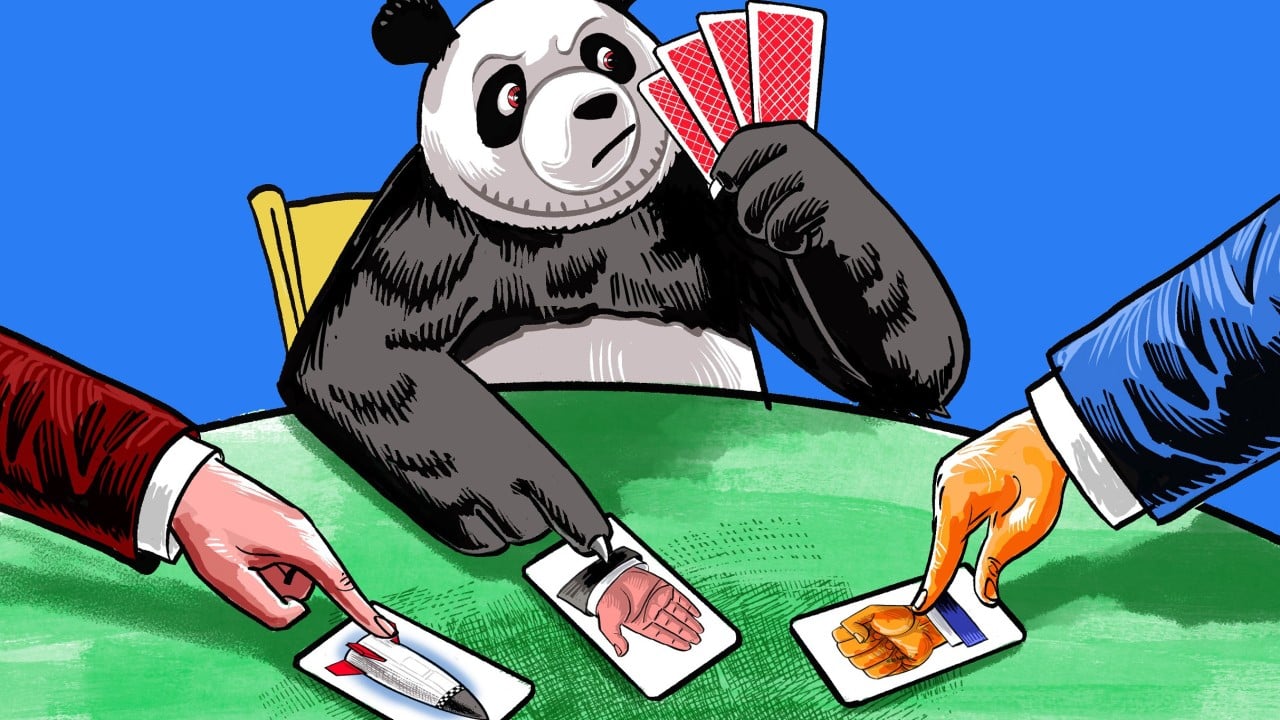
The foreign policy establishment is trapped in a 19th-century mindset. They look at Beijing’s footprint in the Middle East, see a lack of carrier strike groups and overseas military bases, and declare it "power without projection." They call China a free rider, a cautious merchant unwilling to get its hands dirty in the treacherous geopolitics of the Persian Gulf.
They are completely missing the point.
The assumption that power must be projected through Tomahawk missiles and boots on the ground is a Western bias born of legacy thinking. Beijing isn't failing to project power in Iran. It is deliberately redefining what power projection means. While Washington spends trillions playing whack-a-mole with regional militias, China is quietly building an un-brickable economic and technological dependency.
It isn't an exercise in weakness. It is a masterclass in strategic asymmetry.
The Myth of the Passive Hyperpower
The standard narrative, popularized by think-tank pundits who have never negotiated a trade deal in Eurasia, goes like this: China signed a 25-year, $400 billion Strategic Cooperation Agreement with Iran in 2021, but because we haven't seen massive, immediate capital outlays, the deal is a bust. They claim Beijing is terrified of violating US sanctions and is dragging its feet.
This view mistakes calculated patience for cowardice.
China does not operate on Western quarterly cycles or four-year election horizons. The value of Iran to Beijing isn't as a high-yield investment portfolio; it is a geostrategic insurance policy.
Consider the Strait of Malacca. If a conflict ever erupts over Taiwan, the US Navy can effectively choke off China’s maritime energy supply. To survive, Beijing needs overland supply lines that are entirely immune to Western naval dominance. Iran, sitting squarely at the crossroads of Central Asia and the Persian Gulf, is the ultimate choke-point bypass.
I have watched corporate strategists misread state-backed initiatives for over a decade. They look for immediate ROI. They don't see that Beijing is perfectly content to keep Iran on a life-support drip of oil purchases—buying discounted Iranian crude through a shifting network of "ghost tankers" and small independent refineries (teapots) using yuan—until the exact moment the broader strategic trap needs to be sprung.
Weaponized Interdependence Beats Blue-Water Navies
Let's dismantle the PAA (People Also Ask) question that dominates every security forum: Why doesn't China protect its oil lanes in the Gulf?
The question itself is flawed. It assumes China needs to police the waves to secure its interests.
Instead of deploying a massive navy to protect shipping, China is implementing a strategy of weaponized interdependence. By becoming Iran’s top trading partner and its primary economic lifeline under maximum pressure sanctions, Beijing has achieved total leverage over Tehran without firing a single shot or committing a single soldier to a desert outpost.
Look at the mechanics of the 2023 Saudi-Iran normalization deal mediated by Beijing. Western commentators were shocked. They shouldn't have been. China didn't use gunboat diplomacy to force Riyadh and Tehran to the table. It used its position as the largest buyer of oil from both nations.
When you buy the majority of the region's exports, your economic gravity becomes its own security architecture. If Iran disrupts the Gulf, it directly harms its only systemic patron. Beijing doesn't need to patrol the waters because it holds the remote control to the Iranian economy. That is far more effective than an aircraft carrier.
The Technological Chokehold
The real projection of power isn't happening in the oil fields of Khuzestan; it is happening in the digital infrastructure of Tehran.
While Western analysts worry about whether China will sell J-10 fighter jets to the Islamic Republic, Beijing is exporting something far more potent: surveillance architecture, telecommunications hardware, and satellite navigation systems.
By integrating Iran into the BeiDou satellite network and supplying the backbone for its domestic intranet, China is ensuring that Iran’s security apparatus is structurally dependent on Chinese technology for decades. If you control a nation's digital nervous system, you don't need to project power across its borders. You are already inside the house.
This approach carries undeniable risks. If Iran detonates a broader regional war, China's economic interests will suffer in the short term. Beijing’s diplomatic balancing act between Israel, Saudi Arabia, and Iran is a high-wire routine with no safety net. But to think this vulnerability means China is powerless is a profound miscalculation.
Stop looking for Chinese military bases in the Persian Gulf. They aren't building them because they don't need them. The West is playing a game of geopolitical chess using pieces from the last century, while China is quietly buying the board.