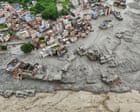
A massive wall of mud and water tore down the Himalayas without warning, leaving at least 165 people dead and over 1,000 missing across the Nepal-Tibet frontier. This wasn't your standard seasonal monsoon overflow. It was a high-altitude glacial collapse that triggered an inland tsunami, wiping out roads, bridges, and entire village settlements along the Bhote Koshi and Trishuli river corridors.
If you are tracking the crisis or trying to find missing loved ones, the scale of the devastation makes standard updates hard to parse. Officials report that hundreds of foreign tourists and religious pilgrims—including travelers from India, the United States, Australia, and Canada—are among the unaccounted-for persons.
The True Cause of the Disaster
Initial reports pointed toward a localized earthquake, but the U.S. Geological Survey and international geophysical agencies quickly corrected that narrative. The tremor recorded on seismic monitors wasn't a tectonic shift at all. It was the catastrophic weight of a collapsing glacier crashing onto the valley floor, sending an immense wall of rock, ice, and debris downstream.
When the debris flow hit Timure near the Rasuwagadhi border crossing, it behaved like a liquid wrecking ball. Security footage from the Chinese side captured multi-story buildings being swallowed by sludge in seconds. The surge traveled nearly 170 kilometers deep into central Nepal, destroying at least 19 motorable bridges and knocking out vital hydropower infrastructure.
Who Was Caught in the Path
The human toll is heavily concentrated among travelers. The region is a major artery for international tourists moving between Kathmandu and Lhasa, as well as a primary route for pilgrims heading to Tibet for the Kailash Mansarovar Yatra.
Nepal's tourism board and local travel agencies compiled preliminary lists showing hundreds of foreign nationals missing. Pilgrimage groups, independent trekkers, and tour operators found themselves cut off instantly as communication lines went dark and deep sediment blocked access roads. Across the border in China's Tibet region, state media confirmed hundreds more missing around the Gyirong Port hub, including over 250 foreign nationals.
The Rescue Bottleneck
Emergency responders face brutal operational hurdles. The terrain is defined by steep gorges and deep valleys, making ground deployment painfully slow. In places like Syapru Besi and Timure, silt layers reached depths of five feet or more, completely choking pathways and preventing helicopters from landing safely in the immediate aftermath.
Nepal's military and police forces deployed fourteen helicopters along with drones and sniffer dogs to pluck survivors from rooftops and isolated pockets. Prime Minister Balendra Shah urged immediate relocation for anyone living near low-lying riverbanks, warning that secondary floods remain an active threat if remaining debris blockages suddenly rupture.
If you are searching for missing relatives, rely exclusively on official embassy channels or direct state-operated helplines rather than unverified social media lists, as verification updates from the ground are slow and ongoing.