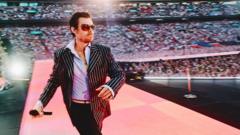
The modern stadium residency is not an accident of scheduling. It is a highly engineered financial and cultural apparatus. When Harry Styles took the stage at Wembley Stadium to kick off his massive multi-night run, the headlines predictably gravitated toward the easy emotional narrative. Media outlets focused entirely on the singer paying homage to his origins, nodding to the specific spot where his career was manufactured on The X Factor over a decade prior.
That narrative is clean, satisfying, and largely incomplete.
To understand the reality of the stadium era, one must look past the colorful boas and the shared sentimentality between an artist and ninety thousand fans. The decision to anchor an entire touring cycle around multi-night stints in a single city represents a fundamental shift in the live music economy. It is a strategy designed to maximize profit margins while mitigating the brutal, rising costs of traditional touring. The nod to televised talent shows is a useful marketing tool. It grounds an industrial-scale operation in a relatable human origin story.
The Hidden Economics of Fixed Location Stadium Runs
The old way of touring was a logistical nightmare of constant motion. A massive convoy of diesel trucks traveled through the night, a different arena or stadium swallowed a crew every twenty-four hours, and local labor costs accumulated across dozens of jurisdictions. In the current economic climate, that model is breaking down. Fuel costs fluctuate wildly. Inflation has driven the price of staging, rigging, and audio equipment to historic highs.
By staying in one place for a week or more, an artist changes the math entirely.
Traditional Tour Expenses vs. Residency Efficiency
-------------------------------------------------
Traditional: High transport costs + daily load-in/load-out + hotel blocks in 30 cities
Residency: One-time setup + fixed local crew rates + massive merchandise scale
When a production occupies a venue like Wembley for consecutive dates, the savings are immediate. The initial setup happens once. The complex rigging of lights, sound delays, and massive LED screens is a grueling process that usually takes days and commands premium union labor rates. In a residency format, those fixed costs are amortized over four, five, or six nights instead of one. The stage sits quietly between shows, generating zero additional setup fees while the ticket revenue multiplies.
Furthermore, the financial risk shifts significantly from the promoter to the consumer. Instead of the artist traveling to meet the audience, the audience travels to meet the artist. Hoteliers, restaurateurs, and public transit systems in London reap the secondary rewards, while the artist's camp enjoys a streamlined operation that functions more like a theatrical residency than a rock-and-roll road trip.
The Function of Manufactured Memory in Modern Stardom
Pop music has always traded on a sense of shared history, but the mechanism has grown more sophisticated. Mentioning a television audition from 2010 is not just a casual trip down memory lane. It is a calculated reinforcement of brand loyalty.
For an artist who has successfully transitioned from the tightly controlled confines of a boy band to a critically respected solo act, the past is a delicate thing to manage. Many performers spend the first decade of their independence trying to bury their pop roots. They chase indie credibility or pivot to avant-garde sounds to prove they are serious creators.
The smarter play is integration. By openly embracing the reality television machine that created him, Styles accomplishes two things simultaneously. First, he validates the long-term investment of his oldest fans, validating their taste and loyalty. Second, he highlights the sheer scale of his trajectory. The contrast between a nervous teenager singing for television judges and an icon commanding a historic stadium is the ultimate narrative arc. It turns the concert from a simple collection of songs into the triumphant climax of an ongoing documentary.
The Evolution of the Fan Relationship
This narrative integration alters the power dynamic in the stadium. The audience is no longer just observing a performance; they are participating in a historical milestone.
- The Shared Journey: Fans who watched the televised auditions as children are now buying premium tickets as working adults. The show acts as a mirror for their own aging process.
- The Community Ritual: The uniform of the crowd—custom clothing, specific accessories, and shared inside jokes—transforms a massive municipal stadium into a temporary, highly exclusive subculture.
- The Documentation Factor: Every night of a residency must feel distinct to encourage repeat viewing on social platforms. A specific localized comment or a historical reference serves as a unique digital watermark for that specific evening's performance.
The Strategic Failure of the Television Talent Pipeline
There is a profound irony in celebrating a television show inside a stadium in the current media landscape. The very system being mythologized on stage is completely dead.
The X Factor and its contemporary equivalents no longer possess the power to launch stadium-level commodities. The monoculture that allowed a Saturday night broadcast to capture the attention of an entire nation has fragmented beyond repair. Today, the path to cultural dominance is decentralized, chaotic, and driven by algorithms rather than music industry kingmakers.
The Shift in Artist Development
---------------------------------
2010 Pipeline: TV Audition -> National Broadcast -> Immediate Major Label Machine
2026 Pipeline: Algorithmic Virality -> Independent Scale -> Fragmented Niche Stardom
The music industry currently faces a critical talent pipeline crisis. While legacy acts and the small handful of monocultural survivors from the early 2010s can sell out stadiums instantly, the newer generation of artists struggles to scale up from theaters to arenas. Record labels no longer invest the millions of dollars required for long-term artist development, preferring instead to chase short-term engagement on video apps.
The stadium residency is a luxury reserved for those who made it through the gate before the gate was torn down. It relies on a level of broad, multi-generational recognition that is nearly impossible to cultivate in a hyper-personalized media environment.
The physical toll of the stationary marathon
While a residency eliminates the exhaustion of overnight travel, it introduces a different kind of physical and vocal strain. Performing three to four hours of high-energy pop music multiple times a week in the exact same environment requires the discipline of an elite athlete.
The acoustic environment of a stadium is notoriously unforgiving. An artist is singing against a wall of delayed sound bouncing off concrete tiers hundreds of feet away, requiring immense vocal control to avoid straining over the monitors. The climate is unpredictable. An open-air venue leaves a performer at the mercy of shifting temperatures, wind patterns, and moisture levels, all of which directly affect vocal cord elasticity.
Musicians who thrive in this environment treat the tour like a military operation. Behind the scenes, the infrastructure resembles a sports medicine clinic more than a backstage party. Vocal rest protocols, physical therapy rooms, and meticulously planned nutritional schedules are standard operating procedure. The goal is consistency. The fan who bought a ticket for night four expects the exact same vocal precision and physical charisma as the fan who attended opening night.
The pop spectacle remains a brilliant illusion. It presents itself as an spontaneous outburst of joy, glamour, and emotional connection. But beneath the surface of the stadium floor, away from the glittering lights and the roaring crowds, it remains a business of cold calculations, logistical efficiency, and precise brand management. The return to the scene of the audition is a beautiful story. It also happens to be exceptionally good for the bottom line.