The fluorescent hum of a customs hall at Johannesburg's O R Tambo International Airport is a distinct brand of nowhere. It smells of floor wax, stale coffee, and the collective anxiety of ten thousand transiting souls. Bags slide off rubber belts with heavy thuds, swallowed by plastic flaps, tagged for distant cities. Most carry ordinary things. Wool sweaters, framed photographs, jars of homemade preserves wrapped in bubble wrap.
Then, there is the suitcase that does not hum. It ticks. Or, more precisely, it clicks with a faint, papery rustle—a sound so delicate it should be swallowed whole by the ambient roar of jet engines, yet sharp enough to stop an experienced wildlife inspector in their tracks.
Imagine, for a moment, the atmosphere inside that inspection bay. (Note: This is a hypothetical reconstruction based on standard wildlife interdiction protocols.) A traveler stands under the harsh glare of overhead lamps, passport damp with sweat. The zipper parts. Inside, nestled among layers of ordinary clothing, are not smuggled bricks of currency or plastic-wrapped narcotics. There are dozens of small, silent cylinders, secured in makeshift mesh pouches.
They look like ordinary stones at a glance. Smooth, pale, and entirely unremarkable. But pick one up, and you feel the frail, racing hammer of life against your palm.
A heart.
The Anatomy of an Invisible Trade
We rarely think about the logistics of grief. We see the headline—Parrot eggs hatch after suspected Thai smuggler arrested at South African airport—and we scroll past. It registers as a minor curiosity. A footnote on a Tuesday morning news feed. Another bizarre collision between human greed and airport security.
Stop scrolling.
Consider what it takes to smuggle life across continents. The African grey parrot—Psittacus erithacus, for those who prefer the cold taxonomy of science—is not merely a bird. It is an intellect wrapped in feathers. For decades, the global pet trade has treated these creatures as commodities, treating their staggering cognitive capacity—often compared to that of a human toddler—as a feature to be harvested. When poachers raid nests in the dense rainforests of Central and West Africa, they are not just stealing eggs. They are ripping the architectural integrity out of ancient ecosystems.
And why? Because somewhere thousands of miles away, in a high-rise apartment in Bangkok or a suburban kitchen in the Northern Hemisphere, someone wants a green-eyed shadow that can mimic the sound of a microwave beep or whisper a human name.
The mechanics of this trade are breathtakingly ruthless. The eggs must be kept warm, but not too warm. They require precise humidity, shielded from the crushing vibrations of cargo holds and the freezing altitudes of long-haul flight paths. Smugglers use specialized vests, body wraps, and modified luggage lined with thermal insulation. They gamble on the blind spots of global transit, banking on the statistical reality that customs agents cannot look inside every single bag.
Until they do.
The Room Where Silence Ends
When the Thai national was detained at O R Tambo, the operation shifted instantly from a matter of law enforcement to an emergency maternity ward.
Confiscating smuggled wildlife is one thing. Keeping fragile, embryonic life alive in the sterile, high-stress environment of an airport quarantine facility is an entirely different war. If you have ever tried to hatch a chicken egg in a classroom science project with a cheap incubator, you know how precarious the balance is. A fraction of a degree off, a sudden drop in humidity, and the delicate web of blood vessels inside the shell collapses.
Now scale that up to endangered, wild avian embryos that have just endured hours of illicit transit, trapped against a human body or hidden beneath false bottoms in luggage, vibrating with the terror of their carrier.
Specialists from the Johannesburg Wildlife Veterinary Hospital were called in. Imagine the transition. One minute, you are drinking your morning tea; the next, you are rushing through security badges into a holding room where thirty-two silent, calcium-fortified spheres sit in the palm of an inspector's hand.
This is where the story pivots from crime reportage to biology in real-time.
You cannot reason with an unhatched chick. You cannot explain to it that the law has intervened, that the flight is cancelled, that humanity is sorry for the way it treats the earth. You can only provide warmth, steady oxygen, and time.
The First Breath
Inside the makeshift incubator, the first sound was not a squawk. It was a scratch.
A tiny, microscopic beak breaking through the inner membrane. In the wild, this moment is soundtracked by the rustle of mahogany leaves, the distant call of a parent returning with fruit, the humid breath of an equatorial canopy. Here, the soundtrack was the low, steady drone of an air conditioning unit and the held breath of a veterinarian watching through plexiglass.
To watch an endangered animal hatch under these conditions is to experience a strange, contradictory mix of triumph and profound sorrow. You are witnessing the persistence of life, yes. But you are also looking at a survivor of a war it never volunteered to fight.
Why do we do this? Why do human beings pack living souls into suitcases?
The answer is as old as civilization itself, yet sickeningly modern. The exotic pet trade is a multi-billion-dollar subterranean economy driven by status, isolation, and a deep, psychological disconnect from the natural world. We want to own what is wild because we feel increasingly caged ourselves. We trap the things that fly because we have forgotten how to reach for the sky on our own terms.
Every smuggled egg represents a failure of imagination. It represents a buyer who could not fathom loving a creature from a distance, who needed to cage it, own it, and silence its wildness in a living room cage.
The Road Back to the Canopy
What happens to birds that are born in a customs warehouse?
They cannot simply be dropped into a forest. They do not know the language of their own kind. They do not know which fruits are poisonous, which branches will snap underfoot, or how to dodge the sweeping shadow of a hawk. Human-reared parrots often imprint on their keepers, viewing humans not as a threat, but as clumsy, featherless parents who bring mashed formula on plastic syringes.
Rehabilitation is a grueling, multi-year pilgrimage back to instinct. It requires sanctuaries with massive flight enclosures where young birds can learn the physics of air resistance without hitting a living room wall. It requires silence from human voices, replacing speech with recorded calls of wild flocks played through hidden speakers.
It is a long, expensive, heartbreakingly difficult undoing of human damage.
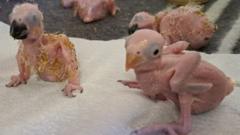
And yet, watching those small, featherless hatchlings stretch their necks toward the warmth of the heat lamp in Johannesburg, you realize something essential. Nature does not negotiate with our cruelty. It simply keeps trying to hatch.
The suitcase is locked in an evidence locker now. The suspect faces trial under stringent wildlife trafficking laws—statutes that treat the theft of biodiversity not as a minor customs violation, but as the grand theft of the planet's future.
Somewhere outside the terminal, the African sun is setting over the highveld, casting long, bruised shadows across the tarmac. A jet screams overhead, lifting its nose toward the horizon. Inside a quiet, climate-controlled room far from the public eye, a tiny beak breaks through a shell, gasps for air, and lets out its very first, fragile cry.