Cold water changes the geometry of a human hand.
Anyone who has ever plunged their fingers into an alpine stream in late summer knows the immediate, sharp contraction of skin and blood vessels. Fingers shrink. Knuckles lose their prominence. A band of gold that sat snugly against the base of a ring finger in the humid warmth of a Mediterranean afternoon suddenly becomes a loose hoop, waiting for a single careless flick of the wrist to slip free.
For an Irish father vacationing in northern Italy, that slip happened in a fraction of a second. One moment, he was cooling his hands in the clear, fast-moving current of a mountain stream, watching the light fracture over smooth river stones. The next, the water had claimed a piece of his life. His wedding ring—not merely an alloy of precious metal, but a physical anchor to years of shared mornings, quiet compromises, and the family standing nearby—vanished into the gravel bed.
Gone.
If you have ever lost an object that carries the weight of your personal history, you recognize the specific, hollow panic that follows. You drop to your knees. You stare through the rippling surface, your eyes straining against the refraction of light, convinced that if you just look hard enough, the glint of yellow metal will reveal itself. Your hands rake through freezing silt. Minutes stretch into an hour. Eventually, the sun begins to dip behind the ridges, the water grows too dark to read, and you have to stand up, dry your hands on your trousers, and walk away empty-handed. You leave behind a piece of your identity in a foreign country, knowing the odds of ever seeing it again are effectively zero.
In a cynical age, that is where the story is supposed to end. We are conditioned by daily headlines and algorithmic feeds to expect apathy, transactional behavior, and the slow erosion of public trust. When something is lost in a public place, we assume it is swallowed by the void—either buried forever by nature or pocketed by the first opportunist who stumbles across it.
Yet three strangers in Italy looked at that empty space in the riverbed and decided the story wasn't finished.
The Anatomy of an Impossible Search
To understand what happened next, you have to understand the sheer physical absurdity of finding a wedding band in a flowing stream.
A stream is not a swimming pool. It is a dynamic, shifting conveyor belt of rock, sand, and organic debris. Even a modest current exerts continuous lateral force on small, dense objects. Gold is heavy—roughly nineteen times denser than water—which means it doesn't float downstream like a leaf. Instead, it drops straight down and immediately begins to work its way into the interstitial spaces between pebbles and coarse sand. Within hours, the natural movement of the riverbed buries it.
Consider a hypothetical parallel to appreciate the scale of the task. Imagine dropping a single copper penny into a gravel driveway the size of a tennis court, then turning a fire hose on the stones for twenty minutes. Now try to find that penny without draining the area, while freezing water numbs your wrists and distorts your depth perception.
When word of the lost ring reached three local men in Italy, they didn't offer hollow sympathy or shrug at the inevitability of the loss. They treated the Irishman’s misfortune as a personal mandate. Armed with metal detectors, underwater scoops, and the kind of stubborn patience that cannot be bought, they went back to the stream.
Metal detecting in moving water is an exercise in frustration. Mountain streams in northern Italy are littered with mineralization—iron-rich rocks, old bottle caps, foil wrappers, and discarded nails that scream through headphones with the exact same tonal pitch as gold. Every false signal requires digging into shifting stones against the push of the current, holding a waterproof pinpointer steady while silt clouds the water and obscures your vision.
Hours passed. Cold water seeped through gear. Backs ached from bending over the rushing current.
Then, beneath the hum of the river and the static of the detector, a clean, unmistakable signal broke through. When the scoop came up and the gravel washed away through the mesh, there it was: a circle of gold, unscathed by the stones, catching the Italian sunlight once more.
Why We Cross Oceans for Things That Have No Price
Finding the ring was a triumph of persistence and technical skill. What they did afterward was something else entirely.
The three men could have dropped the ring into a padded envelope, paid for international tracked shipping at a local post office, and sent it back to Ireland. That alone would have made them heroes in the eyes of the man who lost it. It would have been sensible, economical, and entirely sufficient.
Instead, they bought plane tickets.
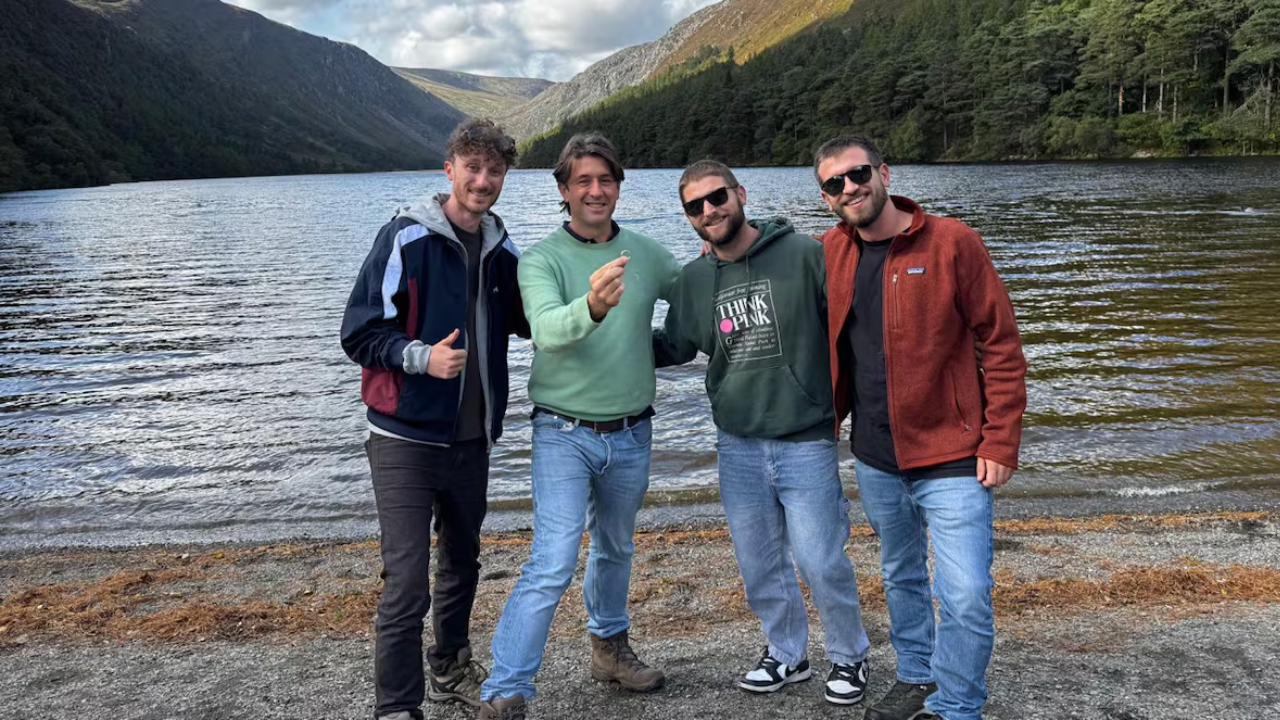
Three strangers boarded a flight from Italy to Ireland, crossing a continent not for business, not for sightseeing, and not for a paycheck, but to place a single piece of jewelry back onto the hand of a man they barely knew.
Why? Economists and behavioral psychologists have spent decades trying to decode this exact impulse—the willingness of human beings to incur real financial cost and physical inconvenience for someone outside their immediate tribe. In classical economic theory, this behavior makes no sense. There is no return on investment. There is no contractual obligation.
Yet anthropologists who study human cooperation point out that ritual objects—especially wedding rings—occupy a sacred category in the human psyche. Unlike cash or electronics, a wedding band has almost no resale value relative to its emotional gravity. Its worth is entirely biographical. When you return a stranger's wallet, you are protecting their finances. When you return a wedding ring, you are restoring their narrative.
The three Italians instinctively understood that a padded envelope couldn't carry the weight of what they had found. Some moments demand physical presence. They require a handshake, eye contact, and the shared witness of a debt that was never asked for and can never truly be repaid.
The Silence Before the Reunion
Picture the arrival in Ireland.
Think about the emotional state of a father who has spent days or weeks looking down at his bare left hand—at the pale, untanned band of skin where the ring used to sit. Every time he reaches for a coffee mug, grips a steering wheel, or holds his child's hand, his thumb brushes across empty skin. It is a phantom limb sensation, a constant, low-grade reminder of a mistake made in a moment of distraction. You try to tell yourself it’s just an object, that the marriage lives in the people and not the metal, and you know that’s true. Still, the absence hurts.
And then the door opens, or the arrivals gate parts, and three men stand there with smiles born of a shared secret, holding out a tiny piece of gold that traveled from the bottom of an Italian stream to the emerald coast of Ireland.
In that exchange, the invisible stakes of the story come into sharp focus.
We spend so much of our lives building walls against strangers. We lock our doors, guard our time, and treat unfamiliar faces with cautious neutrality. Modern travel itself often reinforces this isolation; we move through airports and foreign cities inside invisible bubbles, consuming experiences while remaining detached from the people who actually inhabit those places.
This story punctures that bubble completely. It reminds us that the geography of human kindness does not respect national borders, language barriers, or the cold logic of convenience. A vacationer from Ireland stepped into a river in Italy, and the currents of that river ended up linking four lives across Europe forever.
What Remains After the Water Clears
The next time you wash your hands in cold water, or take off a ring to knead dough, or slip a watch onto your wrist before walking out the door, pause for half a second. Look at the small, ordinary objects you carry that hold the architecture of your life together.
Most of the time, we only measure their value in the terrible instant they disappear. We assume that once they slip beneath the surface, they are lost to the dark. We forget that the world is still full of people willing to wade into freezing water, sift through the gravel, and fly across an ocean just to make sure a stranger feels whole again.
On a quiet street in Ireland, a father looks down at his hand, and the circle is unbroken.


