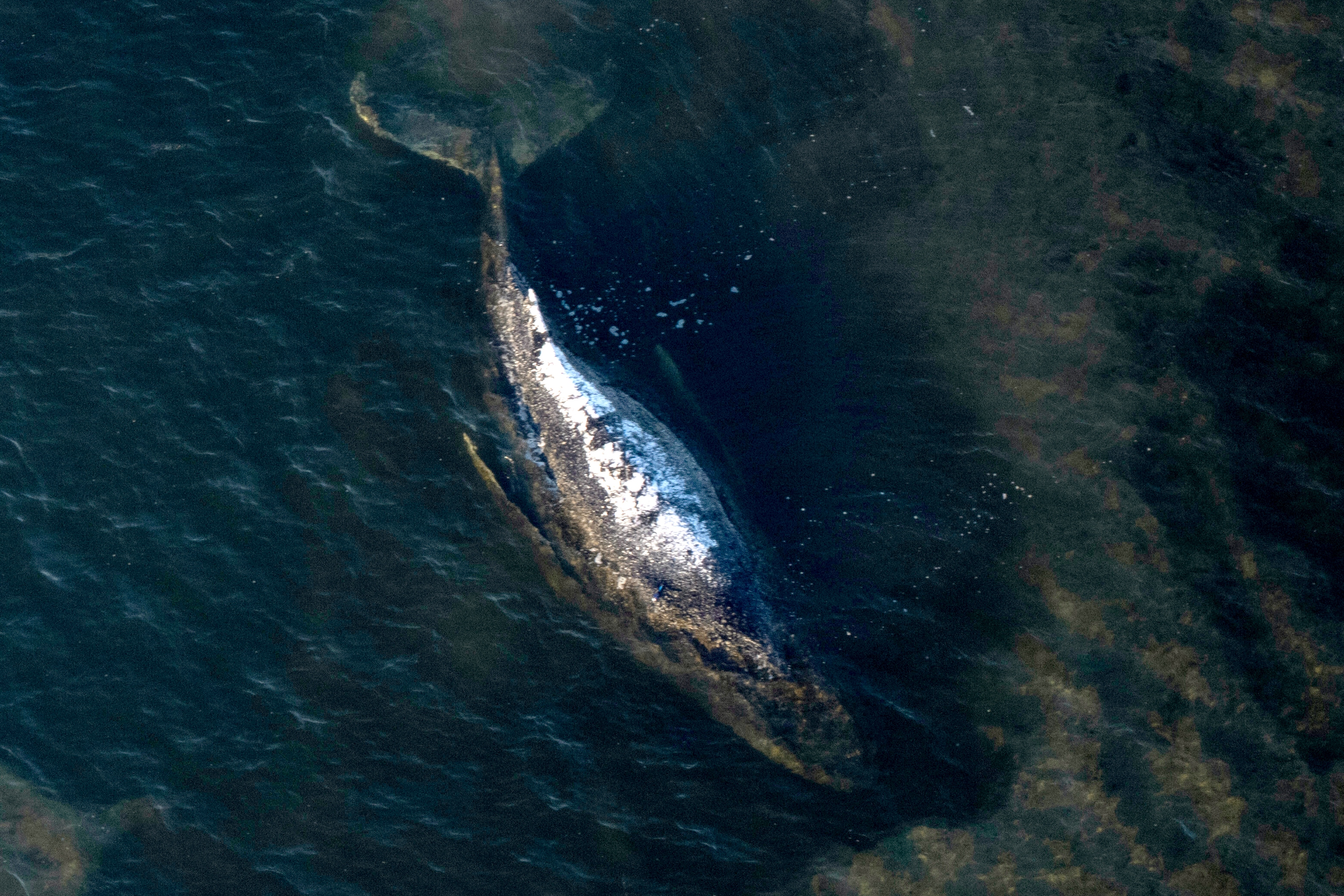
The wind off the Kattegat Sea does not care about human ambition. It blows cold, smelling of salt and decaying kelp, biting at the chapped faces of the locals gathered on the shoreline. They stand in small, muted clusters, their hands shoved deep into heavy wool pockets. Nobody is talking much. When they do, their voices are swallowed instantly by the crash of the surf.
They are looking at Timmy.
To the scientific community, he was a data point—a male humpback whale, scientifically tracked, measuring over thirty feet long. To the international news wires, he was a headline: a carcass towed to a Danish harbor after dying at sea. But to the people standing on the sand, watching the massive, dark gray island of flesh rock gently in the shallows, he was something else entirely. He was a sudden, jarring reminder of how small we are, and how heavy the natural world becomes when it stops moving.
The Mechanics of Mourning
When a whale dies in the open ocean, it usually sinks. It becomes a "whale fall," dropping thousands of feet to the barren seafloor to create an ecosystem that will feed deep-sea creatures for decades. It is a quiet, poetic end.
But sometimes, currents and gases conspire against gravity. The ocean rejects the body. It pushes the giant toward us.
Bringing a dead humpback whale to shore is not an act of grace; it is an engineering nightmare wrapped in a tragedy. Consider the sheer physics of the task. A mature humpback weighs roughly one ton per foot of length. Timmy was thirty tons of dense muscle, blubber, and bone. You cannot simply tie a rope to a tail like that and pull. The skin tears. The flesh gives way.
The Danish authorities, working alongside local marine biologists and maritime experts, had to coordinate a delicate ballet of tugboats, heavy-duty straps, and flatbed cranes. The harbor smelled of diesel exhaust mixed with the thick, cloying scent of marine decomposition. It is a smell that stays in your clothes for days. It gets into your skin.
For the biologists on site, the arrival of the carcass was a grim race against time. A dead whale on land is a biological ticking clock. Internal gases build up rapidly under the thick layer of insulating blubber, transforming the magnificent creature into a volatile pressure vessel. The team worked with specialized long-handled knives, moving methodically, their movements precise despite the freezing rain that began to fall.
They were there to find out why.
Reading the Scars
Every whale carries the story of its life written on its skin. Humpbacks are the nomads of the oceans, traveling thousands of miles every year from tropical breeding grounds to icy feeding northern waters. They navigate by stars, magnetic fields, and ancient instincts we are still trying to decode.
As the researchers began their necropsy, the crowd watched from behind the police tape. Children sat on their parents' shoulders, staring wide-eyed at the massive pectoral fins—fins that once swept through the pitch-black depths, guiding thirty tons of life through the water with the grace of a ballerina.
The scientists looked for clues. Was it a ship strike? A collision with a massive container vessel can fracture a whale’s jaw or cause fatal internal bleeding without leaving much of an external mark. Was it entanglement? Discarded fishing gear—ghost nets that wander the oceans like transparent traps—can wrap around a whale’s tail or flippers, slowly exhausting the animal until it drowns. Or was it simpler? Old age. Sickness. Starvation in an ocean where fish stocks are shifting due to warming waters.
We often view the ocean as a separate world, a vast blue void where our actions vanish without a trace. But Timmy’s body was a mirror. The heavy metals in his blubber, the microplastics that might be found in his stomach, the scars from ropes around his peduncle—they are all our signatures, written on the wild.
The mood on the beach shifted from curiosity to a strange, collective solemnity. A local fisherman, his face lined by decades of salt and sun, watched the heavy machinery lift a section of the whale's baleen. These are the long, fringed plates made of keratin—the same material as human fingernails—that the whale used to filter millions of tiny krill from the water.
"You see them out there sometimes when you're netting," the fisherman said to no one in particular, his voice low. "Just a dark shape breaking the surface, a exhale like a steam engine, and then they're gone. You think they own the place. You think they'll always be there."
The Ephemeral Witness
There is a distinct vulnerability in seeing something so inherently majestic brought so low. In the water, a humpback whale is weightless. It defies the brutal reality of its mass, launching itself entirely out of the sea in spectacular breaches that leave onlookers breathless. On land, gravity becomes a crushing force. Without the water to support it, the whale's own immense weight compresses its internal organs.
It becomes an object. A problem to be solved. A clean-up operation.
Yet, the people stayed. They stayed through the afternoon as the light faded into a bruised purple twilight. They stayed as the heavy excavators began the grim work of dismantling the carcass for disposal and scientific study. The skeleton would likely be preserved for a museum, a static display under bright lights where school children would look up at the bones and try to imagine the creature they once belonged to.
But the bones tell only half the story. They don't capture the song.
Humpback whales are famous for their complex, haunting vocalizations—songs that carry for miles through the water column, evolving over time as whales learn new phrases from one another. We do not know what Timmy’s voice sounded like. We do not know who heard his last song in the dark waters of the North Sea before the silence took him.
The Tide Comes In
The heavy machinery eventually fell silent. The trucks drove away, their tires leaving deep, muddy ruts in the gravel parking lot. The crowd thinned out until only a few stragglers remained, staring at the empty patch of sand where the giant had rested just hours before.
The tide was coming back in, washing over the stained gravel, erasing the footprints of the scientists, the police, and the onlookers. The sea was reclaiming its space, smoothing out the disruptions we had made on its edge.
Tomorrow, the harbor will go back to its normal routine. The fishing boats will head out past the breakwater, their engines thrumming in the pre-dawn gray. The tourists will walk the docks with their ice creams and cameras, looking at the picturesque red houses and the calm, blue horizon.
But for those who stood on the beach and watched the cold wind lift the dark skin of the fallen giant, the horizon will look a little emptier. The ocean will seem a little quieter. We like to believe we are the masters of this planet, steering our steel ships through the waves and charting every corner of the globe. But every now and then, the sea sends something to our shores that reminds us of the ancient, fragile mysteries that still roam just beneath the surface, completely beyond our control.