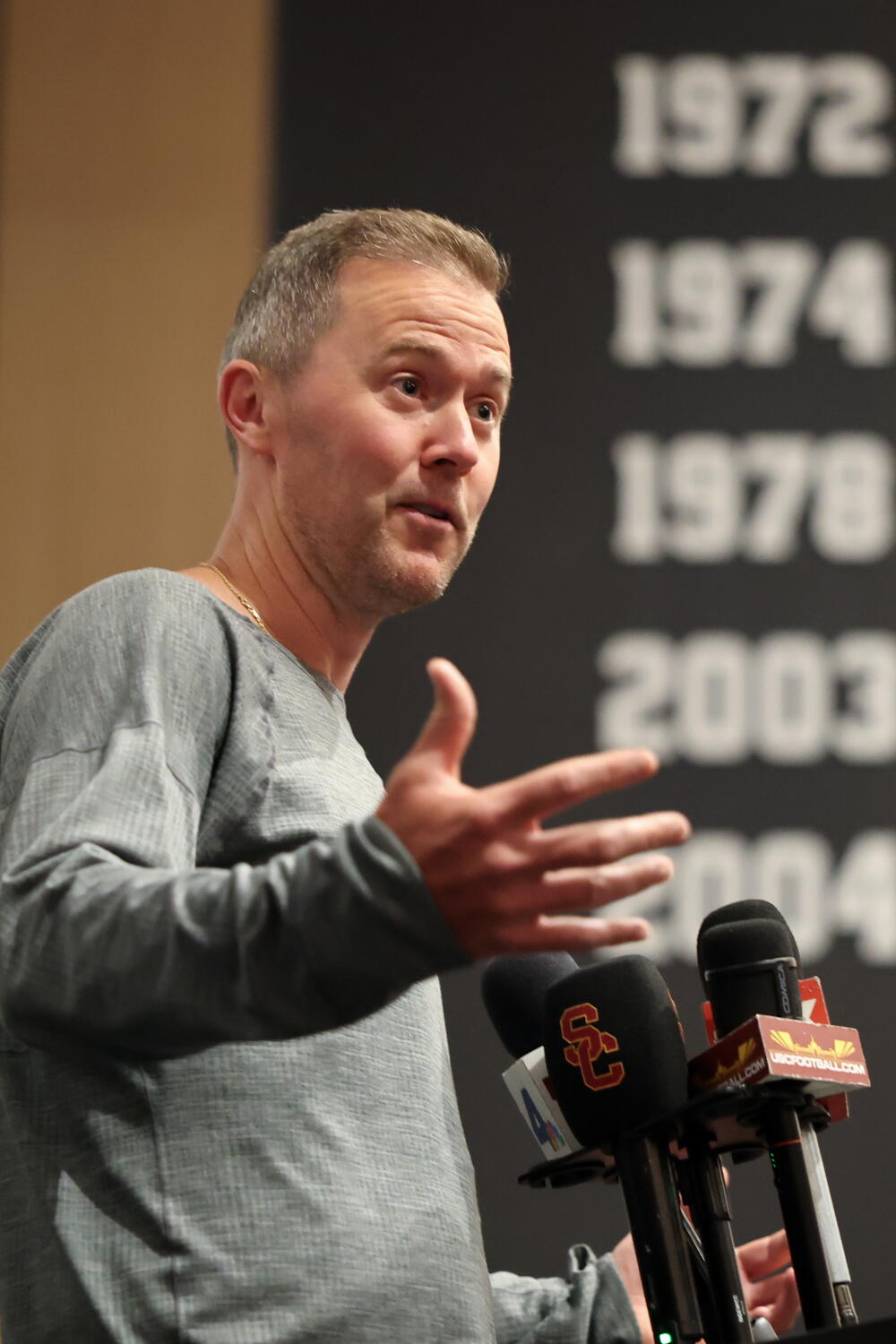
The afternoon air in Los Angeles smells like eucalyptus, ozone, and old iron. If you stand outside Heritage Hall long enough, past the bronze statues and the ghosts of Heisman winners frozen mid-stride, you can hear the faint, rhythmic thud of a shoulder pad hitting a blocking sled. It is the sound of an obsession renewing itself.
Lincoln Riley stands on the practice field with his hands tucked deep into the front pouch of a dark charcoal hoodie, watching a redshirt freshman overthrow a corner route by six inches. He does not yell. He does not throw his visor. He simply watches, his jaw working a piece of gum with slow, deliberate precision. He knows what everyone outside these gates is saying. He knows the whispers in the Trojan family group chats, the impatient murmurs in the sports bars along Figueroa Street, and the bold-ink projections scrolling across sports networks.
Expectations are through the roof. They always are when you wear cardinal and gold, but this time, the weight feels different. It feels personal.
To understand the current temperature of Southern California football, you have to rewind past the confetti of past decades and look at the raw calculus of transition. When Riley arrived in Los Angeles, he walked into a program that had spent years wandering a desert of its own making. There was talent, sure—the fertile recruiting soil of Southern California never truly goes barren—but there was also fracture. Disconnection. A culture that had forgotten what it actually takes to scale the mountain, relying instead on the historical gravity of the brand name to do the heavy lifting.
His first year was a brilliant, dizzying magic trick. Caleb Williams danced backward, flicked his wrist, and transformed a bruised roster into a Playoff contender until the final month caught up with them. It was intoxicating. It made people forget that turnarounds are usually concrete poured over mud; they want the skyscraper built overnight.
Then came the gravitational pull of reality.
Last season did not just test the walls; it rattled the foundation. The defense leaked yardage like a sieve with rusted seams. Games turned into high-stakes track meets where survival depended entirely on whether the offense could score on every single possession. Losses accumulated not because the team lacked talent, but because the margin for error had shrunk to the width of a razor blade. The noise grew louder. The radio callers sharpened their tones.
(Note: This transition from offensive euphoria to defensive reckoning is a familiar script in modern college football, where the arms race of scheme often outpaces the brutal physicality required in the trenches.)
Watch Riley on the sideline during a tight fourth quarter. His face remains flat, almost bored, but his eyes never stop tracking the leverage of the safeties. He understands the trap of the modern college football landscape. You can recruit five-star receivers until your binder is thick, but if your defensive front cannot stop a third-and-short dive play in November, November becomes a very long month.
This offseason was not about flashy additions or viral social media hype videos. It was an exercise in institutional grit. The coaching staff was overhauled with an unapologetic emphasis on defensive pedigree. Bodies were brought in—big, angry human beings designed to occupy space, disrupt blocking schemes, and make opposing quarterbacks hear footsteps before they even drop back.
There is an invisible tax that comes with coaching at USC. John McKay understood it. Pete Carroll mastered the art of weaponizing it, wrapping the pressure in a blanket of loose-limbed swagger. Riley is cut from a quieter cloth, more Midwestern pragmatist than California surfer, but the mandate remains identical. You either win immediately, or you become the topic of a three-part investigative retrospective on what went wrong.
Consider the psychological landscape of a nineteen-year-old athlete walking into the facility today. He scrolls past pictures of Marcus Allen and Matt Leinart every single morning. He hears the echoes of fans who remember national championships the way older generations remember the moon landing. That kind of history can either be a tailwind or a 500-pound anchor.
Riley’s job isn't just drawing up pass concepts or managing practice scripts. His primary task is managing the temperature of that collective heartbeat.
The schedule waiting ahead is not a gentle introduction; it is a gauntlet wrapped in barbed wire. The Big Ten conference is no longer a distant geographic curiosity for USC fans; it is the physical reality stamped on every weekend ticket. Cold-weather November afternoons in hostile Midwestern stadiums. Physical, bruising lines of scrimmage that demand a different kind of stamina than the wide-open spaces of the old Pac-12.
If you ask the cynics, the window is already closing, the defensive fix is a pipe dream, and the pressure will eventually eat the program from the inside out. They point to the defensive collapses, the missed tackles, the moments when the identity seemed to slip through their fingers like dry sand.
They might be right, or they might be underestimating the stubbornness of a coach who left a comfortable throne in Norman precisely because he wanted to test himself against the highest possible ceiling.
On the practice field, the redshirt freshman throws another slant. This time, the receiver catches it in stride, tucks it away, and turns upfield. Riley gives a single, sharp nod—barely perceptible, just a slight dip of the chin—before turning his attention back to the line of scrimmage. The sun dips lower behind the Los Angeles skyline, casting long, bruised shadows across the turf, and the work simply continues.
.png?width=1200&auto=webp&trim=0%2C0%2C0%2C0)


