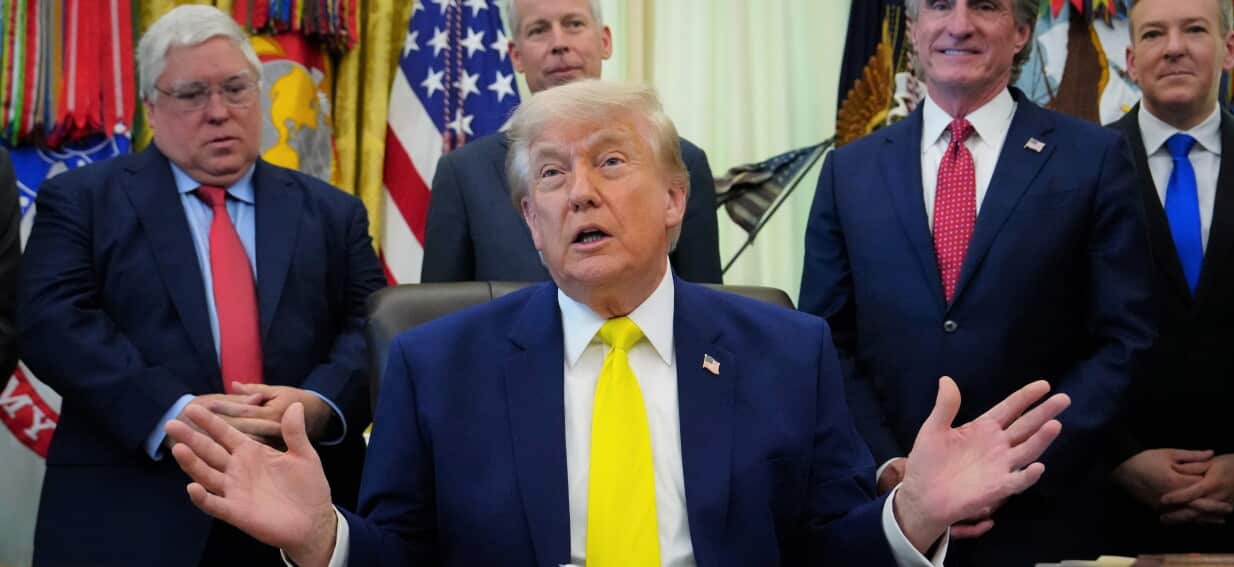
Donald Trump did not just fall asleep during a live television broadcast; he exposed the exhaustion of an administration running on late-night grievances and dawn-patrol directives. When video emerged of the president dozing off in his chair during high-level briefings on pharmaceutical prices and maternal healthcare, the immediate internet reaction was predictable mockery. Viral clips showed his eyelids drooping, his head tilting forward, and his inner circle engineering rapid-fire cover stories about "extended blinking."
The optics are bad for a leader who built his brand on relentless energy, but the reality of the situation is far more complicated than a simple health scare. This is not a sudden medical crisis. It is the predictable outcome of an executive schedule designed to push an aging body past its structural limits.
Behind the scenes, the current administration is locked in a constant battle between public optics and private exhaustion, where sleep is treated as a sign of weakness and 2:00 a.m. phone calls are badges of honor.
The Strategy Behind the Slump
For years, political opponents have used fatigue as a political weapon. Every heavy blink or slurred word is instantly dissected by partisan commentators looking for signs of cognitive decline. Yet the obsession with finding a definitive medical diagnosis misses the broader operational reality of the executive branch.
The president operates on a sleep schedule that would break a corporate executive half his age. Secretary of State Marco Rubio defended the administration during recent congressional testimony, insisting that the president simply does not sleep. Rubio detailed receiving official phone calls at 2:00 a.m. and 5:00 a.m., describing a nocturnal workflow that routinely stretches past midnight in the Oval Office.
Typical Executive Sleep Cycles vs. The Trump Schedule

Standard Recommendation:  ||||||||||||||| 7-8 Hours (Consistent)
The White House Reality:   |||| 3-4 Hours (Fragmented by late-night social media & early calls)
This fragmented rest creates a physiological debt that cannot be repaid by sheer willpower. When the cameras turn on for a monotonous afternoon policy briefing on drug costs or digital portals, the human brain demands payment. The resulting microsleeps—brief episodes of unconsciousness lasting from a fraction of a second to a few seconds—are uncontrollable biological responses, not conscious choices.
The Myth of the Sleepless Leader
Washington has long romanticized the sleepless statesman. From Winston Churchill’s late-night whiskey sessions to Bill Clinton’s notorious four-hour rest cycles, the ability to function without sleep has been conflated with structural strength.
It is a dangerous delusion. Sleep science has spent the last three decades proving that chronic sleep deprivation degrades executive function, alters risk assessment, and heightens emotional reactivity.
- Cognitive Fragmenting: The brain fails to sustain attention, leading to visible zoning out during routine tasks.
- Vulnerability to Microsleeps: The body forces temporary shutdowns to protect basic neurological function, regardless of environment.
- Emotional Volatility: Lack of deep REM sleep impairs the prefrontal cortex, making it harder to regulate temper and impulse control.
When an administration treats sleep deprivation as a performance metric, the entire policy apparatus begins to reflect that erratic schedule. The late-night social media barrages that define this presidency are not separate from the afternoon dozing; they are the direct cause of it.
The White House Cover-Up Engine
The response from the press office to these viral clips follows a well-worn playbook of aggressive denial. When confronted with undeniable footage of a slumping commander-in-chief, officials do not pivot to humanizing the president's workload. Instead, they deny the physics of the video.
During a tense House Foreign Affairs Committee hearing, Representative Ted Lieu openly accused administration officials of lying to the public, playing footage of the president sleeping during a cabinet meeting. The official response from the witness table was a flat refusal to acknowledge what was visible on the screen.
This refusal to concede even minor human vulnerability stems from a foundational belief that any admission of physical limitation is politically fatal. The administration has positioned itself as the antithesis of perceived weakness. To admit the president needs a nap is to surrender the central narrative of their political movement.
The Real Cost of Executive Burnout
The focus on whether the president is suffering from a specific neurological ailment obscures a more urgent policy question. How does a government function when its central decision-maker is perpetually exhausted?
National security crises do not wait for the morning. If the president is entering micro-sleep states during low-stakes policy briefings on maternal health or economic websites, the operational capacity during a prolonged international standoff becomes a liability. A tired brain defaults to routine, struggles with nuance, and becomes highly susceptible to flattery and manipulation by advisers who manage to stay awake.
The system is currently sustained by a protective ring of staff members who manage the flow of information around these energy dips. They schedule high-energy events in narrow morning windows and stack dense, reading-heavy briefings in the late afternoon when the biological drive to sleep hits its peak.
This arrangement functions well enough during standard operations, but it lacks resilience. A presidency run on sleep deprivation is a machine running without oil; it works efficiently until the moment the friction destroys the engine. The viral videos are not just embarrassing clips for the nightly news loop. They are early warning lights on the dashboard of the state.
The administration cannot spin its way out of basic human biology. No amount of late-night bravado or congressional defensiveness can change the fact that a seventy-nine-year-old body requires rest to function. Until the White House alters its internal culture to value sustainable stamina over performative sleeplessness, the spectacle of a nodding leader will remain a recurring feature of the modern political landscape.