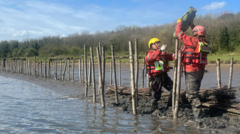
Arthur remembers when the river bank didn't feel like a ticking clock. Forty years ago, as a boy, he watched his grandfather walk along the earthen dyke, patting the packed dirt as if it were an old horse. In those days, the wall was a symbol of human dominance. We built it. We held the tides back. We claimed the fertile silt behind it for cattle and wheat, turning a blind eye to the muddy, squelching wilderness on the other side.
But rivers have long memories. Discover more on a similar issue: this related article.
Over the decades, the water grew hungrier. Every high tide bit a little deeper into the mud. The saltmarsh outside the wall—that messy fringe of grey-green grass and sucking clay—began to starve. Deprived of the sediment that the river used to drop gently across the plains, the marsh dissolved. It shrank from a wide, protective mattress into a pathetic strip of slick mud. Without that mattress to absorb the energy of the waves, the river slammed directly into the earthen wall.
Arthur watched the cracks appear. First, they were just hairline fractures in the dry summer clay. Then, they became deep, muddy wounds that swallowed fence posts. The community spent thousands of dollars dumping jagged rocks against the bank. The river swallowed those too. More analysis by Reuters delves into related perspectives on this issue.
This isn't just Arthur’s story. It is the story of thousands of miles of tidal river banks across the globe. For centuries, our relationship with coastal waterways has been defined by a single, stubborn word: resistance. We built walls to keep the water out, unaware that we were destroying the very buffer that kept those walls standing. Now, a quiet revolution is beginning on the muddy fringes of our rivers. We are finally tearing down the walls.
The Invisible Fortress Under Our Feet
To the untrained eye, a saltmarsh looks like a wasteland. It smells of sulfur and decaying vegetation. It ruins a good pair of boots in seconds. If you stand in one at low tide, it feels like the middle of nowhere, a forgotten space between the solid certainty of dry land and the clean open water of the estuary.
That ugliness is a mask. In reality, these muddy fringes are some of the most efficient, complex engineering systems on Earth.
Consider how a wave behaves. When a body of water rushes toward a sheer concrete wall or an earthen dyke, it hits a dead end. The energy has nowhere to go but up and down, scouring away the base of the wall and weakening its foundations. It is a violent, destructive collision.
Now, consider what happens when that same wave meets a healthy saltmarsh.
The water enters a dense jungle of sea-purslane, cordgrass, and saltwort. Millions of stiff, flexible stems act like billions of tiny shock absorbers. The wave is chopped up, confused, and stripped of its momentum. By the time the water reaches the true shoreline, its destructive power has been bled away to almost nothing.
Scientists call this wave attenuation. To the people living behind the marsh, it is the difference between a dry basement and a catastrophic flood.
But the magic of the marsh goes deeper than mere defense. It is a self-healing system. As the slowed-down water wanders through the vegetation, it loses the strength to carry the heavy silt it dragged up from the riverbed. The silt drops. It settles around the roots of the plants. Over months and years, the marsh literally builds itself upward, keeping pace with the rising sea levels.
When we built walls to turn these marshes into farmland, we disconnected the land from the river. We stopped the silt from dropping. Behind the walls, the dry agricultural soil began to dry out, compact, and sink. Outside the walls, the remaining sliver of marsh was drowned by the rising tides. We trapped ourselves in a geographic paradox: our land was sinking, the sea was rising, and we had destroyed our only shield.
The Great Realignment
The heavy machinery arrived on Arthur’s stretch of the river on a cold Tuesday morning. To the older residents of the valley, what the engineers were about to do looked like an act of madness, or at least a total surrender.
They weren't building the wall higher. They were breaching it.
This process, known formally as managed realignment, is the core of modern river bank restoration. It is an admission of vulnerability. We are acknowledging that we cannot out-engineer the physics of a rising ocean forever. Instead of fighting the water, we are choosing where to invite it in.
The engineers did not just smash the dyke and run. The process is a delicate, calculated dance. First, a new wall was built hundreds of yards inland, safely wrapping around the historic homes and critical infrastructure of the valley. This is the new line of defense, shorter, stronger, and much easier to maintain.
Then came the breach. Excavators dug a wide trench through the old, crumbling outer wall.
Arthur stood on the new inland ridge and watched the first high tide rush through the gap. The water didn't crash or destroy. It flowed home. It spilled across the low-lying fields that had been stolen from the river centuries ago, filling the old drainage ditches and spreading out like a silver sheet across the soil.
To see fertile land covered in saltwater feels wrong instinctively. It triggers a deep-seated human fear of loss. But this is not a loss; it is a resurrection.
Within weeks, the transformation began. The tide brought in billions of seeds from native marsh plants. The river sediment, rich and thick, began to coat the old cow pastures. The transition is messy. For the first year, the site looks like a battlefield of brown slime and dead terrestrial grass. The skepticism from the local community was loud. People pointed at the mud and wondered why public funds were being spent to create a swamp.
But patience is a requirement when working on geological time.
Life in the Intertidal Nursery
By the second summer, the brown battlefield began to blush green.
The salt-tolerant plants took hold, their deep root systems binding the loose agricultural soil into a tough, resilient mat. If you walk along the new setback wall today, you can hear the change before you see it. The silence of the old, monoculture cattle fields has been replaced by a chaotic, living symphony.
Redshanks and curlews stalk through the shallow pools, their long, curved bills probing the mud for worms and snails. In the deeper creeks that have naturally carved their way through the emerging marsh, the water is alive.
Let us look at what is happening beneath the surface, because the true value of a saltmarsh is often invisible.
Estuaries and tidal rivers are the nurseries of the sea. Species like sea bass, herring, and grey mullet rely on these shallow, sheltered environments to lay their eggs and raise their young. In the open river or the deep ocean, a young fish is nothing more than a snack for a larger predator.
The flooded saltmarsh changes the rules of survival. When the tide rises, the juvenile fish swim into the submerged vegetation. The dense network of plant stems forms an impenetrable cage. Big fish cannot get in; small fish can hide, grow, and feed on the massive abundance of microscopic life that thrives in the mud.
The economic ripple effect of this muddy nursery travels far beyond the river banks. The commercial fisheries miles out at sea are directly fueled by the quiet success of these restored upstream marshes. When we lose the marsh, we lose the fish. When we bring the marsh back, the nets out in the deep water start coming up heavy again.
The Breath of the Mud
There is another stake in this game, one that cannot be seen, smelled, or caught with a fishing line. It involves the very air we breathe.
We hear a lot about tropical rainforests as the lungs of the planet, the great carbon sinks that soak up our industrial sins. But pound for pound, a saltmarsh can trap and store carbon up to forty times faster than a mature tropical forest.
This is the concept of blue carbon.
When a forest tree dies, it falls to the ground, rots in the open air, and releases most of its stored carbon back into the atmosphere as carbon dioxide. A saltmarsh operates differently. The plants grow quickly, capturing carbon through photosynthesis. When those plants die, their leaves and roots are buried in the wet, oxygen-poor mud of the marsh.
Because there is almost no oxygen in that deep clay, the normal processes of decay slow to a crawl. The carbon is locked away, effectively frozen in time, buried deeper and deeper under new layers of silt with every passing tide. A healthy saltmarsh can store carbon for thousands of years, acting as a permanent vault.
When we drain a marsh for agriculture, we open the vault. The oxygen rushes into the dried soil, the ancient organic matter rots, and centuries of stored carbon are discharged back into the sky in a matter of decades. Restoring the river banks is not just about stopping a local flood or saving a local bird; it is a localized intervention in a global climate crisis.
The Cost of the Long View
The hardest part of restoring a river bank is not the engineering. It is the human psychology.
We are creatures of the short term. We like clean lines, predictable boundaries, and immediate returns. A concrete sea wall provides an instant, comforting sense of security, even if it is a false one that will fail dramatically in fifty years. A restored saltmarsh requires us to accept ambiguity. It requires us to understand that land is not always static, that the border between water and earth is meant to be blurry.
It also requires a difficult conversation about sacrifice.
To restore a marsh, someone usually has to give up land. Sometimes it is a farmer whose family has worked that soil for generations. Sometimes it is a coastal homeowner who must accept that the true line of defense is moving closer to their back door. It is easy to celebrate environmental restoration from a distance, but up close, it often looks like a compromise that hurts.
Arthur understands this better than most. The old dyke his grandfather tended is gone now, reduced to a couple of grassy mounds where the ducks rest at high tide. The view from his porch has changed completely. The neat, green fields of his youth are gone, replaced by a wild, shifting landscape of water, mud, and grass.
But last autumn, a massive storm hit the coast. The tide rose to heights that would have easily shattered the old, brittle earthen wall. In the past, the community would have spent the night in terror, watching the river rise, waiting for the breach, preparing for the evacuation sirens.
Instead, Arthur sat on his porch with a cup of coffee.
He watched the storm wave hit the outer edge of the restored marsh. He saw the water rush into the grass, slowing down, losing its white crests, turning from a monster into a ripple. By the time the tide reached the inland wall beneath his feet, the water was gentle, quiet, and spent.
The river had come back, but it had brought peace with it.