The fog over the Strait of Gibraltar does not care about borders. It rolls in from the Atlantic, swallowing the jagged silhouette of the Rif Mountains, blurring the line where the cold ocean meets the warm Mediterranean, and turning the narrow channel dividing Africa from Europe into a blind, grey void.
On clear days, you can stand on the beach near Fnideq and see the white buildings of Ceuta shimmering under the Spanish sun. It looks close enough to touch. A strong swimmer could dream of making it across before the tide turns. A desperate person can look at that sliver of European soil and see an entire lifetime of safety, stability, and second chances just a few miles away.
Distance is a cruel illusion.
Between that beach and that European enclave lies an intricate maze of razor wire, thermal cameras, patrols, and bureaucracy. And tonight, that maze caught nearly three hundred people.
The Anatomy of a Midnight Rush
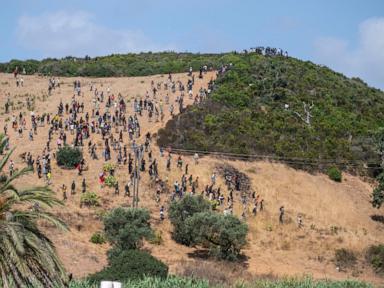
Imagine standing on a hillside in the dead of night. The wind carries the scent of salt and damp earth. Far below, a collective shadow moves.
According to reports from Moroccan security forces, this was not a quiet, scattered trickle of unauthorized crossings. It was a coordinated mass movement. Nearly three hundred individuals—young men, exhausted teenagers, and a handful of families willing to gamble everything—converged on the perimeter fences surrounding Ceuta.
This is where statistics obscure humanity. We read a number like "nearly 300" in a morning headline and file it away as geopolitical background noise. We forget the aching muscles. We forget the blisters wrapped in duct tape. We forget the months or years spent hiding in forest camps, surviving on scraps, waiting for a rumor to turn into a plan.
When the signal was given, they ran.
They ran toward the triple-layered fences topped with barbed wire. They ran toward the automated sensors and the blinding white arcs of searchlights. Some carried homemade hooks; others relied on sheer momentum and human ladders, hoisting one another toward the top of a barrier designed to keep the Global South firmly separated from the Global North.
They did not make it.
The Iron Grip of the Perimeter
Security forces were waiting. They always are.
Moroccan authorities, operating under increasing pressure to police Europe's southern borders, moved swiftly. Riot gear clattered against pavement. Sirens cut through the salt air. Within hours, the mass attempt was broken into manageable, tragic fragments. Detainees were rounded up, loaded onto buses, and driven away from the coast, back into the interior.
Ceuta remains Spanish, a tiny scrap of the European Union physically attached to the African continent. Along with its sister enclave, Melilla, it is a geographical anomaly—a physical door left ajar, guarded ferociously by nations caught in the middle of a global migration crisis.
Spain wants secure borders. Morocco wants international validation, economic cooperation, and security partnerships. And the migrants want a future that doesn't require dodging patrols in the dark.
Everyone is playing a role assigned to them by geography and economics. Yet, the human cost is rarely factored into the geopolitical ledger.
What the Numbers Leave Out
Consider a hypothetical eighteen-year-old named Tariq. (This scenario is a narrative composite, built from hundreds of documented accounts of young men making the journey north through Morocco.)
Tariq left a village where the soil turned to dust years ago. He spent fourteen months crossing the Sahara, paying smugglers he despised, hiding in abandoned buildings, and watching friends disappear into detention centers or hospital wards. By the time he reached the hills overlooking Ceuta, he was no longer a teenager. He was a survivor of an invisible war of attrition.
When the Moroccan security forces intercepted him tonight, what did he feel? Relief that the brutal chase was over? Despair as the iron gates closed behind him once more?
Anger is a luxury. Hunger is immediate.
When we talk about border enforcement, we speak in the language of capacity, deterrence, and sovereignty. We debate interception rates and deportation flights as if they were abstract chess moves. But every single one of those three hundred arrests represents a human ecosystem colliding with a wall of state power.
The Geography of Desperation
Why Ceuta? Why Morocco?
To understand the pressure cooker that erupted tonight, you have to look at the map through the eyes of someone with nothing left to lose. Traditional maritime routes across the Mediterranean from Libya or Tunisia have grown increasingly lethal and heavily monitored. The Atlantic route from Western Sahara to the Canary Islands is a watery grave for poorly constructed wooden boats.
That leaves the land borders. That leaves the peculiar colonial hangover of Ceuta and Melilla—the only terrestrial EU borders on the African continent.
For decades, these enclaves have acted as magnets. They are European territory where anyone who manages to scale the fence and touch the ground can claim asylum rights under international law. That single legal reality turns a ten-meter fence into Mount Everest. It turns a desperate midnight sprint into a legal lottery.
Morocco acts as the primary gatekeeper. Backed by European funding and diplomatic pressure, Moroccan security forces maintain a relentless vigil along the northern coast. They break up camps in the Beliones mountains. They sweep the beaches at dawn. They intercept dinghies before they clear the surf.
It is an exhausting, Sisyphean task. For every three hundred people arrested tonight, another group is waiting in the forest, watching the guards rotate shifts, calculating the next moonless night.
The Sound of Silence After the Raid
The buses have long since departed from the perimeter of Ceuta. The dust kicked up by the patrol vehicles has settled back onto the dry earth. The searchlights sweep across empty fences, cutting blank arcs through the coastal fog.
Down on the beach, the waves continue their ancient, indifferent rhythm, crashing against the sand and pulling back into the dark.
Three hundred lives have been redirected, paused, or shattered. Their names will not appear in history books. Their faces will blur into the vast, anonymous statistic of global migration policy. Yet, out there in the dark, the wind still whispers across the strait, carrying the sound of a distant shore where the light never quite goes out.