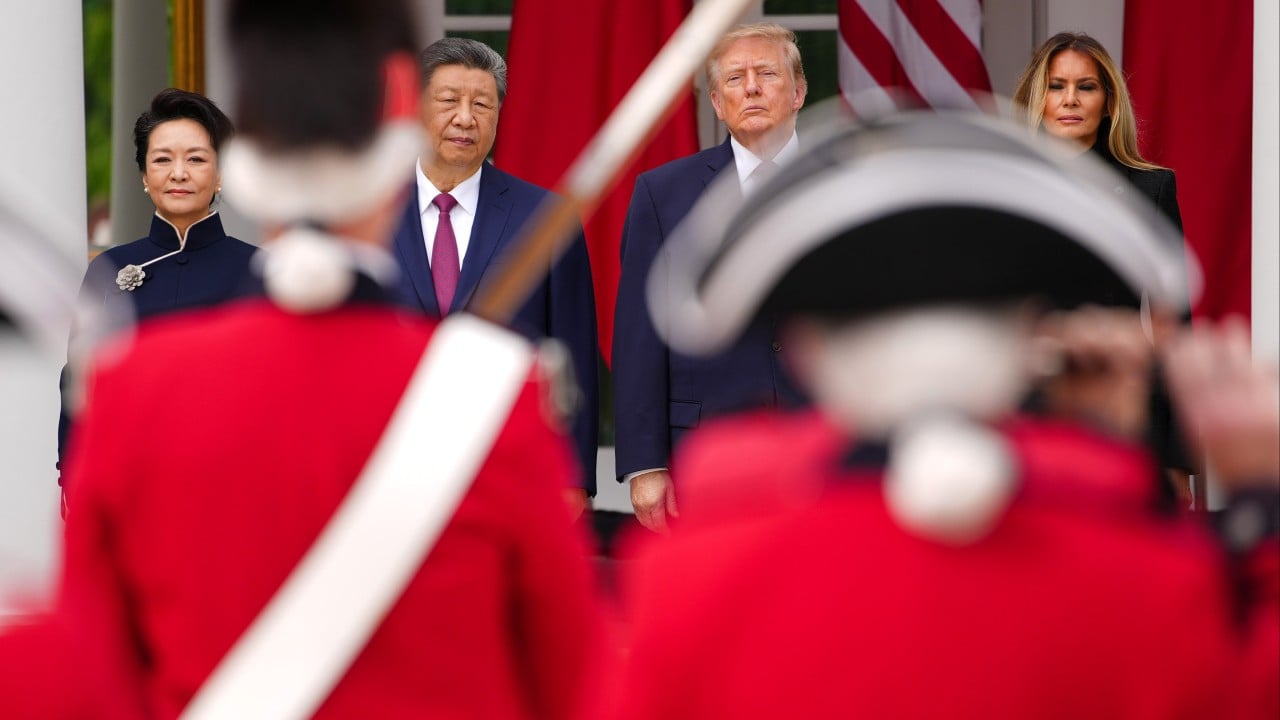
The Red Carpet Mirage
A massive Air China jet touched down at Joint Base Andrews. Donald Trump stood on the tarmac waiting. Not inside the White House, not peering through bulletproof glass, but right there on the concrete, flanked by a military band and a gleaming red carpet. Minutes later, the skies above Maryland roared with the unmistakable, dagger-shaped silhouette of a B-2 Spirit stealth bomber escorted by four F-22 Raptors.
The mainstream press corps immediately swooped on the pageantry. Headlines hailed a diplomatic thaw. Commentators declared that the specter of a catastrophic US-China war had been permanently locked in a diplomatic vault. They pointed to bilateral working groups, panda exchanges, and hurried handshakes as proof that the two superpowers had successfully settled into a comfortable groove of managed rivalry.
It is a comforting fiction. It is also completely wrong.
I have spent decades watching foreign policy analysts swoon over summit choreography while missing the structural tectonic plates grinding beneath their feet. The Washington summit was not a peace treaty. It was a tactical ceasefire wrapped in military intimidation, designed by both capitals to buy time, secure industrial supply chains, and rearm for the next phase of an unyielding techno-nationalist cold war. Treating a photo-op under the shadow of strategic bombers as evidence of permanent harmony is professional malpractice.
The Lazy Consensus of Permanent Truces
The core argument of the diplomatic optimists rests on a fundamental category error. They look at transactional deals, temporary tariff suspensions, and joint communiqués about artificial intelligence and assume that interstate rivalry works like a corporate contract negotiation. If you sit two powerful executives in a room long enough, the logic goes, they will split the market share and shake hands.
History disagrees. Great power competition does not dissolve because of agricultural purchase commitments or polite tea ceremonies at the National Archives.
Consider the economic architecture constructed over recent years. Tariffs remain locked in place. Export controls on advanced semiconductors are tightening into an industrial iron curtain. Beijing's strategic pivot toward domestic self-sufficiency—accelerated by memories of previous rare-earth choke points and supply line weaponization—has not slowed down by a single decimal point because two leaders walked the White House South Lawn together.
When analysts claim that Beijing and Washington have embraced managed competition, they confuse management with resolution. A cage match has rules, referees, and protocols for medical timeouts, but it is still a fight to the finish inside a locked enclosure. Both sides want to prevent an accidental kinetic conflagration that would wreck global financial markets before their military modernization programs are complete. That is not peace. That is mutual deterrence under duress.
The Algorithmic Arms Race Behind Closed Doors
Nowhere is this dangerous delusion more pronounced than in the technology file. The summit produced solemn declarations that the United States and China would cooperate on artificial intelligence risks, particularly concerning human control over critical command systems. Trump publicly dubbed previous existential panic a hoax, while Beijing insisted that algorithms must remain subservient to political masters.
Breathtaking naivety fills the commentary celebrating these agreements.
Algorithms are dual-use instruments of absolute national power. They are the nervous system of modern automated warfare, autonomous drone swarms, cyber espionage, and hypersonic missile guidance. Expecting Beijing or Washington to outsource national security to bilateral transparency pacts is like expecting two rival poker players to show each other their hole cards because they promised to play nice.
When Treasury officials and high-ranking bureaucrats negotiate AI safety lines, they are engaging in bureaucratic theater. The actual developers inside military-industrial laboratories and state-backed research complexes are racing toward algorithmic supremacy at breakneck speed. The minute an edge is discovered in autonomous targeting or quantum encryption cracking, no diplomatic communique signed in Maryland will stop either capital from deploying it. To pretend otherwise is to ignore how great power competition has operated since the invention of gunpowder.
The Structural Inevitability of Decoupling
The most egregious error in the consensus narrative is the belief that economic gravity will eventually pull the two economies back together. Proponents of this view point to multinational supply chains as an unbreakable anchor keeping the peace.
This argument ignores how state power actually operates when national survival is perceived to be on the line. Interdependence is no longer viewed as a stabilizer by national security planners in Washington or Beijing; it is recognized as a weaponized vulnerability. Every shared component, every software standard, and every critical mineral supply line is mapped as a potential chokepoint to be secured or severed.
When supply chains are weaponized, efficiency takes a back seat to sovereign resilience. Factories do not move back home or diversify into friendly jurisdictions because executives want to spend more on labor; they move because the board of directors realizes that a single geopolitical crisis could instantly freeze their operations. The structural decoupling of the global economy is not a policy preference that can be reversed by a presidential election or a state dinner. It is a grinding, irreversible realignment of global commerce along adversarial lines.
Why Realism Refuses to Sleep
Adopting this harsh perspective invites accusations of cynicism. Critics argue that writing off diplomatic engagement creates a self-fulfilling prophecy of conflict, trapping nations in an inescapable security dilemma.
That critique misunderstands the function of realism. True security does not come from pretending adversaries share your worldview. It comes from clear-eyed recognition of hard constraints and irreconcilable interests. Pretending that a B-2 bomber flyover and a handful of polite diplomatic statements have solved the structural contradictions between a declining global hegemon and a rising regional superpower does not prevent war. It makes policymakers complacent. It lowers the guard rails just as the road gets steepest.
We are living through a fundamental restructuring of the international order. The rules-based system hammered together after the Second World War is fracturing into regional blocs, protected by digital firewalls, sovereign currency corridors, and hard military power.
The red carpets will be rolled up. The leaders will return home to domestic political pressures that reward confrontation far more often than compromise. The pandas will settle into their new enclosures, and the strategic bombers will return to their hangars. But the cold, unyielding logic of great power competition will remain entirely unchanged.
To understand why the pageantry on the tarmac matters far less than the quiet work happening inside military laboratories, watch this analysis of the Washington summit military display. This footage captures the precise moment high-stakes diplomacy collided with unvarnished military projection.