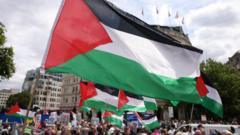
The United States government officially designated Palestine Action as a Specially Designated Global Terrorist entity, imposing heavy financial sanctions that freeze any US-based assets and bar American citizens from conducting transactions with the organization.
This sudden move by the Treasury Department marks an escalation in international pressure against the British-founded direct-action network. Originally established in 2020 to target defense contractors and disrupt supply chains linked to Israel's military, the group has spent years moving from campus demonstrations and factory blockades to aggressive property damage. By crossing the threshold from domestic protest disturbance to a formal counter-terrorism designation, Washington has signaled a rigid change in how Western governments intend to handle militant civil disobedience.
The Anatomy of an Escalation
For years, the playbook for handling aggressive anti-war activism relied heavily on local municipal policing, trespass charges, and property destruction indictments. That boundary dissolved rapidly.
The immediate catalyst for Washington's intervention lies in the group's escalating operational tactics. US officials pointed directly to online rhetoric and physical security breaches—such as the infamous mid-2025 raid on the Royal Air Force base at Brize Norton, where activists sprayed red paint across military transport aircraft.
Intelligence assessments circulating within Western security apparatuses grew increasingly anxious about transnational contagion. When a localized direct-action model proves effective at shutting down manufacturing facilities through occupation and sabotage, it stops being a local policing nuisance.
Governments view it as a blueprint for domestic subversion. The Treasury Department explicitly noted that Palestine Action's digital footprint actively encouraged similar disruptive tactics internationally, including potential replication within the United States and along its borders.
Transatlantic Echoes and Legal Quagmires
The American designation does not happen in a vacuum. It rides the coattails of a fierce domestic battle already playing out across the United Kingdom.
London proscribed Palestine Action under domestic terrorism laws following the Brize Norton incident, sparking a multi-layered constitutional showdown. British courts have wrestled continuously with the legitimacy of the ban.
While the High Court initially found the government's proscription order unlawful, an appellate court reversed that decision, ruling the severe restriction on civil liberties a proportionate response to national security threats. The UK Supreme Court agreed to hear a final appeal, setting up a high-stakes legal referendum on the boundaries of state power.
By layering US financial sanctions on top of the British ban, the alliance attempts to cut off the network's oxygen supply. Assets are frozen. Fundraising channels are blocked. Digital service providers face intense compliance pressure to strip away the group's organizational infrastructure.
The Chilling Effect on Civil Liberties
Civil rights organizations have sounded immediate alarms. The transition from criminal trespass to terrorism charges creates a dangerous gray zone for political dissent.
When a protest group is classified alongside traditional militant cells, the legal exposure expands exponentially. In the UK, expressing support or displaying symbols associated with a proscribed group carries severe prison sentences.
Critics argue this expansive interpretation of terrorism erodes the foundational right to dissent. If breaking a window at an arms manufacturer or occupying a factory floor is legally categorized as an act of terror, the state effectively redefines political violence to encompass militant property destruction.
This creates a chilling effect that extends far beyond radical cells. Mainstream activists now face unprecedented legal jeopardy if their rhetoric crosses arbitrary compliance lines established by counter-terrorism agencies.
The Broader Campaign Against Far-Left Networks
The sanctioning of Palestine Action was accompanied by broader moves against digital and logistical networks supporting similar ideological factions. The Treasury also targeted entities like Autistici Inventati, an Italian technological collective accused of providing encrypted communication infrastructure to extremist groups, alongside networks tied to regional prisoner solidarity campaigns.
This coordinated administrative push reflects a broader strategic pivot by Western security agencies. For decades, counter-terrorism budgets remained laser-focused on ideological Islamist networks or domestic right-wing militias.
Intelligence frameworks are now pivoting to re-examine far-left and anarchist networks that utilize digital anonymity, direct action, and supply-chain sabotage. The message from Washington and allied capitals is uncompromising. The tolerance window for aggressive disruption of defense infrastructure has officially closed, and the financial weight of the global superpower is now deployed to ensure those networks remain permanently dismantled.