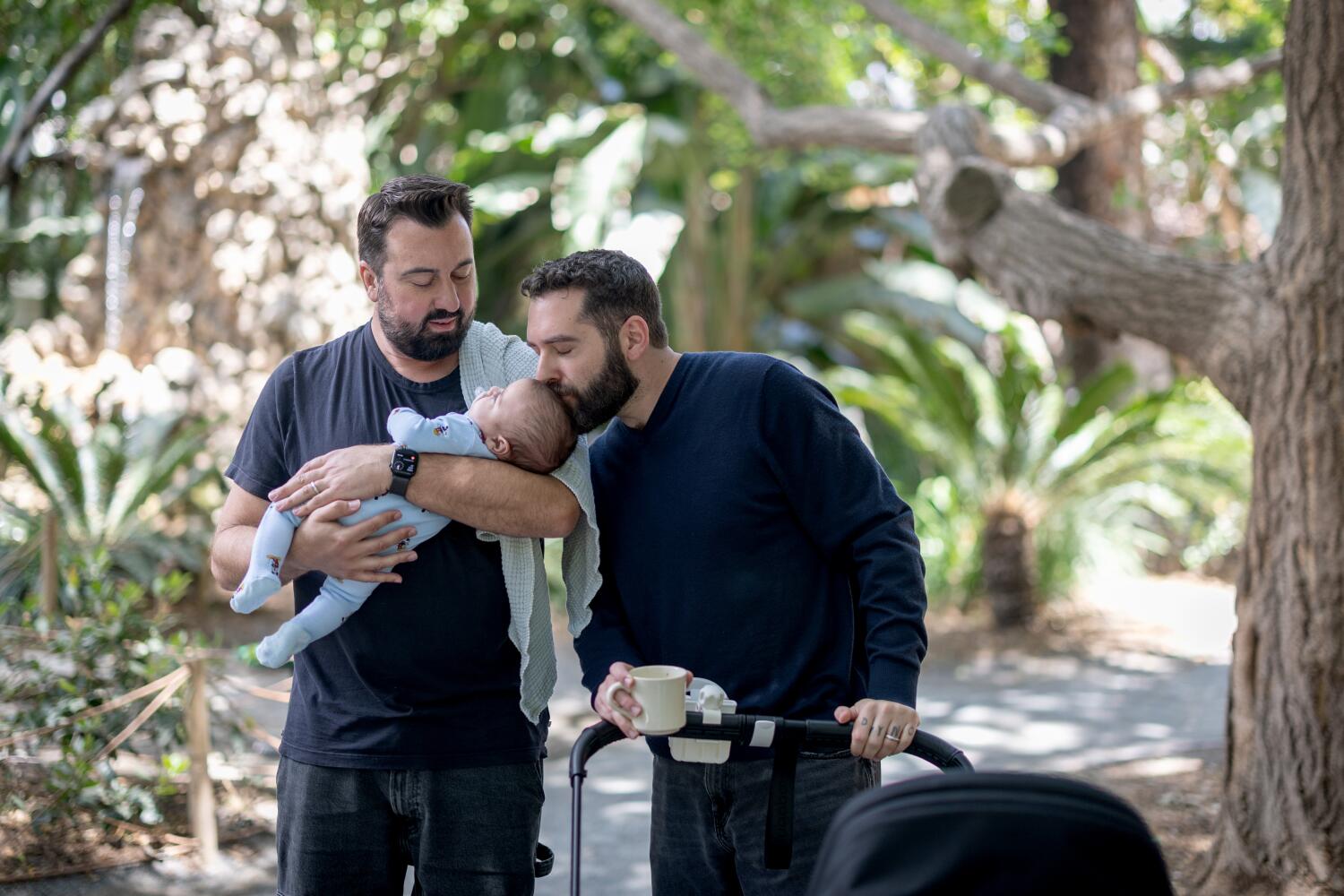
The footage is grainy but the intent is unmistakable. When an online provocateur targeted a gay couple and their newborn child at a public event, the resulting physical altercation became more than a viral clip. It exposed a fundamental shift in how the public views the intersection of digital trolling and physical reality. While the law maintains a clear line regarding physical assault, the court of public opinion has begun to draft its own set of rules regarding the limits of verbal provocation.
Social media metrics show an unprecedented surge in support for the father who threw the punches. This isn't just a brief moment of internet outrage. It is a manifestation of "troll fatigue," a growing societal exhaustion with the weaponization of personal lives for engagement. For years, the prevailing wisdom was to "never feed the trolls." That philosophy is dying. In its place is a raw, volatile demand for immediate consequences.
The Architecture of the Confrontation
This incident did not happen in a vacuum. The individual responsible for the initial harassment belongs to a specific subset of the attention economy where conflict is the primary currency. These creators do not seek debate; they seek a reaction that can be edited, framed, and monetized.
By targeting a family with an infant, the influencer crossed a psychological threshold. Most people can ignore an insult directed at their politics or their profession. Very few can remain passive when their child is used as a prop for a stranger’s content strategy. The biological imperative to protect one’s offspring overrides the social conditioning that tells us to remain civil in the face of absurdity.
The father's reaction was swift. It was violent. It was also, according to thousands of comments across various platforms, "entirely understandable." This sentiment highlights a dangerous gap between legal statutes and human instinct.
Why the Narrative of the Victim is Changing
Historically, the person who threw the first punch lost the moral high ground. That is no longer a certainty. In the current cultural climate, the "verbal first strike"—especially when it involves filming someone without their consent for the purpose of mockery—is increasingly viewed as the true start of the assault.
Public sentiment is shifting toward a more nuanced understanding of "fighting words." While the legal definition of fighting words is narrow, the public definition has expanded to include the invasion of personal space and the targeted harassment of family members. We are seeing a rejection of the idea that a camera lens provides a shield against the consequences of one's mouth.
The Monetization of Hate
Behind every viral confrontation is a business model. The influencers who engage in this behavior rely on a feedback loop of outrage.
- Engagement spikes when they are confronted.
- Victimhood narratives are crafted when they are struck.
- Donation links appear almost immediately after the "attack."
This creates a perverse incentive structure. If an influencer gets punched, their earnings for the week likely triple. They are essentially trading their physical safety for digital growth. The father in this scenario wasn't just defending his family; he was inadvertently participating in a content creator’s financial plan. This is the grim reality of the modern street-harassment industry.
The Legal Reality vs the Viral Verdict
Law enforcement agencies and legal analysts view these cases through a cold lens. Battery is battery. In most jurisdictions, verbal insults do not justify physical retaliation. However, prosecutors often face a significant hurdle when the "victim" of the punch was actively inciting the situation.
Juries are made up of people who use the internet. They are people who have seen their own friends or family members harassed online. If a case like this reaches a courtroom, the defense doesn't have to prove the punch was legal; they only have to make the jury sympathize with the father’s position. When a parent is protecting a child from a screaming stranger with a camera, that sympathy is easy to find.
The Role of De-escalation in a Camera-First Culture
We have reached a point where de-escalation is viewed by some as a form of weakness. This is a hazardous trend. When people feel that the systems designed to protect them—platform moderation, local laws, social norms—have failed, they take matters into their own hands.
The danger is that this creates a cycle of escalation. If the "support" for the father leads others to believe that physical violence is the standard response to trolling, we will see an increase in hospitalizations and arrests. The internet has removed the "buffer zone" that used to exist between different social groups. Now, everyone is in everyone else's face, all the time, and the friction is generating heat that the law isn't equipped to cool down.
The Failure of Platform Accountability
Why did this father feel that physical intervention was his only option? Much of the blame lies with the platforms that host this content. For years, major social networks have been slow to remove "harassment for hire" content because it generates massive amounts of watch time.
If a user knows that reporting a video will take three days to process—and that the video will have reached a million people by then—they lose faith in the digital solution. The punch is a real-time moderation tool. It is an immediate "delete button" for a conversation that should never have happened. Until platforms can offer a way to stop real-world harassment as it happens, the physical world will continue to provide its own, much more permanent, corrections.
Analyzing the Influencer Playbook
The influencer in this case followed a standard operating procedure:
- Identify a target that represents a "hot button" cultural issue.
- Approach with a camera already recording, often with a hidden "second angle" from a teammate.
- Use inflammatory language to provoke a physical response.
- Once struck, immediately pivot to a "free speech" defense while filming the injury.
It is a choreographed dance. The father broke the script by not just pushing back, but by receiving overwhelming public validation. Usually, the influencer relies on their core audience to drown out the critics. This time, the broader public—those outside the political bubble—stepped in. They saw a father, a baby, and a bully. The political identities of the participants became secondary to the universal human roles they were playing.
The Long-Term Impact on Public Spaces
We are witnessing the death of the "public square" as a neutral zone. If every trip to the park or a community event carries the risk of being turned into a strawman for someone’s political TikTok, people will stop going. Or, they will go armed with a much shorter fuse.
The support for the father who threw the punches is a warning. It is a sign that the public is willing to tolerate a certain level of violence if it means silencing a certain level of cruelty. This isn't a victory for civility; it’s a desperate, messy attempt to reclaim it. We are moving toward a reality where the "freedom of speech" is being weighed against the "freedom from harassment," and right now, the scale is tipping toward the latter with a closed fist.
The Illusion of Digital Anonymity in the Physical World
One of the strangest aspects of this phenomenon is the "Avatar Effect." Influencers who spend most of their time behind a screen or talking to a sympathetic camera lens often forget that they are not invincible in the physical world. They treat real-life interactions like a comment section where they can simply block anyone they don't like.
But you cannot block a person standing three feet away from you. You cannot mute the physical impact of a confrontation. This specific "MAGA influencer" seemed genuinely shocked that his words resulted in a physical outcome. That shock is a symptom of a deep disconnection from reality. When you treat life like a video game, you eventually run into a boss fight you aren't prepared for.
The Cost of Support
While the support for the father is high, it comes with a cost. He now faces potential legal fees, a permanent record, and the stress of a looming investigation. The "support" of the internet is loud, but it rarely pays the lawyer's retainer. This is the tragedy of the situation. The troll gets his content, the father gets his "hero" status, and the child is left with a father who is now a target for even more intense scrutiny.
The influencer won the moment he was hit. He secured the footage he needed to prove his "persecution." The father won the moral argument but lost his peace of mind. This is the trap of the modern age: even when you "win" a confrontation with a troll, you lose. You have given them exactly what they wanted—relevance.
The Necessity of New Boundaries
If we are to avoid a future of constant street brawls, we need a new social contract regarding digital consent. The idea that "anything goes" in a public space because there is no "expectation of privacy" is being challenged by the reality of global broadcasting.
Being seen in public is one thing. Being broadcast to millions of people as a villain in someone else's scripted narrative is another. This distinction is what the father was defending. He wasn't just punching a man; he was punching a camera. He was trying to knock the lens out of his life.
The support growing for this man isn't an endorsement of violence in the abstract. It is an endorsement of the right to be left alone. It is a collective "enough" from a population that is tired of being used as fuel for the outrage machine. If you walk into a person’s life with the intent to burn it down for clicks, do not be surprised when you get burned yourself.
The law will eventually catch up with the father, but the influencer has already been judged by the only people he cares about: the audience. And this time, they didn't applaud his bravery; they applauded his bruise.


