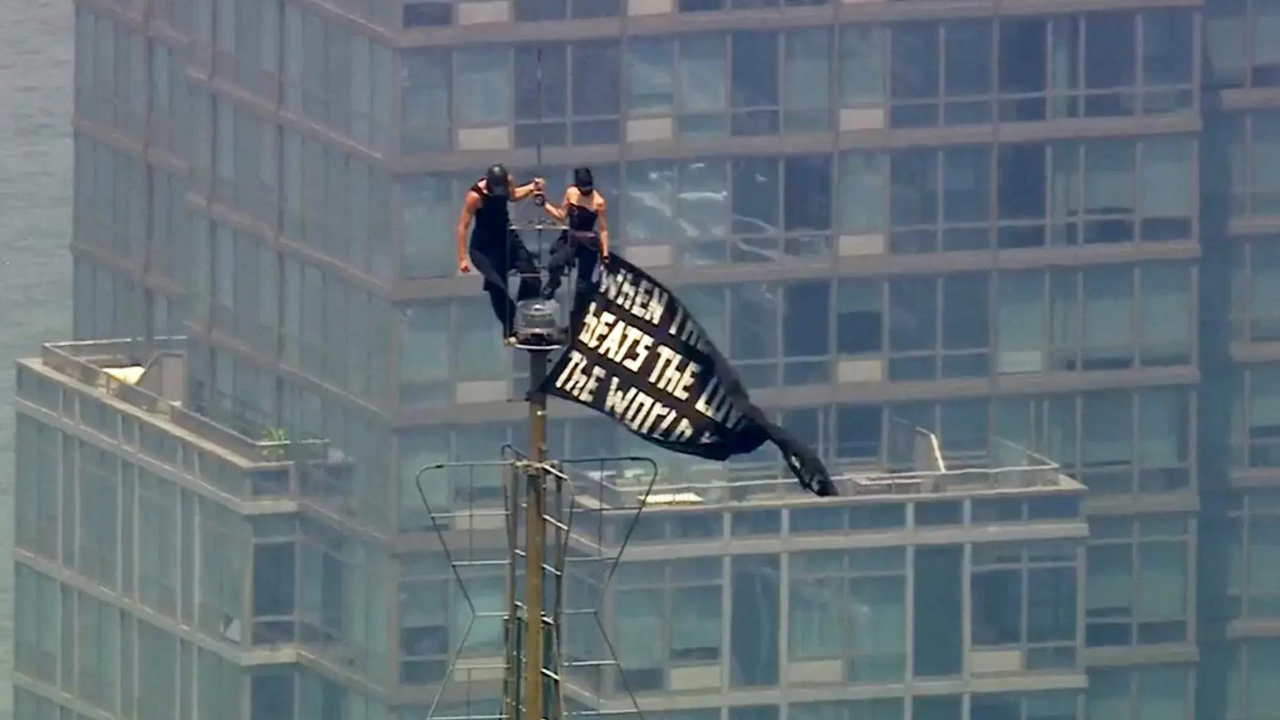
The wind at a thousand feet does not blow. It punches. It arrives in heavy, freezing sheets that rattle the ribcage and strip the breath straight from a throat. Down below, Manhattan is reduced to a grid of glowing embers, a silent circuit board of yellow cabs and steam vents. Up here, on the rusted steel spine of a skyscraper, the noise of the city disappears completely, replaced by the terrifying, rhythmic roar of the atmosphere.
He felt the ring box shifting against his thigh with every agonizing step. It was a small square weight, heavier than the legal consequences he knew were waiting just beyond the next security barrier.
We live in an era obsessed with scale. A quiet dinner in a corner bistro no longer feels like enough to validate a life-altering promise. We are conditioned to believe that the height of our devotion must match the literal height of our surroundings. So, you climb. You bypass the velvet ropes, ignore the standard observation deck where tourists pay forty dollars to look through coin-operated binoculars, and you push into the forbidden architecture of the skyline.
But the real problem lies elsewhere. The line between an unforgettable romance and a criminal record is paper-thin, separated only by the heavy click of a fire exit door closing behind you.
The Architecture of a Risk
Consider what happens next. The adrenaline that carries a person past a "No Trespassing" sign is the same chemical that floods the body during a flight-or-fight response. Your palms sweat. Your heart thuds against your ribs like a trapped bird.
Imagine a hypothetical couple—let us call them Leo and Maya—standing on the maintenance catwalk of a legendary midtown spire. For Leo, the decision to scale the restricted upper tiers wasn't about defiance. It was about escape. He wanted to present a love that felt separate from the mundane, earthbound realities of rent notices and subway delays. He wanted the backdrop of the gods.
When you look at the raw statistics of urban exploration and extreme proposals, the numbers tell a story of escalating stakes. Security budgets for iconic New York landmarks have crept upward every year since the early 2000s, driven by sophisticated surveillance and motion sensors that can detect a human footstep on a restricted ladder within seconds. The authorities do not view a grand romantic gesture as a poetic exception to the rule. To a perimeter defense system, a lover in a trench coat looks exactly like a security threat.
The climb itself is a lesson in sensory overload. The cold metal of the ladders bites through leather gloves. The smell of old grease, oxidized iron, and high-altitude ozone fills the nose. Every step upward requires a conscious negotiation with gravity. You look down, and your brain suffers a momentary glitch; the human eye isn't designed to process a vertical drop where entire apartment complexes look like discarded gray Legos.
The High-Altitude Promise
She turned around, her hair whipped into a blinding shroud by the gale, to find him on one knee.
In that fraction of a second, the entire universe shrinks to the space between two people. The wind still howls, the red aviation warning lights still blink rhythmically against the clouds, but the gravity shifts. The question is asked. The answer is a breathless nod, a tear freezing almost instantly on a cheekbone, and a ring slipped onto a trembling finger.
It is a moment of pure, unadulterated triumph. You have beaten the system. You have touched the sky. You have secured a story that will be told at dinner parties for the next forty years.
Then, the elevator doors open at the base of the spire.
The descent is always faster than the ascent. The euphoria acts as a temporary anesthetic against the cold, masking the fact that your fingers are completely numb. But as the maintenance stairs give way to the concrete corridors of the building’s lower levels, the environment changes. The air grows warmer. The smell of floor wax and industrial cleaning products replaces the clean, biting scent of the upper atmosphere.
And there, waiting under the harsh glare of fluorescent tubes, are the uniforms.
The Cost of the View
The transition from a cinematic climax to a bureaucratic reality is brutal. There is no slow fade to black. Instead, there is the sharp, metallic snap of steel restraints.
The police officers who handle these incidents are rarely amused by the poetry of the moment. To them, a trespasser on a skyscraper spire represents hours of paperwork, a potential breach of citywide counter-terrorism protocols, and a reckless endangerment of the emergency personnel who would have had to retrieve the bodies if a foot had slipped on an icy rung.
The legal system dismantles romance with clinical precision. Reckless endangerment, criminal trespass, disorderly conduct—these are the cold phrases that replace the vows spoken in the clouds. The ring stays on the finger, but the hands are forced behind the back. The newly engaged couple is escorted through the side exits, away from the glittering plazas, and shoved into the hard plastic backseat of a precinct cruiser.
Consider the irony of the situation. The desire to elevate a partnership above the ordinary results in being confined to the most sterile, restricted space imaginable: a holding cell. The view of the Manhattan skyline is replaced by cracked white tiles and a stainless-steel toilet. The whisper of a lifelong commitment is drowned out by the metallic clank of a cell door locking into place.
The Gravity of Earth
We often mistake the magnitude of an event for its depth. We chase the spectacular because we are terrified that the quiet, everyday moments of a relationship aren't enough to sustain it. We need the skyscraper. We need the danger. We need the viral video potential to prove that what we feel is real.
But a marriage isn't lived at a thousand feet. It is lived in the low-ceilinged kitchens, in the crowded grocery store aisles, and in the quiet waiting rooms of doctors' offices. The true weight of a promise doesn't come from the height of the platform where it was made, but from the strength of the foundation when the wind starts to blow at ground level.
As the morning light filters through the high bars of a central booking facility, the adrenaline finally clears from the bloodstream. The realization sets in that the story will indeed be told for decades, but not in the way it was envisioned. It will be read off a rap sheet. It will be calculated in defense attorney fees.
The ring catches the dim, institutional light. It is still beautiful, but it is no longer a symbol of an escape from the world. It is a reminder that no matter how high you climb to say the words, you eventually have to come down and live them.